Rawlinson Stacey, Asadi Faiza, Saraqi Helen, Childs Barbara, Ciric Lena, Cloutman-Green Elaine
Department of Civil, Environmental and Geomatic Engineering, University College London, Chadwick Building, London, UK.
Great Ormond Street Hospital NHS Foundation Trust, Camellia Botnar Laboratories, Department of Microbiology, London, UK.
Infect Prev Pract. 2020 Aug 16;2(4):100083. doi: 10.1016/j.infpip.2020.100083. eCollection 2020 Dec.
Cleaning is a critical tool for infection prevention and control, and is a key intervention for preventing healthcare associated infections (HCAIs) and controlling intermediate transmission routes between patient and environment. This study sought to identify potential areas of weakness in clinical surface cleaning, and assess the effectiveness of a staff group specific training intervention.
One-hundred hours of audit observations in a paediatric cardiac intensive care unit (CICU) assessed surface cleaning technique of healthcare staff within bedspaces. Cleaning was assessed with a 5-component bundle, with each cleaning opportunity scored out of five.
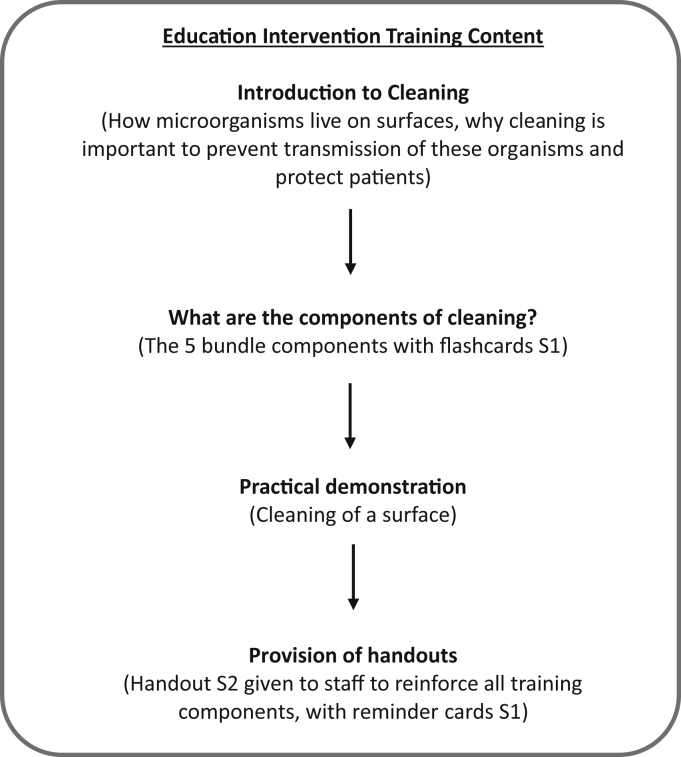
Fifty hours of audit observations before and after a training intervention tested the efficacy of a staff group specific education intervention. The intervention was developed and implemented for 69% of nurses and 100% of cleaners.
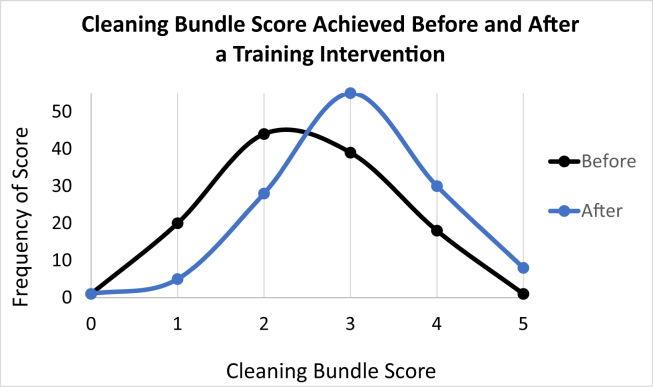
One hundred and eighteen cleaning opportunities were observed before training, and scored an average of 2.4. One hundred and twenty-one cleaning opportunities were observed after training and scored an average 3.0. On average, before training, each cleaning opportunity by nurses and cleaners fulfilled 2.4 and 2.5, respectively, of the 5 bundle components. Following training, this improved to 3.3 and 2.9 respectively. There was a statistically significant improvement in bundle scores for nurses (P=.004) and cleaners (P=.0003).
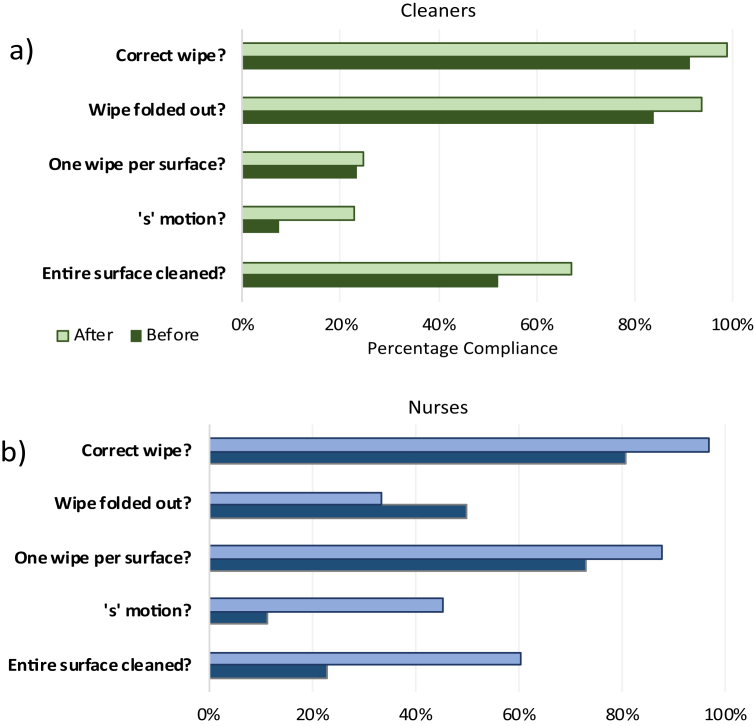
Surface wipe methods were inconsistent between all staff groups. The education based intervention resulted in a small improvement in most of the cleaning components. This study has identified how a small but targeted cleaning training intervention can have a significant (P= <.0001) impact on cleaning bundle compliance for both nurses and cleaners.
清洁是预防和控制感染的关键手段,也是预防医疗相关感染(HCAIs)及控制患者与环境之间中间传播途径的关键干预措施。本研究旨在确定临床表面清洁中潜在的薄弱环节,并评估针对特定工作人员群体的培训干预措施的效果。
在一家儿科心脏重症监护病房(CICU)进行了100小时的审核观察,以评估医护人员在病床区域的表面清洁技术。清洁情况通过一个包含5个部分的组合进行评估,每次清洁机会的满分是5分。
在一项培训干预前后分别进行了50小时的审核观察,以测试针对特定工作人员群体的教育干预措施的效果。该干预措施针对69%的护士和100%的清洁人员制定并实施。
培训前观察到118次清洁机会,平均得分为2.4分。培训后观察到121次清洁机会,平均得分为3.0分。平均而言,培训前护士和清洁人员每次清洁机会分别满足5个组合部分中的2.4个和2.5个。培训后,这一数字分别提高到3.3个和2.9个。护士(P = .004)和清洁人员(P = .0003)的组合得分有统计学意义的提高。
所有工作人员群体的表面擦拭方法不一致。基于教育的干预措施使大多数清洁部分有了小幅改善。本研究确定了一项规模虽小但目标明确的清洁培训干预措施如何能对护士和清洁人员的清洁组合合规性产生显著影响(P = <.0001)。