Department of Medical Oncology and Therapeutics Research, City of Hope Comprehensive Cancer Center, Duarte, California.
Center for Informatics, City of Hope National Medical Center, Duarte, California.
JAMA Netw Open. 2021 Aug 2;4(8):e2118416. doi: 10.1001/jamanetworkopen.2021.18416.
Microsatellite stable (MSS) metastatic colorectal cancer has been historically characterized as resistant to immunotherapy. Recent studies have demonstrated limited clinical activity of programmed cell death receptor 1/programmed death ligand 1 (PD-1/PD-L1) targeting in MSS metastatic colorectal cancer. The association of metastatic disease in the liver with treatment response has not been fully investigated.
To investigate the association of liver metastases with response to PD-1/PD-L1-targeting therapy in MSS metastatic colorectal cancer.
DESIGN, SETTING, AND PARTICIPANTS: This single-center retrospective cohort study evaluated clinical responses to PD-1- or PD-L1-targeting therapy, with or without other investigational agents, in patients with MSS metastatic colorectal cancer and disease progression after standard of care therapy from January 1, 2014, to December 31, 2020.
Objective response rate (ORR) and progression-free survival (PFS), measured from initiation of PD-1/PD-L1-targeting therapy.
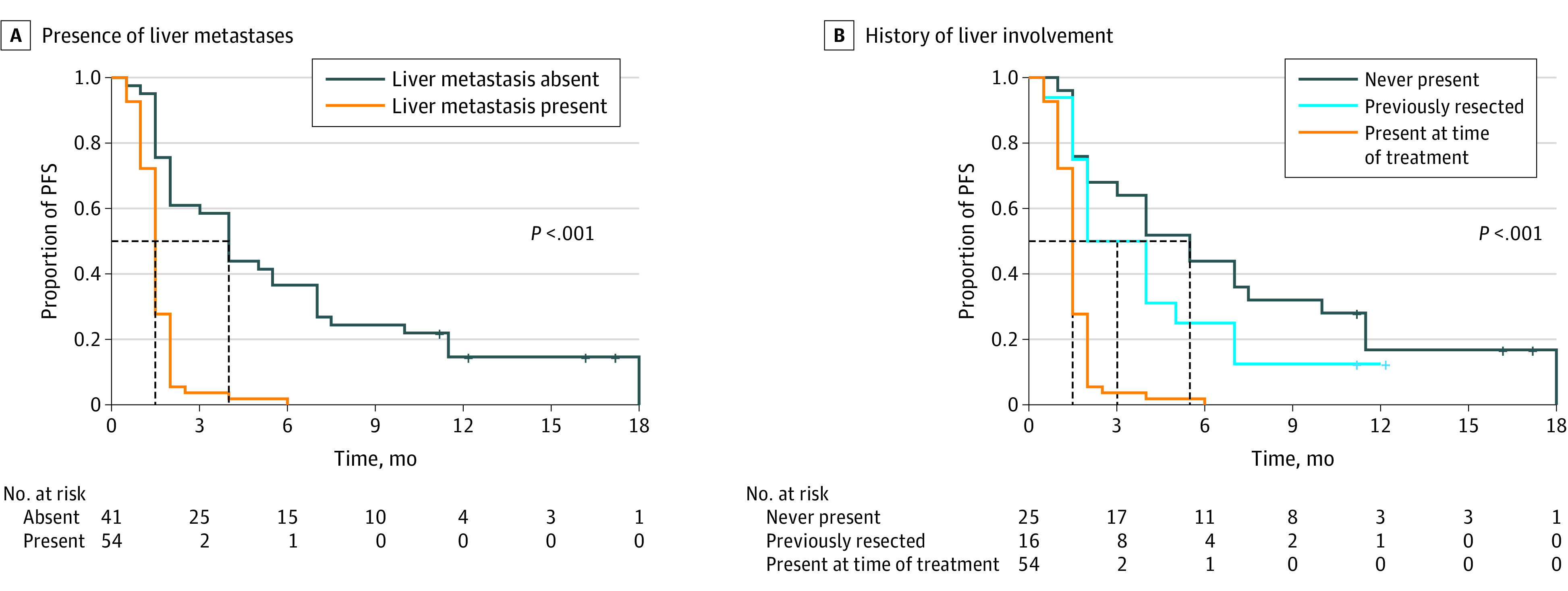
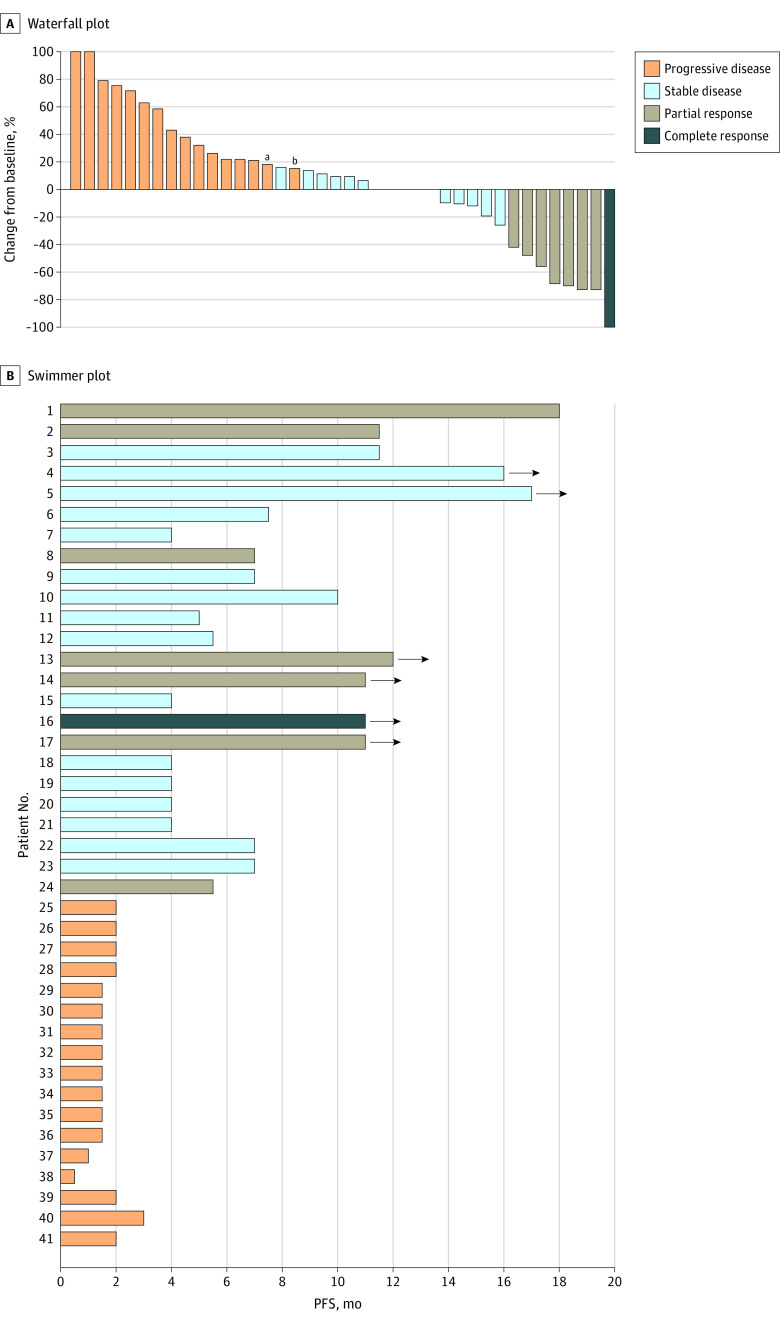
Ninety-five patients with MSS metastatic colorectal cancer were identified (54 men [56.8%]; median age, 55 [interquartile range (IQR), 49-64] years). The overall ORR was 8.4% (8 of 95 patients). Eight of 41 patients without liver metastases achieved an ORR of 19.5%, and no response was observed in 54 patients with liver metastases. The disease control rate was 58.5% (24 of 41) in patients without liver metastasis and 1.9% (1 of 54) in patients with liver metastasis. Patients without liver metastases at the time of PD-1/PD-L1-targeting treatment had a superior median PFS compared with patients with liver metastases (4.0 [IQR, 2.0-7.5] vs 1.5 [IQR, 1.0-2.0] months; P < .001). In addition, median PFS was 5.5 (IQR, 2.0-11.5) months for patients without any prior or current liver involvement at the time of PD-1/PD-L1-targeting treatment initiation. Using a multivariate Cox regression model correcting for Eastern Cooperative Oncology Group status, primary tumor location, RAS and BRAF status, tumor mutation burden, and metastatic sites, liver metastases was the variable with the most significant association with faster progression after PD-1/PD-L1 treatment inhibition (hazard ratio, 7.00; 95% CI, 3.18-15.42; P < .001).
Findings of this cohort study suggest that patients with MSS metastatic colorectal cancer and without liver metastases may derive clinical benefits from checkpoint inhibitors, whereas the presence of liver metastases was associated with resistance. Further prospective studies are needed to investigate PD-1/PD-L1 inhibitors in patients with MSS metastatic colorectal cancer without liver metastases.
微卫星稳定(MSS)转移性结直肠癌在历史上被认为对免疫疗法有抗性。最近的研究表明,程序性细胞死亡受体 1/程序性死亡配体 1(PD-1/PD-L1)靶向治疗在 MSS 转移性结直肠癌中的临床活性有限。转移性疾病在肝脏中的存在与治疗反应之间的关系尚未得到充分研究。
研究 MSS 转移性结直肠癌中肝转移与 PD-1/PD-L1 靶向治疗反应之间的关系。
设计、地点和参与者:这项单中心回顾性队列研究评估了 PD-1 或 PD-L1 靶向治疗(有或没有其他研究药物)在 2014 年 1 月 1 日至 2020 年 12 月 31 日期间接受标准治疗后疾病进展的 MSS 转移性结直肠癌患者中的临床反应。
从 PD-1/PD-L1 靶向治疗开始测量客观缓解率(ORR)和无进展生存期(PFS)。
确定了 95 例 MSS 转移性结直肠癌患者(54 例男性[56.8%];中位年龄为 55 [四分位距(IQR),49-64]岁)。总体 ORR 为 8.4%(95 例患者中的 8 例)。41 例无肝转移患者中有 8 例达到 19.5%的 ORR,而 54 例有肝转移患者中没有观察到反应。无肝转移患者的疾病控制率为 58.5%(41 例患者中的 24 例),而有肝转移患者的疾病控制率为 1.9%(54 例患者中的 1 例)。在开始 PD-1/PD-L1 靶向治疗时没有肝转移的患者的中位 PFS 明显优于有肝转移的患者(4.0 [IQR,2.0-7.5] vs 1.5 [IQR,1.0-2.0]个月;P < .001)。此外,在开始 PD-1/PD-L1 靶向治疗时没有任何先前或当前肝受累的患者中,中位 PFS 为 5.5 个月(IQR,2.0-11.5)。使用多变量 Cox 回归模型校正东部合作肿瘤学组状态、原发肿瘤位置、RAS 和 BRAF 状态、肿瘤突变负担和转移部位,肝转移是 PD-1/PD-L1 治疗抑制后进展更快的最显著相关变量(风险比,7.00;95%CI,3.18-15.42;P < .001)。
这项队列研究的结果表明,MSS 转移性结直肠癌且无肝转移的患者可能从检查点抑制剂中获得临床获益,而肝转移的存在与耐药性相关。需要进一步的前瞻性研究来研究无肝转移的 MSS 转移性结直肠癌患者中 PD-1/PD-L1 抑制剂的作用。