Department of Botany, University of Granada, 18071, Granada, Spain.
Interuniversity Institute for Earth System Research, University of Granada, 18006, Granada, Spain.
Sci Rep. 2021 Aug 9;11(1):16124. doi: 10.1038/s41598-021-95739-4.
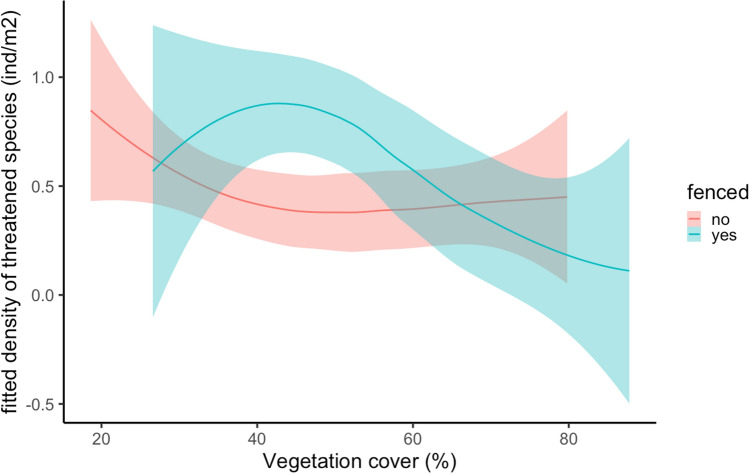
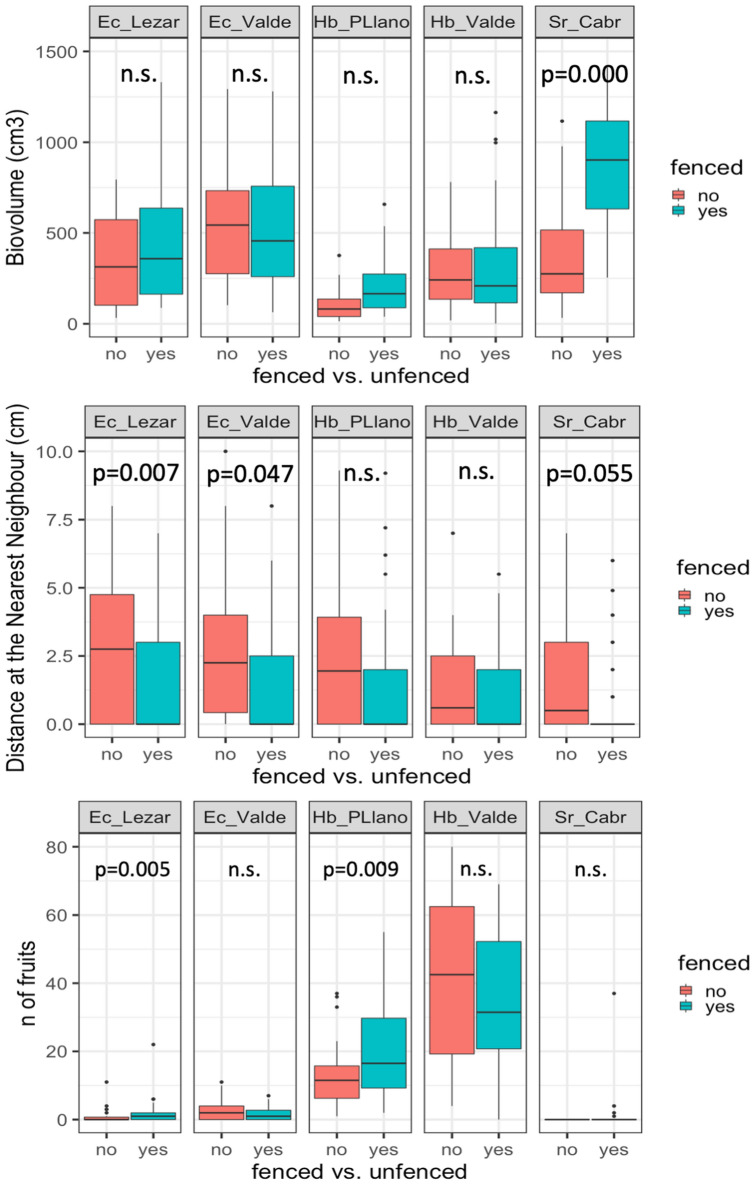
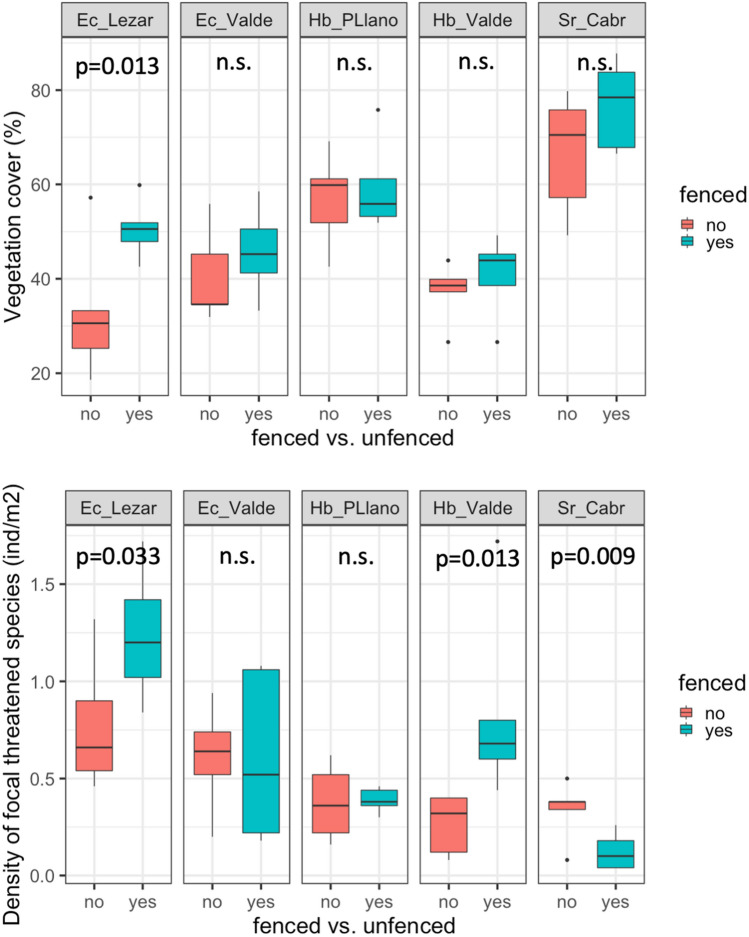
Overgrazing stands out as threat factors on biodiversity, being especially harmful in the Mediterranean, due to strong human pressure and an accelerated climate change acting synergistically. Fencing is a common tool used in conservation biology to tackle this problem. Advantages of fences are usually fast, intuitive, and easy to evaluate. However, disadvantages could also arise (increasing interspecific competition, disturbing habitat structure, limiting pollination, reducing dispersion). Together with management issues (maintenance, conflicts with stakeholders, and pulling effect). Effectiveness of fencing for conservation has been frequently assessed for animals, while it is almost a neglected topic in plants. We evaluated the outcome of fencing three threatened and narrow-endemic plants. Selected 5 populations were only partly fenced, which allowed comparing different variables inside and outside the fence. For evaluating the fencing effects, we sampled several habitats (vegetation cover, composition, density of target species), and target-species features (individual size, neighbouring species, and fruit-set). Fencing had strong effects on the habitat and on target-species individuals, showing contrasting responses at species and population level. Particularly, for Erodium cazorlanum, fence had a positive effect in one case, and negative in another. In Hormathophylla baetica effect was positive in all populations. Finally, fencing negatively affected Solenanthus reverchonii by increasing competition and limiting seed-dispersal. Fencing outcome was different in assessed species, highlighting the need to a case-by-case evaluation to determine the net balance (pros vs. cons), also its suitability and most favourable option (i.e. permanent vs. temporary fences).
过度放牧是生物多样性的威胁因素之一,由于人类的强烈压力和加速的气候变化协同作用,在地中海地区尤其有害。围栏是保护生物学中常用的一种工具,用于解决这个问题。围栏的优点通常是快速、直观和易于评估。然而,也可能会出现缺点(增加种间竞争、干扰栖息地结构、限制授粉、减少扩散)。再加上管理问题(维护、与利益相关者的冲突以及拉动效应)。围栏在保护动物方面的有效性经常被评估,而在植物方面几乎是一个被忽视的话题。我们评估了围栏对三种受威胁和狭窄特有植物的影响。选择了 5 个种群只进行了部分围栏,这允许比较围栏内外的不同变量。为了评估围栏的效果,我们对几个栖息地(植被覆盖、组成、目标物种密度)和目标物种特征(个体大小、相邻物种和果实设置)进行了采样。围栏对栖息地和目标物种个体有强烈的影响,在物种和种群水平上表现出不同的反应。特别是对于 Erodium cazorlanum,围栏在一种情况下有积极的影响,而在另一种情况下则有消极的影响。在 Hormathophylla baetica 中,围栏在所有种群中都有积极的影响。最后,围栏通过增加竞争和限制种子传播,对 Solenanthus reverchonii 产生了负面影响。评估的物种中围栏的结果不同,突出了需要进行个案评估,以确定净平衡(利弊),以及其适用性和最佳选择(即永久性围栏与临时性围栏)。