School of Medical and Health Sciences, Edith Cowan University, Joondalup, WA, Australia.
Centre for Precision Health, Edith Cowan University, Joondalup, WA, Australia.
Br J Cancer. 2022 Feb;126(3):401-408. doi: 10.1038/s41416-021-01507-6. Epub 2021 Aug 9.
The validity of circulating tumour DNA (ctDNA) as an indicator of disease progression compared to medical imaging in patients with metastatic melanoma requires detailed evaluation.
Here, we carried out a retrospective ctDNA analysis of 108 plasma samples collected at the time of disease progression. We also analysed a validation cohort of 66 metastatic melanoma patients monitored prospectively after response to systemic therapy.
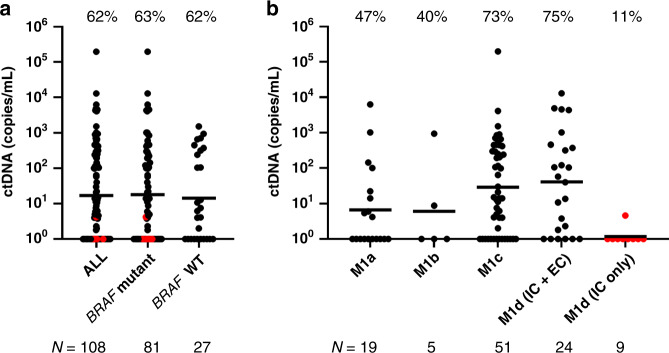
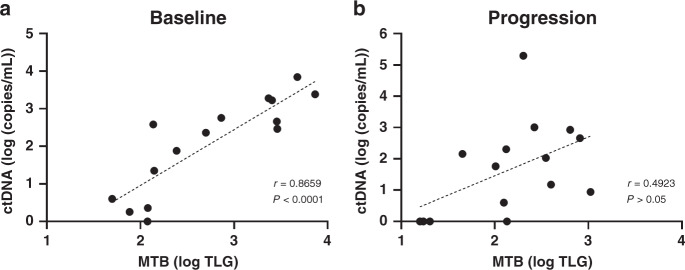
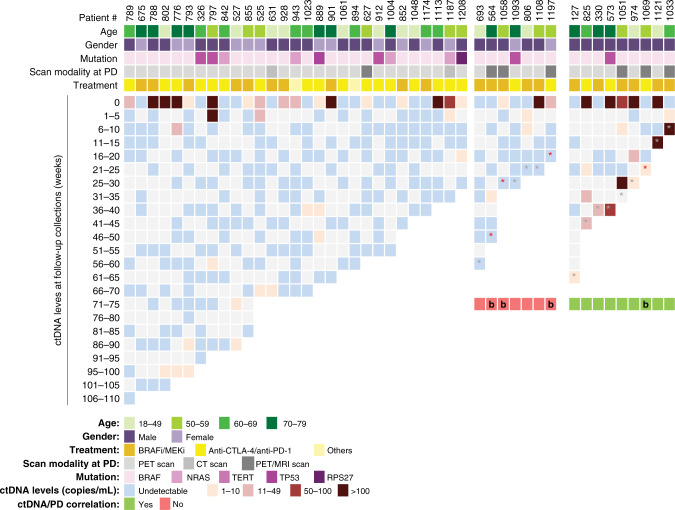
ctDNA was detected in 62% of patients at the time of disease progression. For 67 patients that responded to treatment, the mean ctDNA level at progressive disease was significantly higher than at the time of response (P < 0.0001). However, only 30 of these 67 (45%) patients had a statistically significant increase in ctDNA by Poisson test. A validation cohort of 66 metastatic melanoma patients monitored prospectively indicated a 56% detection rate of ctDNA at progression, with only two cases showing increased ctDNA prior to radiological progression. Finally, a correlation between ctDNA levels and metabolic tumour burden was only observed in treatment naïve patients but not at the time of progression in a subgroup of patients failing BRAF inhibition (N = 15).
These results highlight the low efficacy of ctDNA to detect disease progression in melanoma when compared mainly to standard positron emission tomography imaging.
与转移性黑色素瘤患者的医学影像学相比,循环肿瘤 DNA(ctDNA)作为疾病进展指标的有效性需要详细评估。
在这里,我们对 108 份疾病进展时采集的血浆样本进行了回顾性 ctDNA 分析。我们还分析了 66 例接受系统治疗后前瞻性监测的转移性黑色素瘤患者的验证队列。
在疾病进展时,ctDNA 在 62%的患者中被检测到。对于 67 例对治疗有反应的患者,进展性疾病时的平均 ctDNA 水平明显高于反应时(P<0.0001)。然而,只有 67 例患者中的 30 例(45%)通过泊松检验显示 ctDNA 有统计学意义的增加。前瞻性监测的 66 例转移性黑色素瘤患者的验证队列显示,ctDNA 的检出率为 56%,在影像学进展前仅发现 2 例 ctDNA 增加。最后,仅在未接受治疗的患者中观察到 ctDNA 水平与代谢肿瘤负担之间存在相关性,而在亚组接受 BRAF 抑制治疗失败的患者中(N=15),在疾病进展时并未观察到这种相关性。
这些结果强调了与标准正电子发射断层扫描成像相比,ctDNA 在检测黑色素瘤疾病进展方面的低效率。