University of Washington, Seattle, WA.
Brigham and Women's Hospital, Boston, MA.
J Clin Oncol. 2024 Sep 10;42(26):3151-3161. doi: 10.1200/JCO.23.02054. Epub 2024 Jul 25.
Merkel cell carcinoma (MCC) is an aggressive skin cancer with a 40% recurrence rate, lacking effective prognostic biomarkers and surveillance methods. This prospective, multicenter, observational study aimed to evaluate circulating tumor DNA (ctDNA) as a biomarker for detecting MCC recurrence.
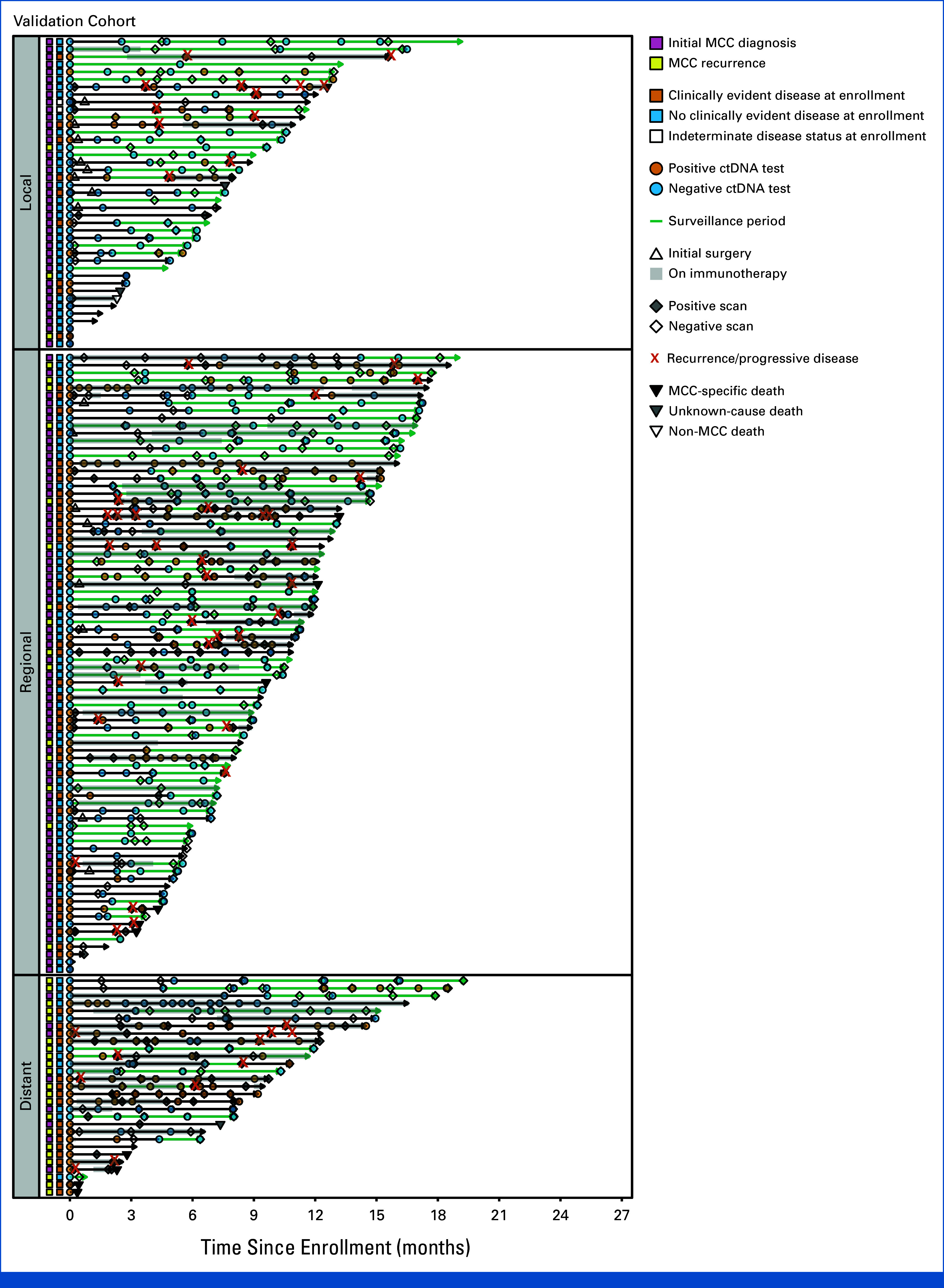
Plasma samples, clinical data, and imaging results were collected from 319 patients. A tumor-informed ctDNA assay was used for analysis. Patients were divided into discovery (167 patients) and validation (152 patients) cohorts. Diagnostic performance, including sensitivity, specificity, positive predictive value (PPV), and negative predictive value (NPV), was assessed.
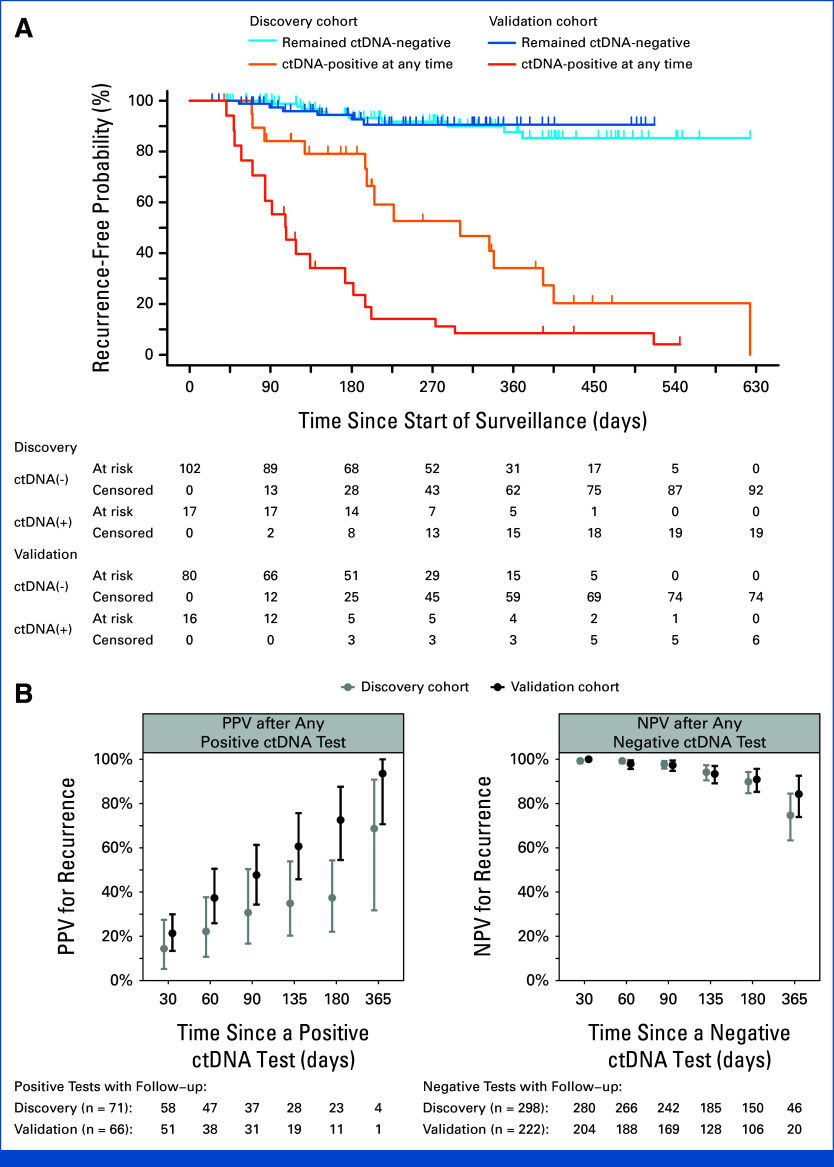
ctDNA showed high sensitivity, 95% (discovery; 95% CI, 87 to 99) and 94% (validation; 95% CI, 85 to 98), for detecting disease at enrollment, with corresponding specificities of 90% (95% CI, 82 to 95) and 86% (95% CI, 77 to 93). A positive ctDNA during surveillance indicated increased recurrence risk, with hazard ratios (HRs) of 6.8 (discovery; 95% CI, 2.9 to 16) and 20 (validation; 95% CI, 8.3 to 50). The PPV for clinical recurrence at 1 year after a positive ctDNA test was 69% (discovery; 95% CI, 32 to 91) and 94% (validation; 95% CI, 71 to 100), respectively. The NPV at 135 days after a negative ctDNA test was 94% (discovery; 95% CI, 90 to 97) and 93% (validation; 95% CI, 89 to 97), respectively. Patients positive for ctDNA within 4 months after treatment had higher rates of recurrence, with 1-year rates of 74% versus 21% (adjusted HR, 7.4 [95% CI, 2.7 to 20]).
ctDNA testing exhibited high prognostic accuracy in detecting MCC recurrence, suggesting its potential to reduce frequent surveillance imaging. ctDNA also identifies high-risk patients who need more frequent imaging and may be best suited for adjuvant therapy trials.
默克尔细胞癌(MCC)是一种侵袭性皮肤癌,复发率为 40%,缺乏有效的预后生物标志物和监测方法。本前瞻性、多中心、观察性研究旨在评估循环肿瘤 DNA(ctDNA)作为检测 MCC 复发的生物标志物。
从 319 名患者中采集血浆样本、临床数据和影像学结果。使用一种基于肿瘤的 ctDNA 检测方法进行分析。患者被分为发现队列(167 名患者)和验证队列(152 名患者)。评估了诊断性能,包括敏感性、特异性、阳性预测值(PPV)和阴性预测值(NPV)。
ctDNA 在入组时检测疾病的敏感性高,分别为 95%(发现队列;95%CI,87 至 99)和 94%(验证队列;95%CI,85 至 98),相应的特异性分别为 90%(95%CI,82 至 95)和 86%(95%CI,77 至 93)。在监测期间出现阳性 ctDNA 表明复发风险增加,风险比(HR)分别为 6.8(发现队列;95%CI,2.9 至 16)和 20(验证队列;95%CI,8.3 至 50)。阳性 ctDNA 检测后 1 年时临床复发的阳性预测值分别为 69%(发现队列;95%CI,32 至 91)和 94%(验证队列;95%CI,71 至 100)。阴性 ctDNA 检测后 135 天时的阴性预测值分别为 94%(发现队列;95%CI,90 至 97)和 93%(验证队列;95%CI,89 至 97)。治疗后 4 个月内 ctDNA 阳性的患者复发率较高,1 年时的复发率分别为 74%和 21%(调整 HR,7.4[95%CI,2.7 至 20])。
ctDNA 检测在检测 MCC 复发方面具有较高的预后准确性,表明其有可能减少频繁的监测成像。ctDNA 还可识别高风险患者,这些患者需要更频繁的影像学检查,可能最适合辅助治疗试验。