The University of Sydney, Sydney, NSW.
Curtin University, Perth, WA.
Med J Aust. 2021 Oct 18;215(8):359-365. doi: 10.5694/mja2.51216. Epub 2021 Aug 9.
To estimate rates of screen-detected and interval breast cancers, stratified by risk factor, to inform discussions of risk-stratified population screening.
Retrospective population-based cohort study; analysis of routinely collected BreastScreen WA program clinical and administrative data.
SETTING, PARTICIPANTS: All BreastScreen WA mammography screening episodes for women aged 40 years or more during 1 July 2007 - 30 June 2017.
Cancer detection rate (CDR) and interval cancer rate (ICR), by risk factor.
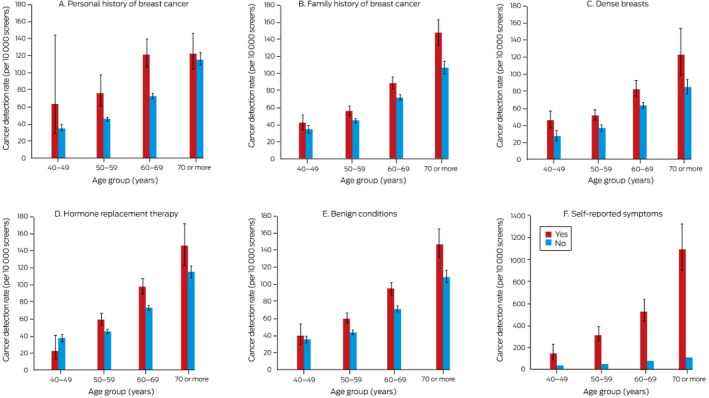
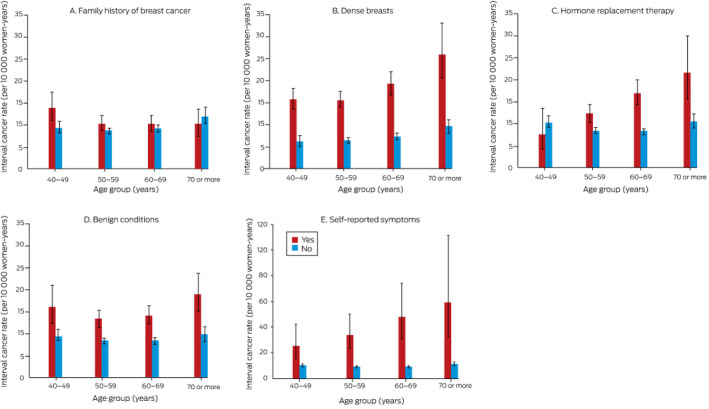
A total of 323 082 women were screened in 1 026 137 screening episodes (mean age, 58.5 years; SD, 8.6 years). The overall CDR was 68 (95% CI, 67-70) cancers per 10 000 screens, and the overall ICR was 9.7 (95% CI, 9.2-10.1) cancers per 10 000 women-years. Interactions between the effects on CDR of age group and five risk factors were statistically significant: personal history of breast cancer (P = 0.039), family history of breast cancer (P = 0.005), risk-relevant benign conditions (P = 0.012), hormone-replacement therapy (P = 0.002), and self-reported symptoms (P < 0.001). The influence of these risk factors (except personal history) increased with age. For ICR, only the interaction between age and hormone-replacement therapy was significant (P < 0.001), although weak interactions between age and family history of breast cancer or having dense breasts were noted (each P = 0.07). The influence of family history on ICR was significant only for women aged 40-49 years.
Screening CDR and (for some risk factors) ICR were higher for women in some age groups with personal histories of breast cancer or risk-relevant benign breast conditions or first degree family history of breast cancer, women with dense breasts or self-reported breast-related symptoms, and women using hormone-replacement therapy. Our findings could inform the evaluation of risk-based screening.
按风险因素分层,估算检出性和间隔性乳腺癌的检出率,为风险分层人群筛查提供参考。
回顾性基于人群的队列研究;对常规收集的 BreastScreen WA 项目临床和管理数据进行分析。
地点、参与者:2007 年 7 月 1 日至 2017 年 6 月 30 日期间,年龄 40 岁及以上的所有参加 BreastScreen WA 乳房 X 线筛查的女性。
按风险因素计算癌症检出率(CDR)和间隔期癌症检出率(ICR)。
共有 323082 名女性参加了 1026137 次筛查(平均年龄 58.5 岁,标准差 8.6 岁)。总体 CDR 为每 10000 次筛查检出 68(95%CI,6770)例癌症,总体 ICR 为每 10000 名女性年检出 9.7(95%CI,9.210.1)例癌症。年龄组和 5 个风险因素对 CDR 的影响之间存在统计学交互作用:个人乳腺癌病史(P=0.039)、乳腺癌家族史(P=0.005)、与风险相关的良性疾病(P=0.012)、激素替代疗法(P=0.002)和自我报告的症状(P<0.001)。这些风险因素(除个人病史外)的影响随年龄增加而增加。对于 ICR,只有年龄和激素替代疗法之间的相互作用具有统计学意义(P<0.001),但也观察到年龄和乳腺癌家族史或乳房致密之间的微弱相互作用(均为 P=0.07)。家族史对 ICR 的影响仅在 40~49 岁的女性中显著。
个人有乳腺癌病史或与风险相关的良性乳腺疾病、一级亲属有乳腺癌病史、乳房致密或自我报告的乳房相关症状、正在使用激素替代疗法的女性,其筛查的 CDR 和(对某些风险因素而言)ICR 更高。我们的研究结果可为基于风险的筛查评估提供信息。