Joint Center for Earth Systems Research, University of Maryland Baltimore County, NASA/GSFC Code 618, Greenbelt, Maryland, 20771, USA.
Department of Biological Sciences and the Environmental Science and Engineering Program, University of Texas at El Paso, El Paso, Texas, 79968, USA.
Ecol Appl. 2021 Dec;31(8):e02435. doi: 10.1002/eap.2435. Epub 2021 Aug 26.
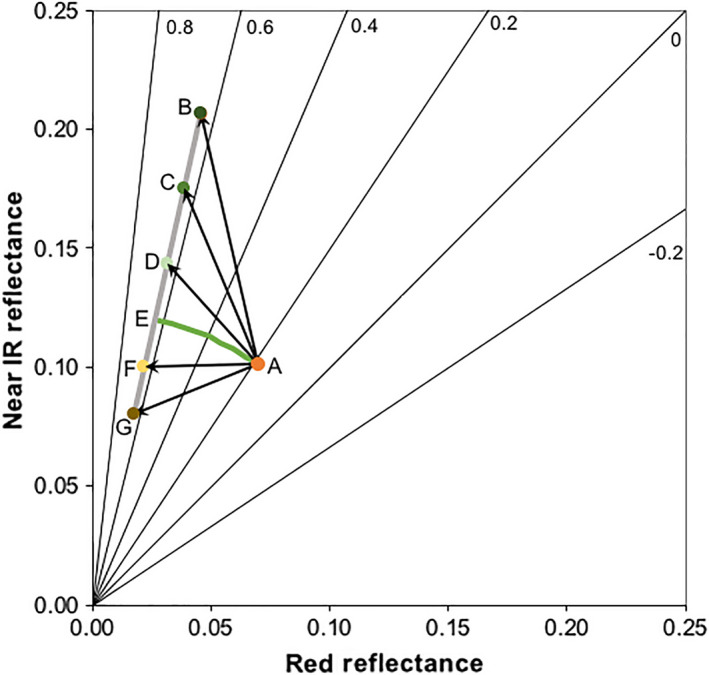
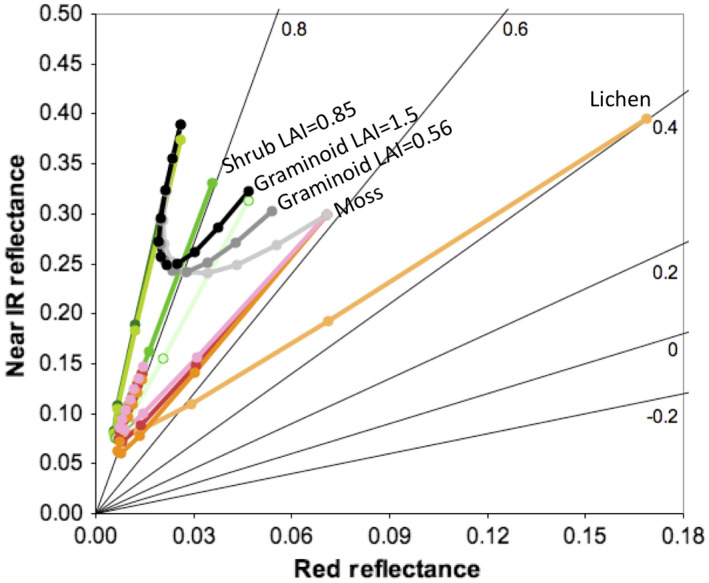
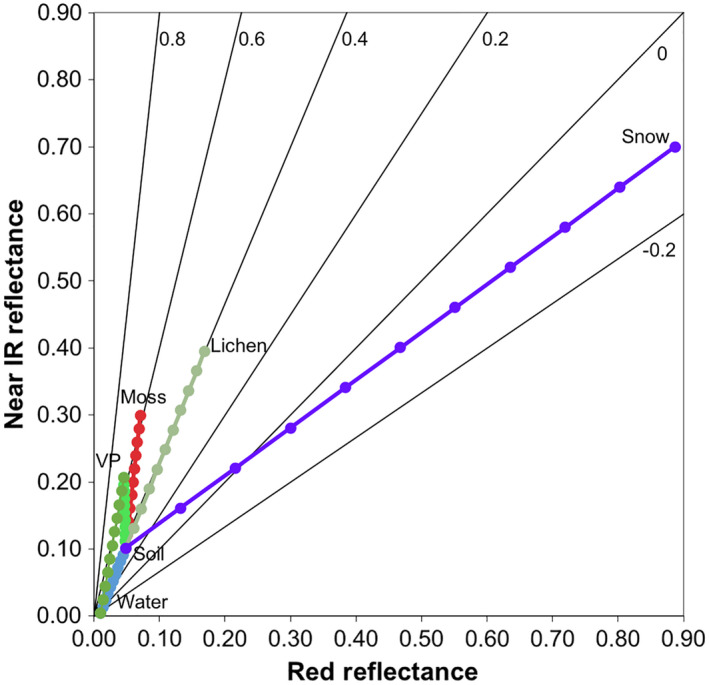
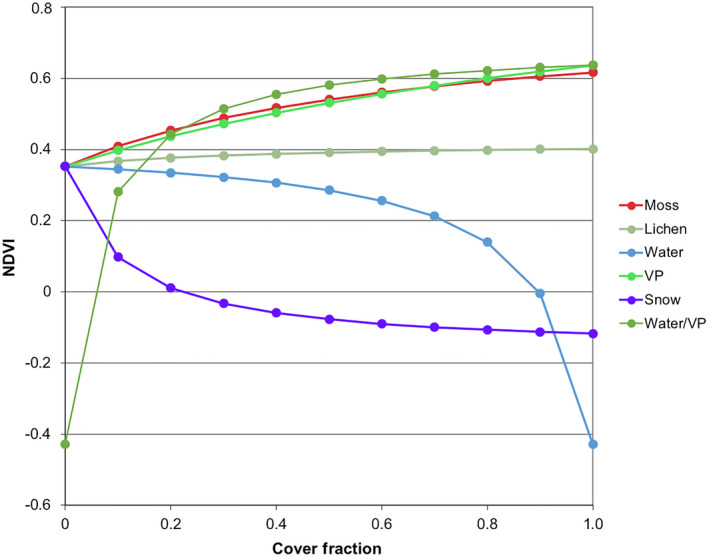
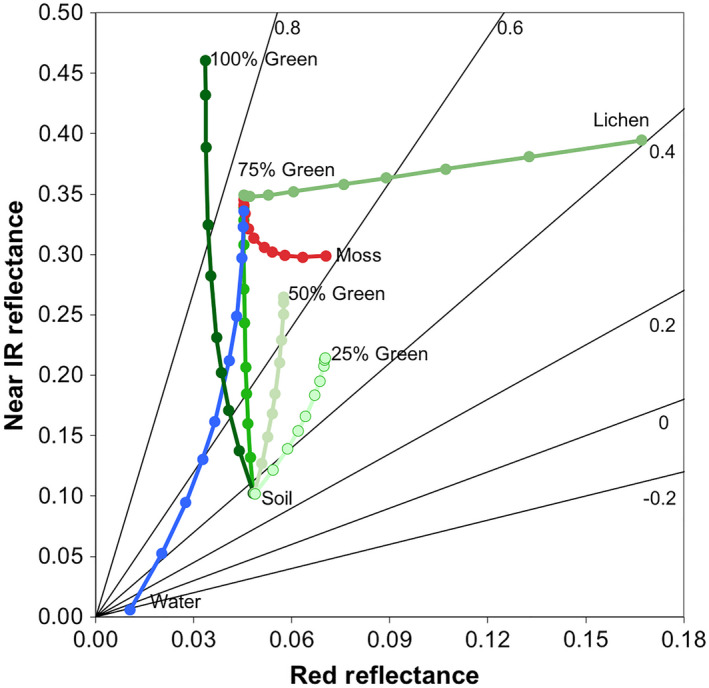
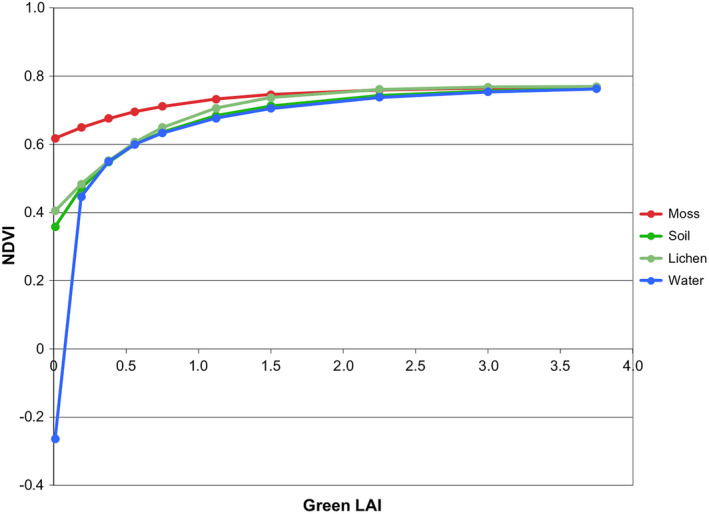
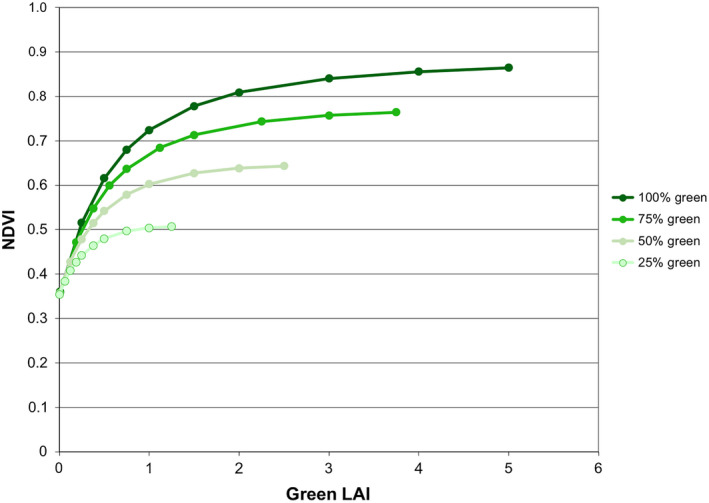
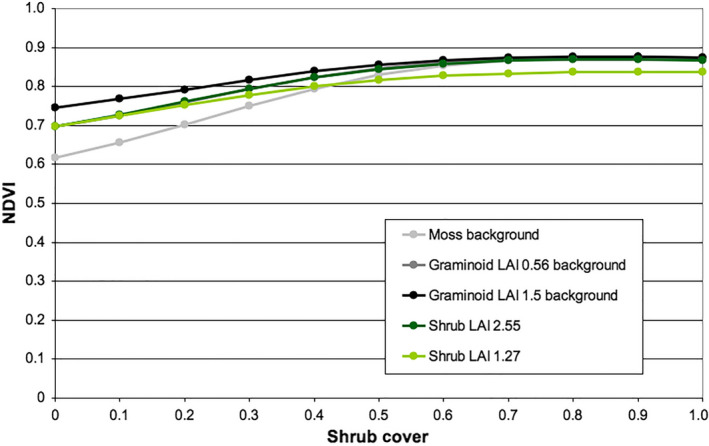
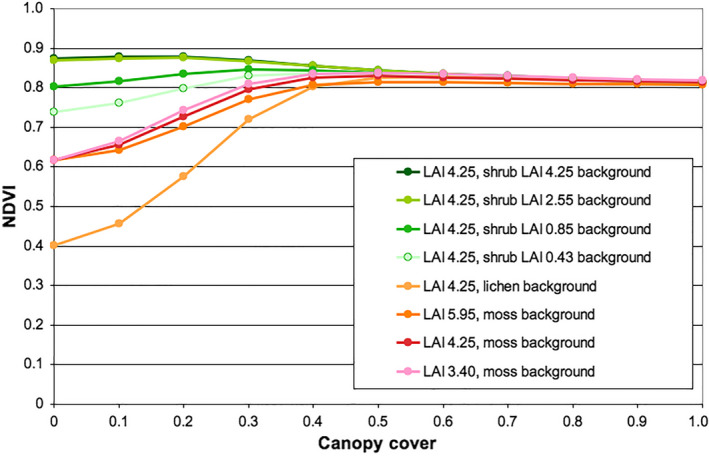
Multiyear trends in Normalized Difference Vegetation Index (NDVI) have been used as metrics of high latitude ecosystem change based on the assumption that NDVI change is associated with ecological change, generally as changes in green vegetation amount (green leaf area index [LAI] or plant cover). Further, no change in NDVI is often interpreted as no change in these variables. Three canopy reflectance models including linear mixture model, the SAIL (Scattering from Arbitrarily Inclined Leaves) model, and the GeoSail model were used to simulate scenarios representing high latitude landscape NDVI responses to changes in LAI and plant cover. The simulations showed inconsistent NDVI responses. Clear increases in NDVI are generally associated with increases in LAI and plant cover. At higher values of LAI, the change in NDVI per unit change in LAI decreases, with very little change in spruce forest NDVI where crown cover is >50% and at the tundra-taiga ecotone with transitions from shrub tundra to spruce woodland. These lower responses may bias the interpretation of greening/browning trends in boreal forests. Variations in water or snow coverage were shown to produce outsized nonbiological NDVI responses. Inconsistencies in NDVI responses exemplify the need for care in the interpretation of NDVI change as a metric of high latitude ecosystem change, and that landscape characteristics in terms of the type of cover and its characteristics, such as the initial plant cover, must be taken into account in evaluating the significance of any observed NDVI trends.
多年来归一化差异植被指数 (NDVI) 的变化一直被用作高纬度生态系统变化的指标,其假设是 NDVI 的变化与生态变化有关,通常与绿色植被数量的变化(绿叶面积指数 [LAI] 或植物覆盖)有关。此外,NDVI 没有变化通常被解释为这些变量没有变化。三种冠层反射模型,包括线性混合模型、SAIL(任意倾斜叶片散射)模型和 GeoSail 模型,被用来模拟代表高纬度景观 NDVI 对 LAI 和植物覆盖变化的响应场景。模拟结果显示 NDVI 的响应不一致。NDVI 的明显增加通常与 LAI 和植物覆盖的增加有关。在 LAI 较高的情况下,NDVI 的变化量与 LAI 的变化量成反比,云杉林的 NDVI 变化很小,树冠覆盖率 >50%,在苔原-泰加生态过渡带,从灌木苔原向云杉林地过渡。这些较低的响应可能会影响对北方森林绿化/变褐趋势的解释。水或雪覆盖的变化被证明会产生不成比例的非生物 NDVI 响应。NDVI 响应的不一致性说明了在解释 NDVI 变化作为高纬度生态系统变化的指标时需要谨慎,并且必须考虑覆盖类型及其特征(如初始植物覆盖)等景观特征,以评估任何观察到的 NDVI 趋势的重要性。