Georgetown University Hospital, Washington, DC.
John Theurer Cancer Center at Hackensack UMC, Hackensack, New Jersey.
Cancer. 2021 Nov 15;127(22):4233-4239. doi: 10.1002/cncr.33831. Epub 2021 Aug 10.
Consolidative autologous hematopoietic stem cell transplantation (AHCT) is commonly used for patients with multiple myeloma (MM). We studied AHCT use and outcomes in patients with MM ≥75 years old.
Patients with MM ≥75 years old receiving AHCT between 2013 and 2017 in the United States were identified using the Center for International Blood and Marrow Transplant Research database. Relapse and/or progression (REL), progression-free survival (PFS), and overall survival (OS) were modeled using Cox proportional hazards models. Covariates used were age, sex, Karnofsky performance score (KPS), HCT-comorbidity index (HCT-CI), International Staging System and/or Durie-Salmon stage, high-risk cytogenetics, melphalan dose, and disease status at and 1 year after transplant. AHCT utilization rate using the Surveillance, Epidemiology, and End Results database was used to estimate specific incidence among ≥75 years old by race and gender.
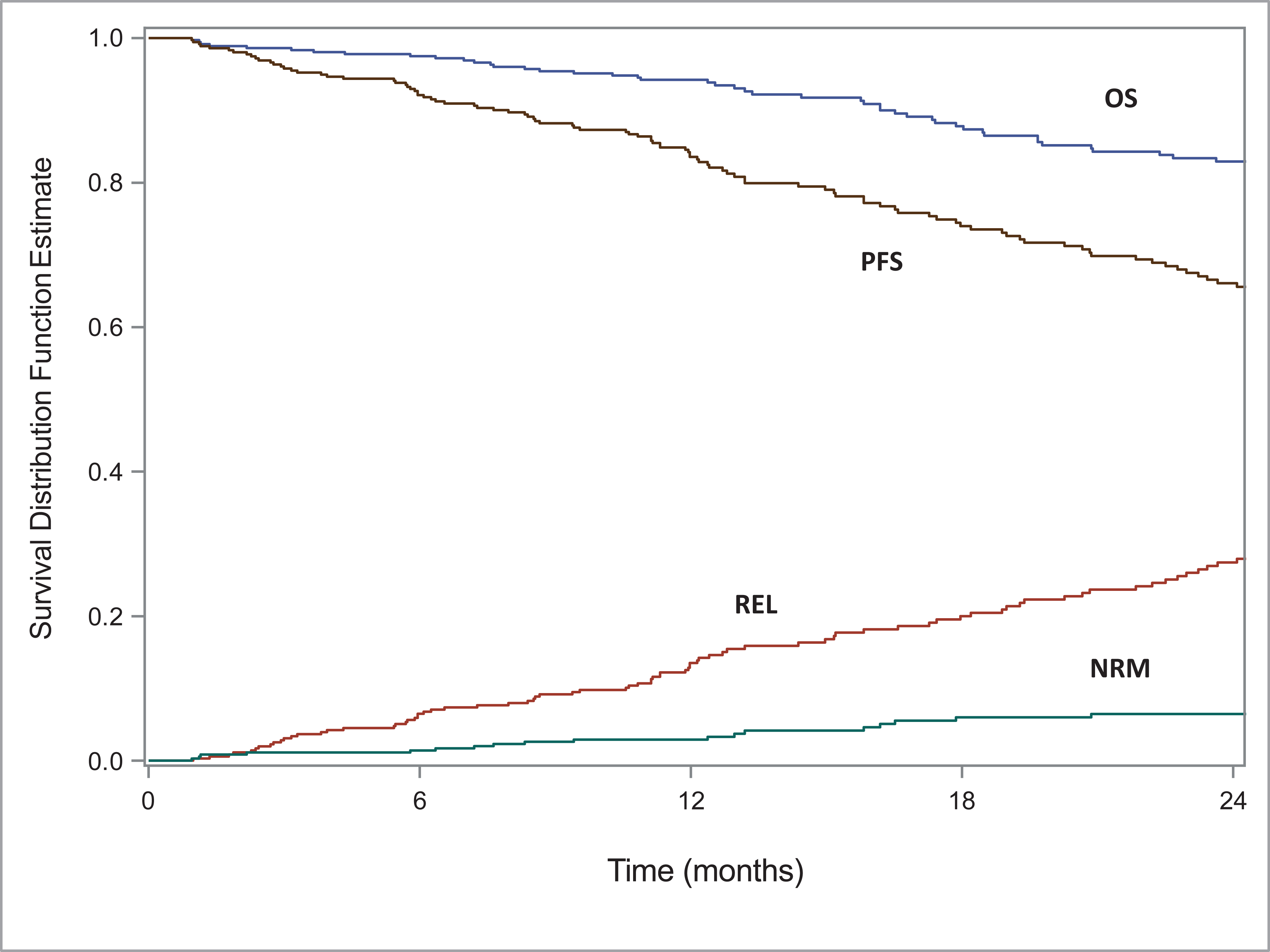
Of 360 patients, 63% were male, 84% were White, 56% had KPS <90, and 57% had HCT-CI ≥3. The 100-day transplant-related mortality was 1% (0%-2%) with a 2-year REL rate of 27% (95% confidence interval [CI], 22%-33%), PFS of 66% (95% CI, 60%-72%), and OS of 83% (95% CI, 78%-87%). On multivariate analysis, only high-risk cytogenetics was associated with REL risk and decreased PFS. In White males, transplant utilization rate was 5.2%-5.8% compared to 3.5%-4.0% in African American males (P = .02). There was 3.37-3.79% transplant utilization in White females compared to 1.88-2.12% in African American females (P < .01).
The use of AHCT was associated with excellent 2-year outcomes in this selected MM population ≥75 years old. Transplant utilization for patients ≥75 years old remains low with significant racial and gender disparities.
巩固性自体造血干细胞移植(AHCT)常用于多发性骨髓瘤(MM)患者。我们研究了≥75 岁 MM 患者接受 AHCT 的使用情况和结局。
使用国际血液和骨髓移植研究中心数据库,在美国确定了 2013 年至 2017 年间接受 AHCT 的≥75 岁 MM 患者。使用 Cox 比例风险模型对复发和/或进展(REL)、无进展生存(PFS)和总生存(OS)进行建模。使用的协变量包括年龄、性别、卡氏功能状态评分(KPS)、HCT 合并症指数(HCT-CI)、国际分期系统和/或 Durie-Salmon 分期、高危细胞遗传学、马法兰剂量以及移植前后 1 年的疾病状态。使用监测、流行病学和最终结果数据库的 AHCT 使用率,按种族和性别估计≥75 岁人群中的特定发病率。
在 360 名患者中,63%为男性,84%为白人,56%的 KPS<90,57%的 HCT-CI≥3。100 天移植相关死亡率为 1%(0%-2%),2 年 REL 率为 27%(95%CI,22%-33%),PFS 为 66%(95%CI,60%-72%),OS 为 83%(95%CI,78%-87%)。多变量分析显示,只有高危细胞遗传学与 REL 风险相关,并降低了 PFS。在白人男性中,移植使用率为 5.2%-5.8%,而非洲裔美国男性为 3.5%-4.0%(P=0.02)。白人女性的移植使用率为 3.37%-3.79%,而非洲裔美国女性为 1.88%-2.12%(P<0.01)。
在这一选择的≥75 岁 MM 患者人群中,AHCT 的使用与 2 年的良好结局相关。≥75 岁患者的移植使用率仍然较低,存在显著的种族和性别差异。