Bonello Francesca, Cani Lorenzo, D'Agostino Mattia
SSD Clinical Trial in Oncoematologia e Mieloma Multiplo, Division of Hematology, University of Torino, Azienda Ospedaliero-Universitaria Città della Salute e della Scienza di Torino, Torino, Italy.
Front Oncol. 2022 Mar 9;12:830922. doi: 10.3389/fonc.2022.830922. eCollection 2022.
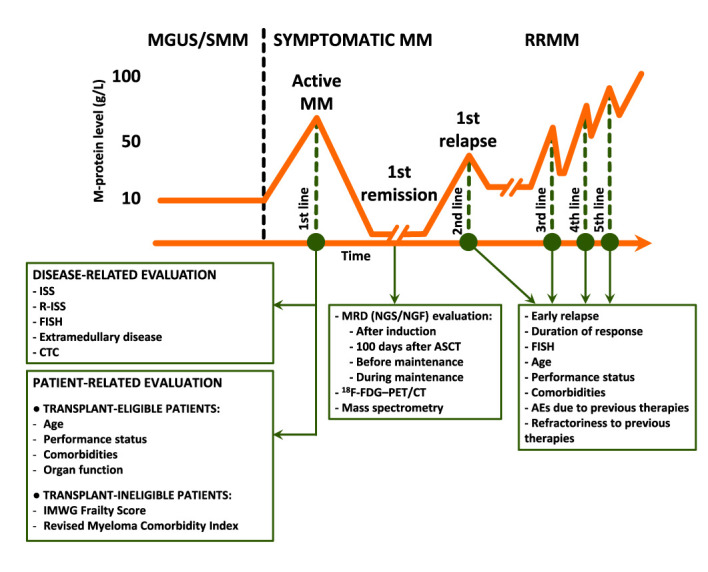
Multiple Myeloma (MM) is a hematologic malignancy characterized by a wide clinical and biological heterogeneity leading to different patient outcomes. Various prognostic tools to stratify newly diagnosed (ND)MM patients into different risk groups have been proposed. At baseline, the standard-of-care prognostic score is the Revised International Staging System (R-ISS), which stratifies patients according to widely available serum markers (i.e., albumin, β 2-microglobulin, lactate dehydrogenase) and high-risk cytogenetic abnormalities detected by fluorescence hybridization. Though this score clearly identifies a low-risk and a high-risk population, the majority of patients are categorized as at "intermediate risk". Although new prognostic factors identified through molecular assays (e.g., gene expression profiling, next-generation sequencing) are now available and may improve risk stratification, the majority of them need specialized centers and bioinformatic expertise that may preclude their broad application in the real-world setting. In the last years, new tools to monitor response and measurable residual disease (MRD) with very high sensitivity after the start of treatment have been developed. MRD analyses both inside and outside the bone marrow have a strong prognostic impact, and the achievement of MRD negativity may counterbalance the high-risk behavior identified at baseline. All these techniques have been developed in clinical trials. However, their efficient application in real-world clinical practice and their potential role to guide treatment-decision making are still open issues. This mini review will cover currently known prognostic factors identified before and during first-line treatment, with a particular focus on their potential applications in real-world clinical practice.
多发性骨髓瘤(MM)是一种血液系统恶性肿瘤,其临床和生物学异质性广泛,导致患者预后不同。已经提出了各种预后工具,用于将新诊断的(ND)MM患者分层为不同的风险组。在基线时,标准治疗预后评分是修订的国际分期系统(R-ISS),它根据广泛可用的血清标志物(即白蛋白、β2-微球蛋白、乳酸脱氢酶)和通过荧光杂交检测到的高危细胞遗传学异常对患者进行分层。尽管该评分明确识别出低风险和高风险人群,但大多数患者被归类为“中危”。虽然通过分子检测(如基因表达谱分析、下一代测序)确定的新预后因素现在已经可用,并且可能改善风险分层,但其中大多数需要专业中心和生物信息学专业知识,这可能会妨碍它们在实际临床环境中的广泛应用。在过去几年中,已经开发出了在治疗开始后以非常高的灵敏度监测缓解和可测量残留病(MRD)的新工具。骨髓内外的MRD分析具有很强的预后影响,实现MRD阴性可能会抵消基线时确定的高危特征。所有这些技术都是在临床试验中开发的。然而,它们在实际临床实践中的有效应用及其在指导治疗决策方面的潜在作用仍然是未解决的问题。本综述将涵盖一线治疗前和治疗期间确定的目前已知的预后因素,特别关注它们在实际临床实践中的潜在应用。