Institute of Environmental Sciences, Faculty of Biology, Jagiellonian University, Kraków, Poland.
Naturalis Biodiversity Center, Leiden, The Netherlands.
Mol Biol Evol. 2021 Oct 27;38(11):5092-5106. doi: 10.1093/molbev/msab237.
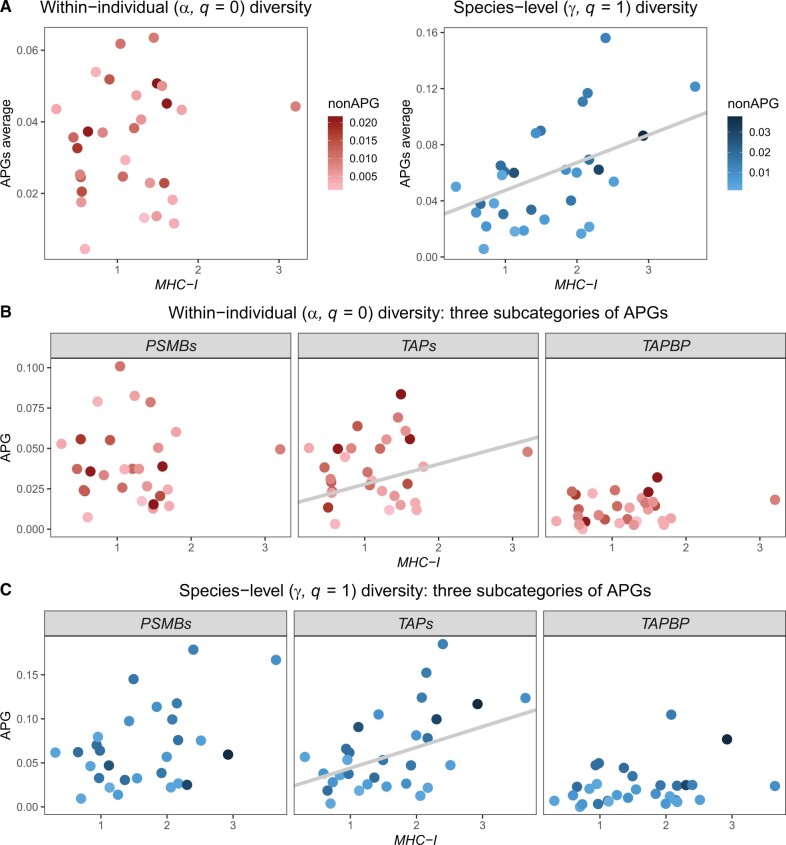
Proteins encoded by antigen-processing genes (APGs) provide major histocompatibility complex (MHC) class I (MHC-I) with antigenic peptides. In mammals, polymorphic multigenic MHC-I family is served by monomorphic APGs, whereas in certain nonmammalian species both MHC-I and APGs are polymorphic and coevolve within stable haplotypes. Coevolution was suggested as an ancestral gnathostome feature, presumably enabling only a single highly expressed classical MHC-I gene. In this view coevolution, while optimizing some aspects of adaptive immunity, would also limit its flexibility by preventing the expansion of classical MHC-I into a multigene family. However, some nonmammalian taxa, such as salamanders, have multiple highly expressed MHC-I genes, suggesting either that coevolution is relaxed or that it does not prevent the establishment of multigene MHC-I. To distinguish between these two alternatives, we use salamanders (30 species from 16 genera representing six families) to test, within a comparative framework, a major prediction of the coevolution hypothesis: the positive correlation between MHC-I and APG diversity. We found that MHC-I diversity explained both within-individual and species-wide diversity of two APGs, TAP1 and TAP2, supporting their coevolution with MHC-I, whereas no consistent effect was detected for the other three APGs (PSMB8, PSMB9, and TAPBP). Our results imply that although coevolution occurs in salamanders, it does not preclude the expansion of the MHC-I gene family. Contrary to the previous suggestions, nonmammalian vertebrates thus may be able to accommodate diverse selection pressures with flexibility granted by rapid expansion or contraction of the MHC-I family, while retaining the benefits of coevolution between MHC-I and TAPs.
抗原加工基因(APG)编码的蛋白质为主要组织相容性复合体(MHC)I 类(MHC-I)提供抗原肽。在哺乳动物中,多态性的 MHC-I 家族由单态性 APG 提供,而在某些非哺乳动物物种中,MHC-I 和 APG 都是多态性的,并在稳定的单倍型中共进化。共进化被认为是一个祖先的有颌类特征,可能只允许一个高度表达的经典 MHC-I 基因。在这种观点中,共进化虽然优化了适应性免疫的某些方面,但通过防止经典 MHC-I 扩展为多基因家族,也会限制其灵活性。然而,一些非哺乳动物类群,如蝾螈,具有多个高度表达的 MHC-I 基因,这表明共进化要么放松了,要么并没有阻止多基因 MHC-I 的建立。为了在这两种选择之间进行区分,我们使用蝾螈(代表六个科的 16 个属的 30 个物种),在比较框架内测试共进化假说的一个主要预测:MHC-I 和 APG 多样性之间的正相关。我们发现,MHC-I 的多样性解释了两个 APG(TAP1 和 TAP2)的个体内和物种间多样性,支持它们与 MHC-I 的共进化,而对于其他三个 APG(PSMB8、PSMB9 和 TAPBP)则没有一致的影响。我们的研究结果表明,尽管共进化发生在蝾螈中,但它并没有排除 MHC-I 基因家族的扩展。与之前的建议相反,非哺乳动物脊椎动物因此可能能够通过 MHC-I 家族的快速扩张或收缩来灵活地适应各种选择压力,同时保留 MHC-I 和 TAP 之间共进化的好处。