Department of Dermatology, The Affiliated Hospital of Southwest Medical University, Luzhou, China.
Duke Cancer Institute, Duke University Medical Center, Durham, NC, USA.
Cancer Sci. 2021 Oct;112(10):4355-4364. doi: 10.1111/cas.15102. Epub 2021 Aug 27.
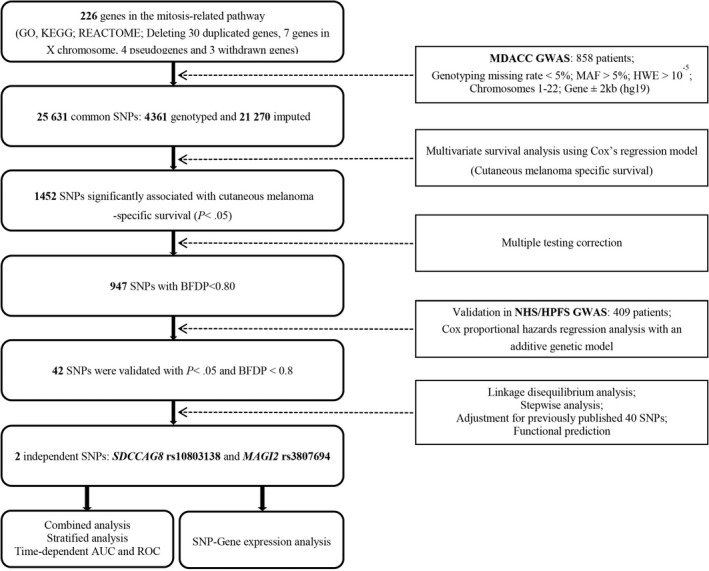
Mitosis is a prognostic factor for cutaneous melanoma (CM), but accurate mitosis detection in CM tissues is difficult. Therefore, the 8th Edition of the American Joint Committee on Cancer staging system has removed the mitotic rate as a category criterion of the tumor T-category, based on the evidence that the mitotic rate was not an independent prognostic factor for melanoma survival. As single-nucleotide polymorphisms (SNPs) have been shown to be potential predictors for cutaneous melanoma-specific survival (CMSS), we investigated the potential prognostic value of SNPs in mitosis-related pathway genes in CMSS by analyzing their associations with outcomes of 850 CM patients from The University of Texas MD Anderson Cancer Center in a discovery dataset and validated the findings in another dataset of 409 CM patients from the Harvard University Nurses' Health Study and Health Professionals Follow-up Study. In both datasets, we identified two SNPs (SDCCAG8 rs10803138 G>A and MAGI2 rs3807694 C>T) as independent prognostic factors for CMSS, with adjusted allelic hazards ratios of 1.49 (95% confidence interval = 1.17-1.90, P = .001) and 1.45 (1.13-1.86, P = .003), respectively. Furthermore, their combined unfavorable alleles also predicted a poor survival in both discovery and validation datasets in a dose-response manner (P = .0006 and .0001, respectively). Additional functional analysis revealed that both SDCCAG8 rs10803138 A and MAGI2 rs3807694 T alleles were associated with elevated mRNA expression levels in normal tissues. Therefore, these findings suggest that SDCCAG8 rs10803138 G>A and MAGI2 rs3807694 C>T are independent prognostic biomarkers for CMSS, possibly by regulating the mRNA expression of the corresponding genes involved in mitosis.
有丝分裂是皮肤黑色素瘤 (CM) 的一个预后因素,但在 CM 组织中准确检测有丝分裂是困难的。因此,基于有丝分裂率不是黑色素瘤生存的独立预后因素这一证据,第八版美国癌症联合委员会分期系统已将其从肿瘤 T 分期的类别标准中删除。由于单核苷酸多态性 (SNP) 已被证明是皮肤黑色素瘤特异性生存 (CMSS) 的潜在预测因子,我们通过分析它们与来自德克萨斯大学 MD 安德森癌症中心的 850 名 CM 患者的结果之间的关系,研究了有丝分裂相关途径基因中的 SNP 对 CMSS 的潜在预后价值在一个发现数据集,并在另一个来自哈佛大学护士健康研究和健康专业人员随访研究的 409 名 CM 患者的数据集中验证了这些发现。在两个数据集,我们确定了两个 SNP (SDCCAG8 rs10803138 G>A 和 MAGI2 rs3807694 C>T) 作为 CMSS 的独立预后因素,调整后的等位基因危险比分别为 1.49(95%置信区间为 1.17-1.90,P=0.001)和 1.45(1.13-1.86,P=0.003)。此外,它们的不利等位基因组合也以剂量反应方式预测了发现和验证数据集中的不良生存(P=0.0006 和.0001)。进一步的功能分析表明,SDCCAG8 rs10803138 A 和 MAGI2 rs3807694 T 等位基因均与正常组织中 mRNA 表达水平升高相关。因此,这些发现表明,SDCCAG8 rs10803138 G>A 和 MAGI2 rs3807694 C>T 是 CMSS 的独立预后生物标志物,可能通过调节涉及有丝分裂的相应基因的 mRNA 表达。