Division of Cardiology, Peter Munk Cardiac Centre, University Health Network, Toronto, Ontario, Canada; Division of Cardiology, Mount Sinai Hospital, Sinai Health System, Toronto, Ontario, Canada.
Libin Cardiovascular Institute, Foothills Medical Centre, Calgary, Alberta, Canada.
Can J Cardiol. 2021 Oct;37(10):1629-1634. doi: 10.1016/j.cjca.2021.08.001. Epub 2021 Aug 8.
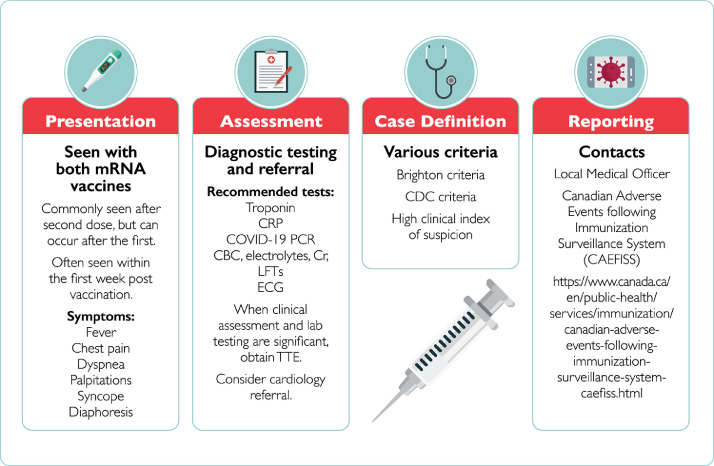
The mRNA vaccines against COVID-19 infection have been effective in reducing the number of symptomatic cases worldwide. With widespread uptake, case series of vaccine-related myocarditis/pericarditis have been reported, particularly in adolescents and young adults. Men tend to be affected with greater frequency, and symptom onset is usually within 1 week after vaccination. Clinical course appears to be mild in most cases. On the basis of the available evidence, we highlight a clinical framework to guide providers on how to assess, investigate, diagnose, and report suspected and confirmed cases. In any patient with highly suggestive symptoms temporally related to COVID-19 mRNA vaccination, standardized workup includes serum troponin measurement and polymerase chain reaction testing for COVID-19 infection, routine additional lab work, and a 12-lead electrocardiogram. Echocardiography is recommended as the imaging modality of choice for patients with unexplained troponin elevation and/or pathologic electrocardiogram changes. Cardiovascular specialist consultation and hospitalization should be considered on the basis of the results of standard investigations. Treatment is largely supportive, and myocarditis/pericarditis that is diagnosed according to defined clinical criteria should be reported to public health authorities in every jurisdiction. Finally, we recommend COVID-19 vaccination in all individuals in accordance with the Health Canada and National Advisory Committee on Immunization guidelines. In patients with suspected myocarditis/pericarditis after the first dose of an mRNA vaccine, deferral of a second dose is recommended until additional reports become available.
针对 COVID-19 感染的 mRNA 疫苗在全球范围内已被证明能有效减少有症状病例的数量。随着广泛接种,疫苗相关心肌炎/心包炎的病例系列报告已经出现,尤其是在青少年和年轻人中。男性受影响的频率更高,症状通常在接种后 1 周内出现。在大多数情况下,临床过程似乎较轻。根据现有证据,我们强调了一个临床框架,以指导提供者如何评估、调查、诊断和报告疑似和确诊病例。在任何有高度提示性症状且与 COVID-19 mRNA 疫苗接种时间相关的患者中,标准化检查包括测量血清肌钙蛋白和检测 COVID-19 感染的聚合酶链反应,常规进行其他实验室检查,并进行 12 导联心电图检查。对于不明原因的肌钙蛋白升高和/或病理性心电图改变的患者,建议使用超声心动图作为首选影像学检查方法。应根据标准检查的结果考虑心血管专家咨询和住院治疗。治疗主要是支持性的,根据明确的临床标准诊断的心肌炎/心包炎应向每个司法管辖区的公共卫生当局报告。最后,我们建议根据加拿大卫生部和国家免疫咨询委员会的指南在所有人群中接种 COVID-19 疫苗。对于接种 mRNA 疫苗第一剂后疑似心肌炎/心包炎的患者,建议推迟第二剂接种,直到有更多报告。