Soliman Moetaza M
Department of Pharmacy Practice, Faculty of Pharmacy, Mansoura University, Egypt.
Postepy Dermatol Alergol. 2021 Jun;38(3):510-519. doi: 10.5114/ada.2020.98726. Epub 2020 Sep 18.
Assessment of psychological well-being in psoriasis patients is recommended. However, studies evaluating depressive, anxiety, stress, and insomnia symptoms in Arabic patients with psoriasis are lacking.
To quantify levels of psoriasis-related depressive, anxiety, stress, and insomnia symptoms in Arabic patients with psoriasis.
A cross-sectional survey on patients' demographics, disease characteristics, and psychological measures using the Patient Health Questionnaire-9, Generalized Anxiety Disorder 7-item scale, Depression Anxiety Stress Scale-21 (7-item stress subscale), and Insomnia Severity Index. The prevalence and scores of depressive, anxiety, stress, and insomnia symptoms were calculated. Multivariate linear regression models were developed to assess patients' demographics and disease characteristics affecting the psychological measures.
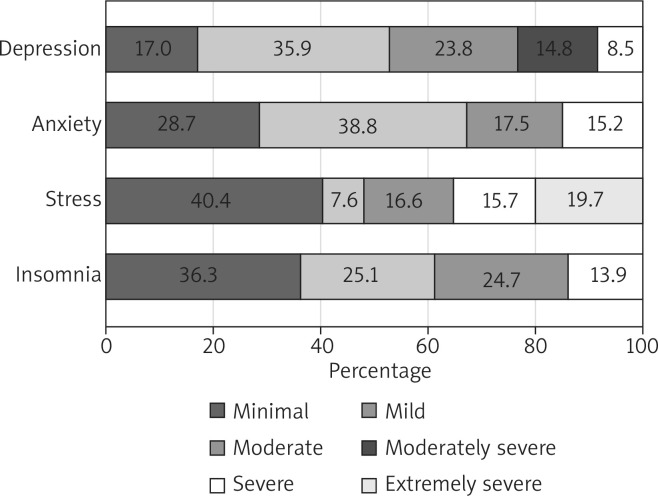
The analysis included 223 patients. The patients reported mild levels of depressive, anxiety, and insomnia symptoms (median (interquartile range (IQR)) scores: 9 (6-14), 6 (4-11), and 12 (4-18), respectively) and a moderate level of stress symptoms (median (IQR) score: 10 (5-14)). The prevalence of depressive, anxiety, stress, and insomnia symptoms were 47.1%, 32.7%, 59.6%, and 57%, respectively. Multivariate linear regression analyses revealed that for each unit increase in the impact of psoriasis on daily life, there were 5.7 (95% confidence intervals (CI): 3.7-7.8), 3.8 (95% CI: 1.8-5.7), 5.3 (95% CI: 3.1-7.4), and 6.5 (95% CI: 3.7-9.4) units increase in depression, anxiety, and stress, and insomnia scores, respectively.
The prevalence of depressive, anxiety, stress, and insomnia symptoms in Arabic patients with psoriasis was high. Clinical interventions, screening for psychiatric comorbidities, and consideration of psychotherapy should be implemented in this patient group.
建议对银屑病患者的心理健康状况进行评估。然而,目前缺乏针对阿拉伯银屑病患者抑郁、焦虑、压力和失眠症状的研究。
量化阿拉伯银屑病患者中与银屑病相关的抑郁、焦虑、压力和失眠症状的水平。
采用患者健康问卷-9、广泛性焦虑障碍7项量表、抑郁焦虑压力量表-21(7项压力子量表)和失眠严重程度指数,对患者的人口统计学特征、疾病特征和心理指标进行横断面调查。计算抑郁、焦虑、压力和失眠症状的患病率及得分。建立多元线性回归模型,以评估影响心理指标的患者人口统计学特征和疾病特征。
分析纳入223例患者。患者报告的抑郁、焦虑和失眠症状水平较轻(中位数(四分位间距(IQR))得分分别为:9(6-14)、6(4-11)和12(4-18)),压力症状水平为中度(中位数(IQR)得分:10(5-14))。抑郁、焦虑、压力和失眠症状的患病率分别为47.1%、32.7%、59.6%和57%。多元线性回归分析显示,银屑病对日常生活影响每增加一个单位,抑郁、焦虑、压力和失眠得分分别增加5.7(95%置信区间(CI):3.7-7.8)、3.8(95%CI:1.8-5.7)、5.3(95%CI:3.1-7.4)和6.5(95%CI:3.7-9.4)个单位。
阿拉伯银屑病患者中抑郁、焦虑、压力和失眠症状的患病率较高。应对该患者群体实施临床干预、筛查精神科合并症并考虑心理治疗。