Damiani Giovanni, Pacifico Alessia, Scoditti Egeria, di Gregorio Sara, Del Fabbro Massimo, Cozzolino Claudia, Buja Alessandra, Mercuri Santo R, Bianchi Vittoria G, Grada Ayman, Garbarino Sergio, Bunick Christopher G
Italian Center for Precision Medicine in Chronic Inflammation, University of Milan, 20122, Milan, Italy.
Department of Biomedical, Surgical and Dental Sciences, University of Milan, 20122, Milan, Italy.
Dermatol Ther (Heidelb). 2023 Oct;13(10):2229-2246. doi: 10.1007/s13555-023-00987-z. Epub 2023 Aug 12.
Minimal erythema dose (MED) remains a parameter of paramount importance to orient narrow-band (NB)-UVB phototherapy in psoriatic (PsO) patients. Recently, circadian rhythm and diet were recognized as potential MED modulators, but their mutual interaction remains understudied. Thus, we aimed to evaluate the potential diet modulation of MED circadian oscillations.
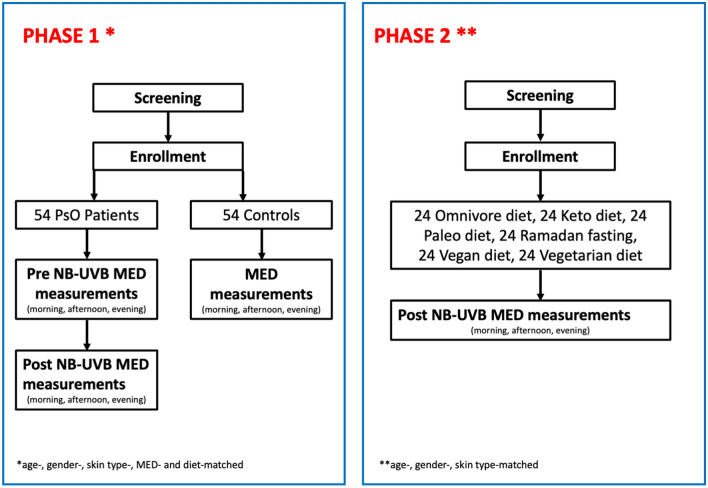
In the first phase, a cohort study was performed comparing potential MED oscillations (morning, afternoon, and evening) among omnivorous psoriatic patients before and after a phototherapy cycle and omnivorous healthy controls. The two groups were age-, gender-, skin-type-, MED-, and diet-matched. Then, in the second phase, another cohort study was carried out comparing MED oscillations 24 h after the last phototherapeutic session only in psoriatic patients cleared with NB-UVB and undergoing different diets (vegan, vegetarian, paleo , ketogenic, intermittent circadian fasting, and omnivore). Patients with different diets were age-, gender-, and skin-type matched.
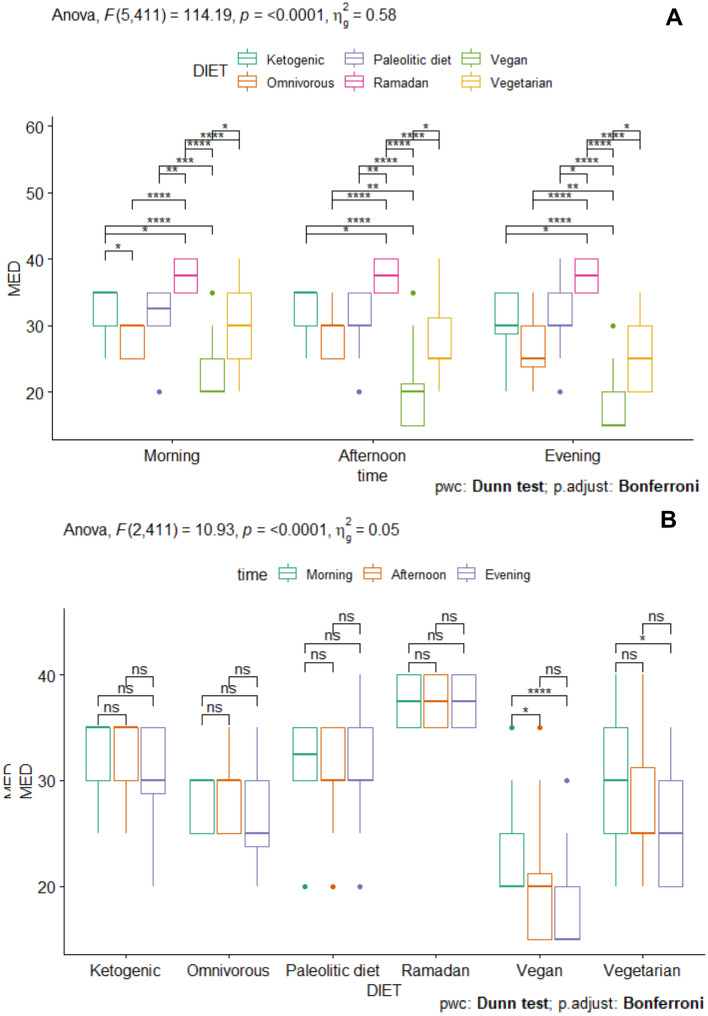
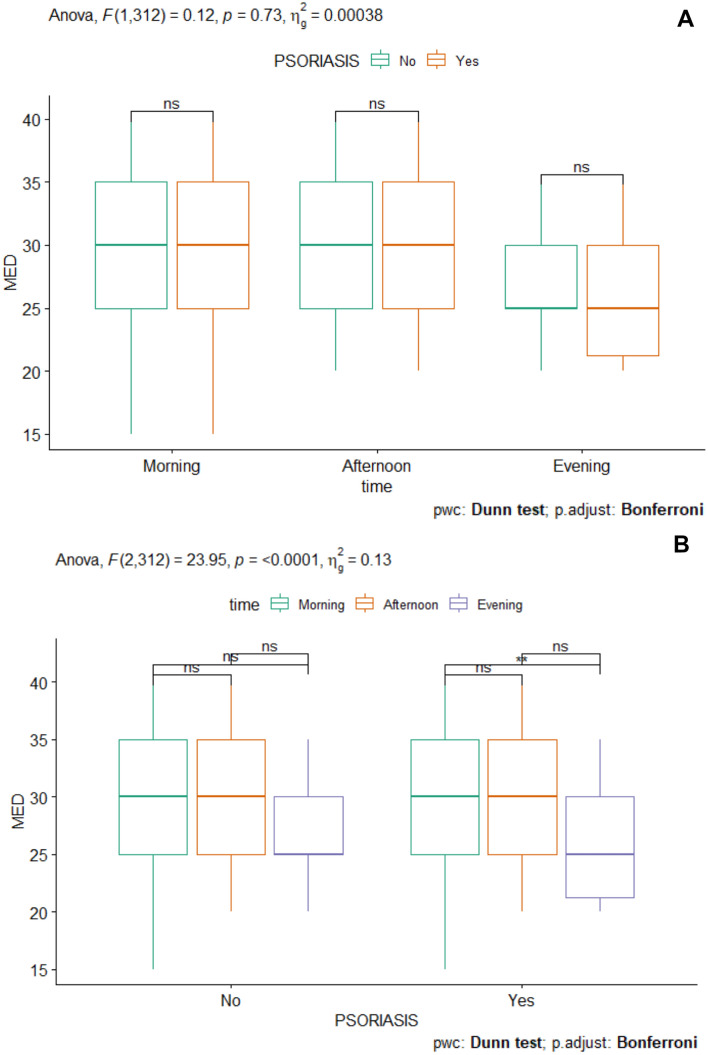
In the first phase, we enrolled only omnivores, specifically 54 PsO patients and 54 healthy individuals. Their MED before and after NB-UVB therapy changed significantly among the three different time-points (morning, afternoon, and evening) (p < 0.001). The time effect was statistically significant in both groups before and after phototherapy. In the second phase, we enrolled 144 PsO patients (vegan, vegetarian, paleo, ketogenic, intermittent circadian fasting, and omnivore). MED circadian oscillations preserved a significant difference also after clearance and were influenced by diet type and time of day (p < 0.001). In particular, vegans displayed the lowest MED values, whilst Ramadan fasting showed the highest values in morning, afternoon, and evening.
Diet, like other ongoing therapies, should be reported in the medical records of patients with psoriasis undergoing NB-UVB and patients with lower MEDs should be preferentially treated in the morning when the MED is higher.
最小红斑量(MED)仍然是指导银屑病(PsO)患者进行窄谱(NB)-UVB光疗的一个至关重要的参数。最近,昼夜节律和饮食被认为是潜在的MED调节因素,但它们之间的相互作用仍未得到充分研究。因此,我们旨在评估饮食对MED昼夜振荡的潜在调节作用。
在第一阶段,进行了一项队列研究,比较了接受光疗周期前后的杂食性银屑病患者与杂食性健康对照者之间潜在的MED振荡情况(早晨、下午和晚上)。两组在年龄、性别、皮肤类型、MED和饮食方面进行了匹配。然后,在第二阶段,进行了另一项队列研究,仅比较了用NB-UVB清除且接受不同饮食(纯素食、素食、原始饮食、生酮饮食、间歇性昼夜禁食和杂食)的银屑病患者在最后一次光疗 session 后24小时的MED振荡情况。不同饮食组的患者在年龄、性别和皮肤类型方面进行了匹配。
在第一阶段,我们仅纳入了杂食者,具体为54例PsO患者和54名健康个体。在三个不同时间点(早晨、下午和晚上),他们在NB-UVB治疗前后的MED有显著变化(p < 0.001)。光疗前后两组的时间效应均具有统计学意义。在第二阶段,我们纳入了144例PsO患者(纯素食、素食、原始饮食、生酮饮食、间歇性昼夜禁食和杂食)。清除后MED的昼夜振荡也存在显著差异,并受饮食类型和一天中的时间影响(p < 0.001)。特别是,纯素食者的MED值最低,而斋月禁食者在早晨、下午和晚上的MED值最高。
饮食与其他正在进行的治疗一样,应记录在接受NB-UVB治疗的银屑病患者的病历中,MED较低的患者应优先在早晨MED较高时进行治疗。