• 文献检索
  • 文档翻译
  • 深度研究
  • 学术资讯
  • Suppr Zotero 插件Zotero 插件
  • 邀请有礼
  • 套餐&价格
  • 历史记录
应用&插件
Suppr Zotero 插件Zotero 插件浏览器插件Mac 客户端Windows 客户端微信小程序
定价
高级版会员购买积分包购买API积分包
服务
文献检索文档翻译深度研究API 文档MCP 服务
关于我们
关于 Suppr公司介绍联系我们用户协议隐私条款
关注我们

Suppr 超能文献

核心技术专利:CN118964589B侵权必究
粤ICP备2023148730 号-1Suppr @ 2026

文献检索

告别复杂PubMed语法,用中文像聊天一样搜索,搜遍4000万医学文献。AI智能推荐,让科研检索更轻松。

立即免费搜索

文件翻译

保留排版,准确专业,支持PDF/Word/PPT等文件格式,支持 12+语言互译。

免费翻译文档

深度研究

AI帮你快速写综述,25分钟生成高质量综述,智能提取关键信息,辅助科研写作。

立即免费体验

神经网络代理中的注意模式理论:使用注意描述模型控制视空间注意。

The attention schema theory in a neural network agent: Controlling visuospatial attention using a descriptive model of attention.

机构信息

Department of Psychology, Princeton University, Princeton, NJ 08544.

Department of Psychology, Princeton University, Princeton, NJ 08544;

出版信息

Proc Natl Acad Sci U S A. 2021 Aug 17;118(33). doi: 10.1073/pnas.2102421118.

DOI:10.1073/pnas.2102421118
PMID:34385306
原文链接:https://pmc.ncbi.nlm.nih.gov/articles/PMC8379943/
Abstract

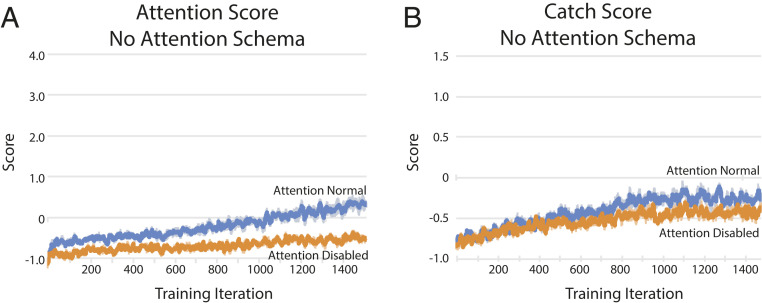
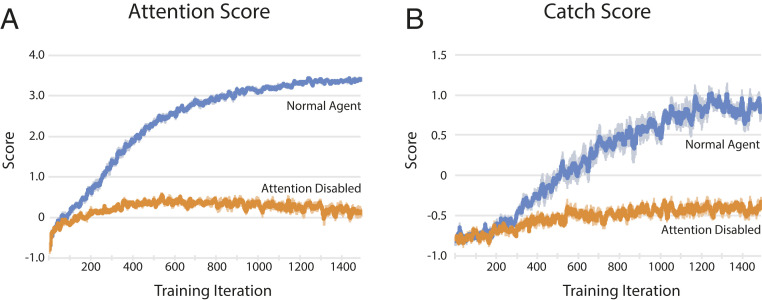
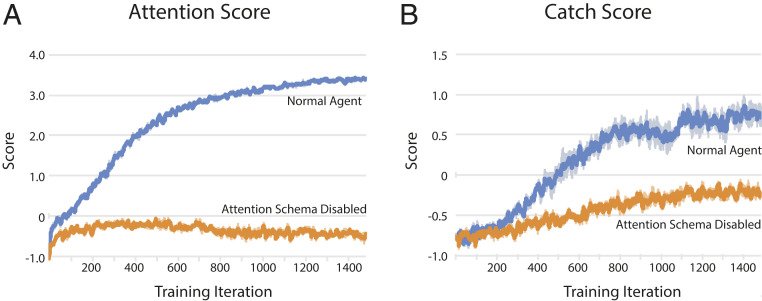
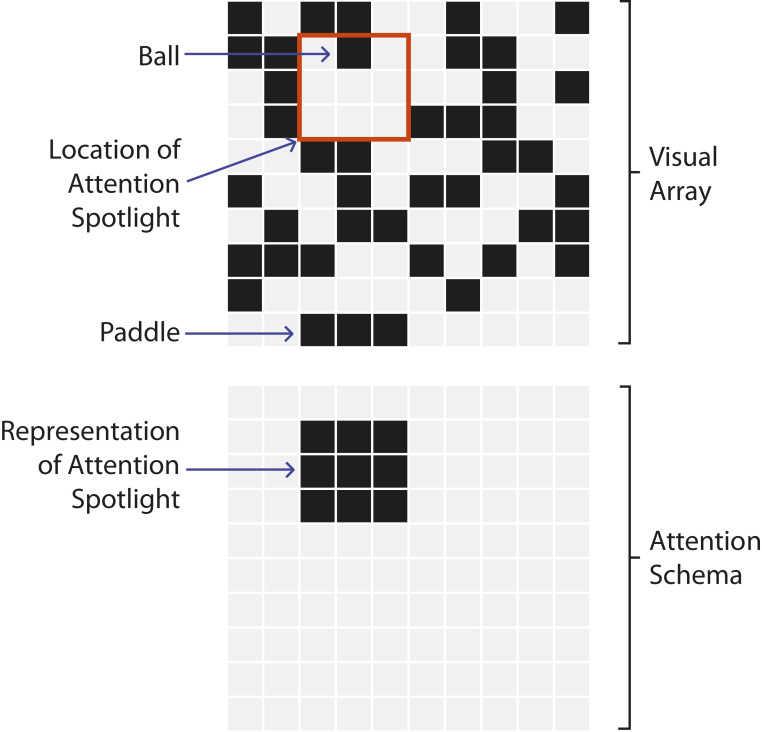
In the attention schema theory (AST), the brain constructs a model of attention, the attention schema, to aid in the endogenous control of attention. Growing behavioral evidence appears to support the presence of a model of attention. However, a central question remains: does a controller of attention actually benefit by having access to an attention schema? We constructed an artificial deep Q-learning neural network agent that was trained to control a simple form of visuospatial attention, tracking a stimulus with an attention spotlight in order to solve a catch task. The agent was tested with and without access to an attention schema. In both conditions, the agent received sufficient information such that it should, theoretically, be able to learn the task. We found that with an attention schema present, the agent learned to control its attention spotlight and learned the catch task. Once the agent learned, if the attention schema was then disabled, the agent's performance was greatly reduced. If the attention schema was removed before learning began, the agent was impaired at learning. The results show how the presence of even a simple attention schema can provide a profound benefit to a controller of attention. We interpret these results as supporting the central argument of AST: the brain contains an attention schema because of its practical benefit in the endogenous control of attention.

摘要

在注意模式理论(AST)中,大脑构建了一个注意模型,即注意模式,以帮助内源性地控制注意力。越来越多的行为证据似乎支持存在注意模型。然而,一个核心问题仍然存在:注意力的控制器实际上是否受益于访问注意模式?我们构建了一个人工深度 Q 学习神经网络代理,该代理经过训练可以控制一种简单的视空间注意力,通过注意力聚光灯跟踪刺激,以解决捕捉任务。该代理在有和没有注意模式的情况下进行了测试。在这两种情况下,代理都收到了足够的信息,理论上它应该能够学习任务。我们发现,在存在注意模式的情况下,代理学会了控制其注意力聚光灯并学会了捕捉任务。一旦代理学会了,如果禁用注意模式,代理的性能会大大降低。如果在学习开始之前移除注意模式,代理在学习时就会受到损害。结果表明,即使是一个简单的注意模式的存在,也可以为注意力的控制器提供深远的好处。我们将这些结果解释为支持 AST 的核心论点:大脑中存在注意模式,是因为它在注意力的内源性控制中具有实际的益处。
https://cdn.ncbi.nlm.nih.gov/pmc/blobs/ea6d/8379943/80db44fb9bce/pnas.2102421118fig05.jpg
https://cdn.ncbi.nlm.nih.gov/pmc/blobs/ea6d/8379943/e268618156bb/pnas.2102421118fig01.jpg
https://cdn.ncbi.nlm.nih.gov/pmc/blobs/ea6d/8379943/e3eb15e2fc22/pnas.2102421118fig02.jpg
https://cdn.ncbi.nlm.nih.gov/pmc/blobs/ea6d/8379943/34870ddc54a8/pnas.2102421118fig03.jpg
https://cdn.ncbi.nlm.nih.gov/pmc/blobs/ea6d/8379943/6e0f37b5c46a/pnas.2102421118fig04.jpg
https://cdn.ncbi.nlm.nih.gov/pmc/blobs/ea6d/8379943/80db44fb9bce/pnas.2102421118fig05.jpg
https://cdn.ncbi.nlm.nih.gov/pmc/blobs/ea6d/8379943/e268618156bb/pnas.2102421118fig01.jpg
https://cdn.ncbi.nlm.nih.gov/pmc/blobs/ea6d/8379943/e3eb15e2fc22/pnas.2102421118fig02.jpg
https://cdn.ncbi.nlm.nih.gov/pmc/blobs/ea6d/8379943/34870ddc54a8/pnas.2102421118fig03.jpg
https://cdn.ncbi.nlm.nih.gov/pmc/blobs/ea6d/8379943/6e0f37b5c46a/pnas.2102421118fig04.jpg
https://cdn.ncbi.nlm.nih.gov/pmc/blobs/ea6d/8379943/80db44fb9bce/pnas.2102421118fig05.jpg

相似文献

1
The attention schema theory in a neural network agent: Controlling visuospatial attention using a descriptive model of attention.神经网络代理中的注意模式理论:使用注意描述模型控制视空间注意。
Proc Natl Acad Sci U S A. 2021 Aug 17;118(33). doi: 10.1073/pnas.2102421118.
2
Attention control and the attention schema theory of consciousness.注意力控制与意识的注意图式理论。
Prog Neurobiol. 2020 Dec;195:101844. doi: 10.1016/j.pneurobio.2020.101844. Epub 2020 Jun 1.
3
Schema formation in a neural population subspace underlies learning-to-learn in flexible sensorimotor problem-solving.在灵活的感觉运动问题解决中,神经群体子空间中的模式形成是学习如何学习的基础。
Nat Neurosci. 2023 May;26(5):879-890. doi: 10.1038/s41593-023-01293-9. Epub 2023 Apr 6.
4
The attention schema theory: a mechanistic account of subjective awareness.注意模式理论:对主观意识的一种机制性解释。
Front Psychol. 2015 Apr 23;6:500. doi: 10.3389/fpsyg.2015.00500. eCollection 2015.
5
Inter-subject transfer learning with an end-to-end deep convolutional neural network for EEG-based BCI.基于端到端深度卷积神经网络的 EEG 脑机接口的跨被试迁移学习。
J Neural Eng. 2019 Apr;16(2):026007. doi: 10.1088/1741-2552/aaf3f6. Epub 2018 Nov 26.
6
Disease named entity recognition using long-short dependencies.使用长短时记忆网络的疾病命名实体识别
J Bioinform Comput Biol. 2020 Jun;18(3):2050015. doi: 10.1142/S0219720020500158. Epub 2020 Jun 5.
7
Task-induced brain functional connectivity as a representation of schema for mediating unsupervised and supervised learning dynamics in language acquisition.任务诱发的脑功能连接作为一种图式表征,用于介导语言习得中无监督和有监督学习动态过程。
Brain Behav. 2021 Jun;11(6):e02157. doi: 10.1002/brb3.2157. Epub 2021 May 5.
8
Modelling aspects of consciousness: A topological perspective.意识的建模方面:拓扑视角。
J Theor Biol. 2021 Aug 21;523:110713. doi: 10.1016/j.jtbi.2021.110713. Epub 2021 Apr 20.
9
Superposition mechanism as a neural basis for understanding others.叠加机制作为理解他人的神经基础。
Sci Rep. 2022 Feb 21;12(1):2859. doi: 10.1038/s41598-022-06717-3.
10
If deep learning is the answer, what is the question?如果深度学习是答案,那么问题是什么?
Nat Rev Neurosci. 2021 Jan;22(1):55-67. doi: 10.1038/s41583-020-00395-8. Epub 2020 Nov 16.

引用本文的文献

1
The public mental representations of deepfake technology: An in-depth qualitative exploration through Quora text data analysis.深度伪造技术的公众心理表征:通过Quora文本数据分析进行的深入定性探索。
PLoS One. 2024 Dec 30;19(12):e0313605. doi: 10.1371/journal.pone.0313605. eCollection 2024.
2
Design and evaluation of a global workspace agent embodied in a realistic multimodal environment.在逼真的多模态环境中实现的全局工作区智能体的设计与评估。
Front Comput Neurosci. 2024 Jun 14;18:1352685. doi: 10.3389/fncom.2024.1352685. eCollection 2024.
3
A conceptual framework for consciousness.

本文引用的文献

1
Attention control and the attention schema theory of consciousness.注意力控制与意识的注意图式理论。
Prog Neurobiol. 2020 Dec;195:101844. doi: 10.1016/j.pneurobio.2020.101844. Epub 2020 Jun 1.
2
Neural Mechanisms of Selective Visual Attention.选择性视觉注意的神经机制。
Annu Rev Psychol. 2017 Jan 3;68:47-72. doi: 10.1146/annurev-psych-122414-033400.
3
Integrated information theory: from consciousness to its physical substrate.综合信息理论:从意识到其物理基础。
意识的概念框架。
Proc Natl Acad Sci U S A. 2022 May 3;119(18):e2116933119. doi: 10.1073/pnas.2116933119. Epub 2022 Apr 29.
4
Consciousness explained or described?意识是被解释了还是被描述了?
Neurosci Conscious. 2022 Jan 21;2022(2):niac001. doi: 10.1093/nc/niac001. eCollection 2022.
Nat Rev Neurosci. 2016 Jul;17(7):450-61. doi: 10.1038/nrn.2016.44. Epub 2016 May 26.
4
Effects of Awareness on the Control of Attention.意识对注意力控制的影响。
J Cogn Neurosci. 2016 Jun;28(6):842-51. doi: 10.1162/jocn_a_00931. Epub 2016 Feb 2.
5
A Multi-Area Stochastic Model for a Covert Visual Search Task.一种用于隐蔽视觉搜索任务的多区域随机模型。
PLoS One. 2015 Aug 19;10(8):e0136097. doi: 10.1371/journal.pone.0136097. eCollection 2015.
6
The attention schema theory: a mechanistic account of subjective awareness.注意模式理论:对主观意识的一种机制性解释。
Front Psychol. 2015 Apr 23;6:500. doi: 10.3389/fpsyg.2015.00500. eCollection 2015.
7
Revisiting the body-schema concept in the context of whole-body postural-focal dynamics.重新审视整体姿势焦点动力学背景下的身体图式概念。
Front Hum Neurosci. 2015 Feb 17;9:83. doi: 10.3389/fnhum.2015.00083. eCollection 2015.
8
Human-level control through deep reinforcement learning.通过深度强化学习实现人类水平的控制。
Nature. 2015 Feb 26;518(7540):529-33. doi: 10.1038/nature14236.
9
Unconscious vision and executive control: how unconscious processing and conscious action control interact.无意识视觉与执行控制:无意识加工与有意识行动控制如何相互作用。
Conscious Cogn. 2014 Jul;27:268-87. doi: 10.1016/j.concog.2014.05.009. Epub 2014 Jun 22.
10
Getting ahead: forward models and their place in cognitive architecture.取得领先地位:前向模型及其在认知架构中的位置。
Trends Cogn Sci. 2014 Sep;18(9):451-6. doi: 10.1016/j.tics.2014.05.006. Epub 2014 Jun 6.