Villumsen Marie, Schelde Astrid Blicher, Jimenez-Solem Espen, Jess Tine, Allin Kristine Højgaard
Center for Clinical Research and Prevention, Bispebjerg and Frederiksberg Hospital, The Capital Region, Copenhagen, Denmark.
Department of Clinical Pharmacology, Copenhagen University Hospital, Bispebjerg and Frederiksberg, Copenhagen, Denmark.
EClinicalMedicine. 2021 Jun 23;37:100979. doi: 10.1016/j.eclinm.2021.100979. eCollection 2021 Jul.
The disease course of inflammatory bowel disease (IBD) following treatment with glucagon-like peptide (GLP)-1 based therapies is unclear. The aim of this study was to examine the disease course of IBD in patients treated with GLP-1 based therapies compared with treatment with other antidiabetics.
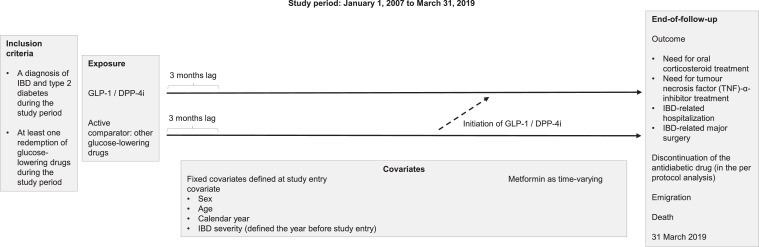
Using nationwide Danish registries, we identified patients with IBD and type 2 diabetes who received antidiabetic treatment between 1 January 2007 and 31 March 2019. The primary outcome was a composite of the need for oral corticosteroids, tumour necrosis factor-α inhibitors, IBD-related hospitalisation, or IBD-related surgery. In the setting of a new-user active comparator design, we used Poisson regression to estimate incidence rate ratios (IRR) comparing treatment with GLP-1 receptor agonists and dipeptidyl peptidase (DPP)-4 inhibitors with other antidiabetic therapies. The analyses were adjusted for age, sex, calendar year, IBD severity, and metformin use.
We identified 3751 patients with a diagnosis of IBD and type 2 diabetes and with a prescription of an antidiabetic drug (GLP-1 receptor agonists/DPP-4 inhibitors: 982 patients; other antidiabetic treatment: 2769 patients). The adjusted IRR of the composite outcome was 0·52 (95% CI: 0·42-0·65) for patients exposed to GLP-1 receptor agonists/DPP-4 inhibitors compared with patients exposed to other antidiabetics.
In patients with IBD and type 2 diabetes, we observed a lower risk of adverse clinical events amongst patients treated with GLP-1 based therapies compared with treatment with other antidiabetics. These findings suggest that treatment with GLP-1 based therapies may improve the disease course of IBD.
基于胰高血糖素样肽(GLP)-1的疗法治疗炎症性肠病(IBD)后的病程尚不清楚。本研究的目的是比较基于GLP-1的疗法与其他抗糖尿病药物治疗IBD患者的病程。
利用丹麦全国性登记系统,我们确定了2007年1月1日至2019年3月31日期间接受抗糖尿病治疗的IBD和2型糖尿病患者。主要结局是口服糖皮质激素、肿瘤坏死因子-α抑制剂、IBD相关住院或IBD相关手术的综合需求。在新用户活性对照设计中,我们使用泊松回归来估计发病率比(IRR),比较GLP-1受体激动剂和二肽基肽酶(DPP)-4抑制剂与其他抗糖尿病疗法的治疗效果。分析对年龄、性别、日历年、IBD严重程度和二甲双胍使用情况进行了调整。
我们确定了3751例诊断为IBD和2型糖尿病且开具了抗糖尿病药物处方的患者(GLP-1受体激动剂/DPP-4抑制剂:982例患者;其他抗糖尿病治疗:2769例患者)。与接受其他抗糖尿病药物治疗的患者相比,接受GLP-1受体激动剂/DPP-4抑制剂治疗的患者综合结局的调整后IRR为0.52(95%CI:0.42-0.65)。
在IBD和2型糖尿病患者中,我们观察到与其他抗糖尿病药物治疗相比,基于GLP-1的疗法治疗的患者不良临床事件风险较低。这些发现表明,基于GLP-1的疗法治疗可能改善IBD的病程。