Cardiology Unit, Department of Internal Medicine, University of Genoa, Genoa, Italy.
Division of Cardiology, Sapienza University of Rome, Sant'Andrea Hospital, Rome, Italy.
Eur J Clin Invest. 2021 Dec;51(12):e13665. doi: 10.1111/eci.13665. Epub 2021 Aug 22.
Transthyretin-related cardiac amyloidosis (TTR-CA) is thought to be particularly common in specific at-risk conditions, including aortic stenosis (AS), heart failure with preserved ejection fraction (HFpEF), carpal tunnel syndrome (CTS) and left ventricular hypertrophy or hypertrophic cardiomyopathy (LVH/HCM).
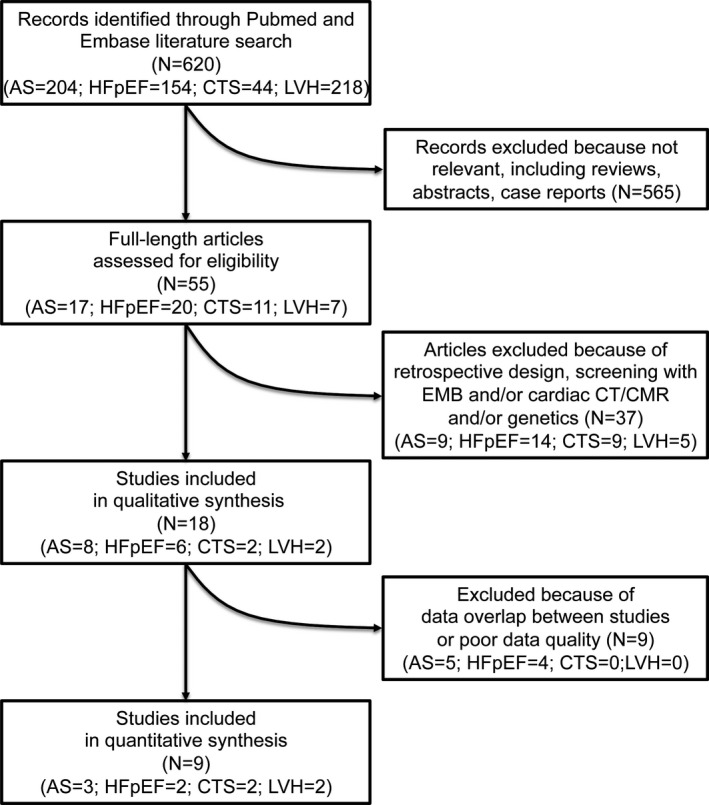
We performed a systematic revision of the literature, including only prospective studies performing TTR-CA screening with bone scintigraphy in the above-mentioned conditions. Assessment of other forms of CA was also evaluated. For selected items, pooled estimates of proportions or means were obtained using a meta-analytic approach.
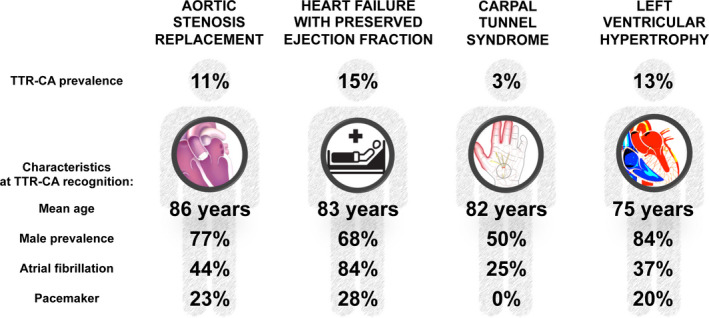
Nine studies (3 AS, 2 HFpEF, 2 CTS and 2 LVH/HCM) accounting for 1375 screened patients were included. One hundred fifty-six (11.3%) TTR-CA patients were identified (11.4% in AS, 14.8% in HFpEF, 2.6% in CTS and 12.9% in LVH/HCM). Exclusion of other forms of CA and use of genetic testing was overall puzzled. Age at TTR-CA recognition was significantly older than that of the overall screened population in AS (86 vs. 83 years, p = .04), LVH/HCM (75 vs. 63, p < .01) and CTS (82 vs. 71), but not in HFpEF (83 vs. 79, p = .35). In terms of comorbidities, hypertension, diabetes and atrial fibrillation were highly prevalent in TTR-CA-diagnosed patients, as well as in those with an implanted pacemaker.
Screening with bone scintigraphy found an 11-15% TTR-CA prevalence in patients with AS, HFpEF and LVH/HCM. AS and HFpEF patients were typically older than 80 years at TTR-CA diagnosis and frequently accompanied by comorbidities. Several studies showed limitations in the application of recommended TTR-CA diagnostic algorithm, which should be addressed in future prospective studies.
转甲状腺素蛋白相关心脏淀粉样变性(TTR-CA)被认为在特定的高危情况下特别常见,包括主动脉瓣狭窄(AS)、射血分数保留的心力衰竭(HFpEF)、腕管综合征(CTS)和左心室肥厚或肥厚型心肌病(LVH/HCM)。
我们进行了系统的文献复习,仅包括在上述情况下使用骨闪烁显像进行 TTR-CA 筛查的前瞻性研究。还评估了其他形式 CA 的评估。对于选定的项目,使用荟萃分析方法获得了比例或平均值的汇总估计值。
纳入了 9 项研究(3 项 AS、2 项 HFpEF、2 项 CTS 和 2 项 LVH/HCM),共纳入 1375 例筛查患者。发现 156 例(11.3%) TTR-CA 患者(AS 中 11.4%,HFpEF 中 14.8%,CTS 中 2.6%,LVH/HCM 中 12.9%)。排除其他形式的 CA 和遗传测试的总体情况令人困惑。在 AS(86 岁 vs. 83 岁,p = 0.04)、LVH/HCM(75 岁 vs. 63 岁,p < 0.01)和 CTS(82 岁 vs. 71 岁)中,TTR-CA 诊断时的年龄明显大于整体筛查人群,但在 HFpEF 中则不然(83 岁 vs. 79 岁,p = 0.35)。就合并症而言,高血压、糖尿病和心房颤动在 TTR-CA 诊断患者中以及植入起搏器的患者中非常普遍。
骨闪烁显像筛查发现,AS、HFpEF 和 LVH/HCM 患者中 TTR-CA 的患病率为 11-15%。AS 和 HFpEF 患者 TTR-CA 诊断时的年龄通常超过 80 岁,且常伴有合并症。一些研究显示,推荐的 TTR-CA 诊断算法的应用存在局限性,这应在未来的前瞻性研究中加以解决。