
大黄石生态系统中灰狼夏季饮食的时空变异性。
Spatial and temporal variability in summer diet of gray wolves () in the Greater Yellowstone Ecosystem.
作者信息
Lodberg-Holm Hanna K, Teglas Bonnie S, Tyers Daniel B, Jimenez Michael D, Smith Douglas W
机构信息
Faculty of Technology, Natural Sciences and Maritime Sciences, Department of Natural Sciences and Environmental Health, University of South-Eastern Norway, P.O. Box 5003, NO-3800 Bø, Norway.
Department of Biology, University of Nevada, Reno, NV 89557, USA.
出版信息
J Mammal. 2021 May 29;102(4):1030-1041. doi: 10.1093/jmammal/gyab060. eCollection 2021 Aug.
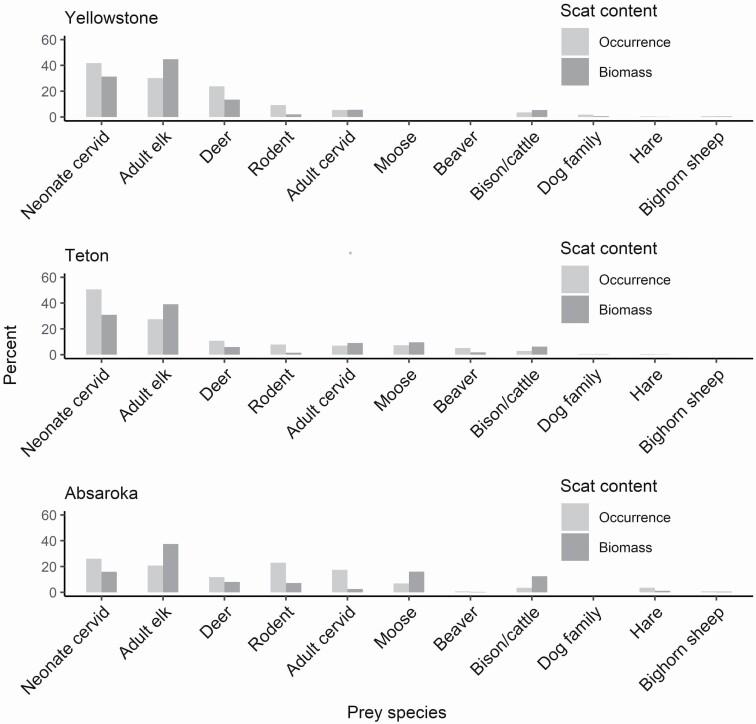
The role of predation by large carnivores in suppressing prey populations and structuring ecosystems is highly debated, calling for a detailed understanding of carnivore diets. Wolves () roam across three continents and persist throughout widely different ecosystems. Their diet is flexible and may vary spatially as well as seasonally, which requires analysis of diet on different spatial and temporal scales. Few studies have investigated the summer diet of wolves, which is more variable, consists of smaller prey, and requires different methods than studying their winter diet. To better understand the summer diet of wolves, we combined three independently collected wolf scat data sets from three distinctly different portions of the Greater Yellowstone Ecosystem: Yellowstone National Park (2009), Grand Teton National Park (2003 - 2009), and the Absaroka-Beartooth Wilderness (2009 - 2010). These areas represent different ecological conditions and management regimes, which may impact wolf diet. We estimated relative biomass and compared occurrence of different prey species among packs, years, as well as the three regions. In total, we analyzed 1,906 wolf scats and found that neonate cervids, adult elk, and adult deer were the most important prey species in the summer diet of the wolves. We found dietary variation among packs residing in the same area, as well as across years. The occurrence of neonate cervids displayed the most variation, and low occurrence of this prey type often was associated with a more diverse diet. Wolf packs within the national parks had a higher occurrence of medium-sized prey (~ 50 - 70 kg) and lower occurrence of small-sized prey (≤ 20 kg) compared to wolves in the Absaroka-Beartooth Wilderness. These results demonstrate flexibility in summer diet across packs, years, and between regions within the Greater Yellowstone Ecosystem.
大型食肉动物的捕食行为在抑制猎物种群数量和构建生态系统方面所起的作用备受争议,这就需要对食肉动物的饮食进行详细了解。狼分布于三大洲,在广泛不同的生态系统中生存。它们的饮食具有灵活性,在空间和季节上都可能有所变化,这就需要在不同的空间和时间尺度上分析其饮食。很少有研究调查过狼的夏季饮食,夏季饮食变化更大,由体型较小的猎物组成,研究方法与研究冬季饮食不同。为了更好地了解狼的夏季饮食,我们整合了来自大黄石生态系统三个截然不同区域的三个独立收集的狼粪便数据集:黄石国家公园(2009年)、大提顿国家公园(2003 - 2009年)以及阿萨罗卡 - 比托特荒野(2009 - 2010年)。这些区域代表了不同的生态条件和管理模式,可能会影响狼的饮食。我们估计了相对生物量,并比较了不同猎物种类在狼群、年份以及这三个区域中的出现情况。我们总共分析了1906份狼粪便,发现新生鹿类、成年麋鹿和成年鹿是狼夏季饮食中最重要的猎物种类。我们发现,居住在同一区域的狼群之间以及不同年份的狼群之间,饮食存在差异。新生鹿类的出现情况变化最大,这种猎物类型出现频率低时,往往与更多样化的饮食相关。与阿萨罗卡 - 比托特荒野的狼相比,国家公园内的狼群捕食中型猎物(约50 - 70千克)的频率更高,捕食小型猎物(≤20千克)的频率更低。这些结果表明,在大黄石生态系统中,狼群的夏季饮食在不同狼群、年份以及区域之间具有灵活性。


 Zotero 插件