Zhang Kai, Jiang Ning, Sang Xiaoyu, Feng Ying, Chen Ran, Chen Qijun
Key Laboratory of Livestock Infectious Diseases in Northeast China, Key Laboratory of Zoonosis, Ministry of Education, College of Animal Science and Veterinary Medicine, Shenyang Agricultural University, Shenyang, China.
The Research Unit for Pathogenic Mechanisms of Zoonotic Parasites, Chinese Academy of Medical Sciences, Shenyang, China.
Front Microbiol. 2021 Jul 28;12:713531. doi: 10.3389/fmicb.2021.713531. eCollection 2021.
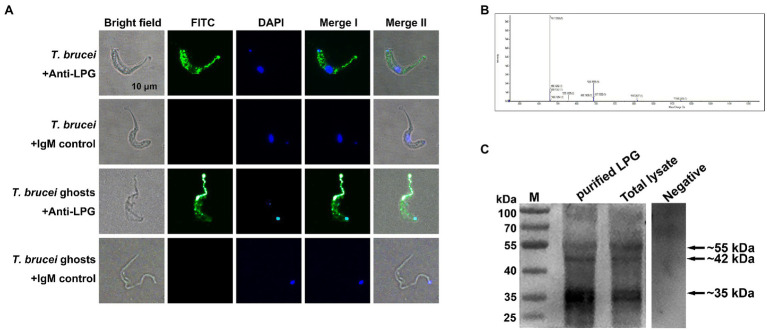
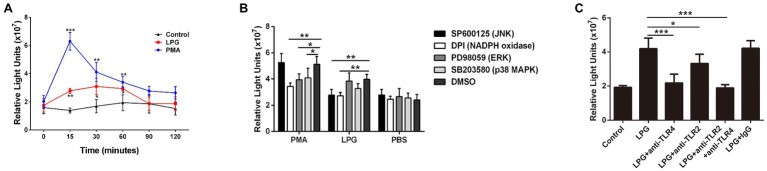
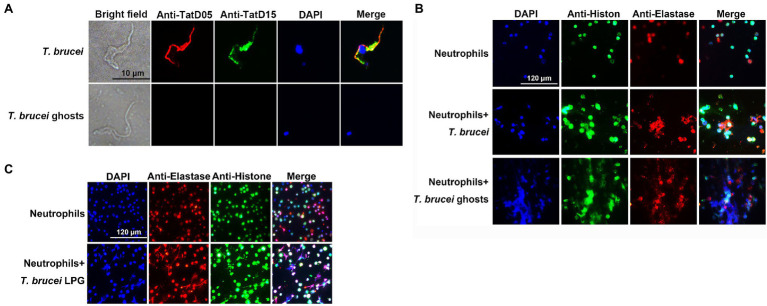
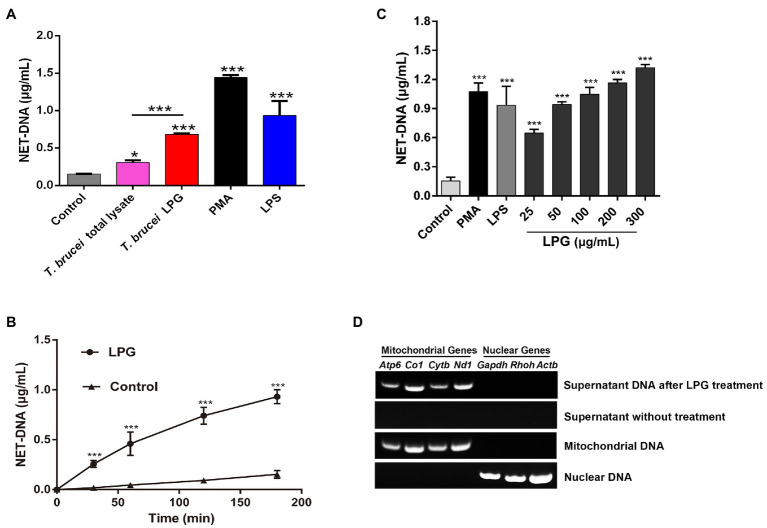
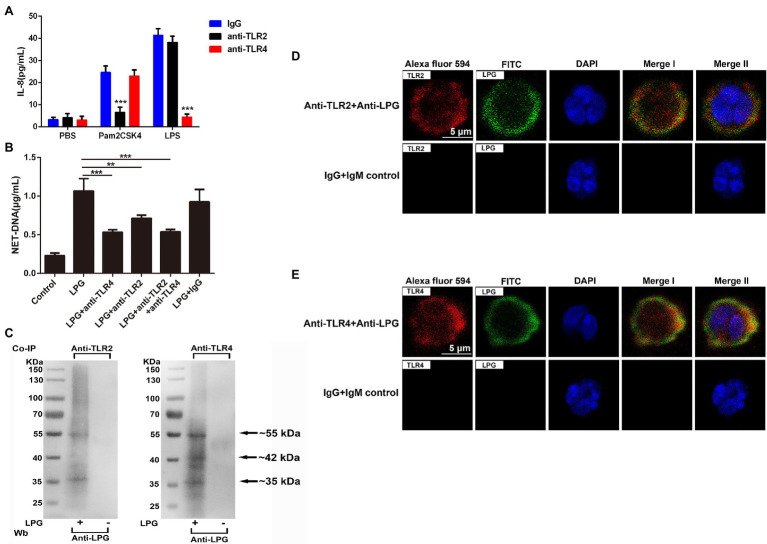
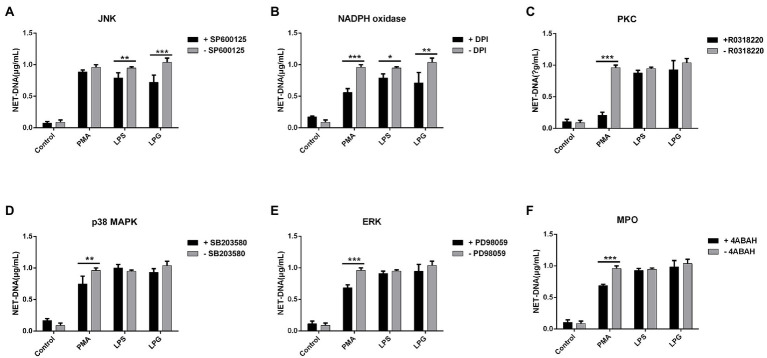
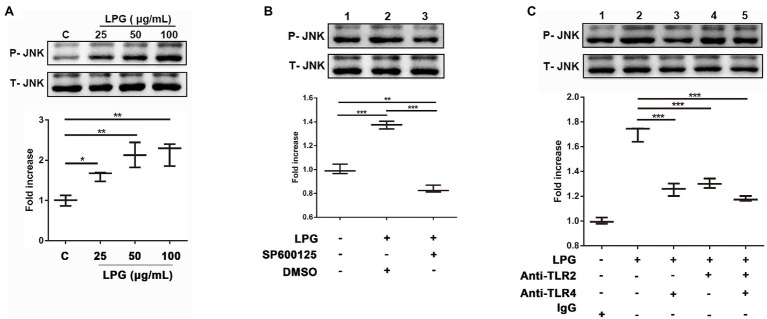
is the causative agent of African animal trypanosomosis, which mainly parasitizes the blood of the host. Lipophosphoglycan (LPG), a polymer anchored to the surface of the parasites, activates the host immune response. In this study, we revealed that LPG stimulated neutrophils to form neutrophil extracellular traps (NETs) and release the reactive oxygen species (ROS). We further analyzed the involvement of toll-like receptor 2 (TLR2) and toll-like receptor 4 (TLR4) and explored the activation of signaling pathway enzymes in response to LPG stimulation. During the stimulation of neutrophils by LPG, the blockade using anti-TLR2 and anti-TLR4 antibodies reduced the phosphorylation of c-Jun N-terminal kinase (JNK), the release of DNA from the NETs, and the burst of ROS. Moreover, the addition of JNK inhibitor and nicotinamide adenine dinucleotide phosphate (NADPH) oxidase inhibitor exhibited similar effects. Our data suggest that LPG activates the phosphorylation of JNK through TLR2 and TLR4 recognition, which causes the formation of NETs and the burst of ROS.
是非洲动物锥虫病的病原体,主要寄生于宿主血液中。脂磷壁酸聚糖(LPG)是一种锚定在寄生虫表面的聚合物,可激活宿主免疫反应。在本研究中,我们发现LPG刺激中性粒细胞形成中性粒细胞胞外陷阱(NETs)并释放活性氧(ROS)。我们进一步分析了Toll样受体2(TLR2)和Toll样受体4(TLR4)的参与情况,并探讨了响应LPG刺激时信号通路酶的激活情况。在LPG刺激中性粒细胞的过程中,使用抗TLR2和抗TLR4抗体进行阻断可减少c-Jun氨基末端激酶(JNK)的磷酸化、NETs中DNA的释放以及ROS的爆发。此外,添加JNK抑制剂和烟酰胺腺嘌呤二核苷酸磷酸(NADPH)氧化酶抑制剂也表现出类似的效果。我们的数据表明,LPG通过TLR2和TLR4识别激活JNK的磷酸化,从而导致NETs的形成和ROS的爆发。