Department of Medical Microbiology Immunology and Parasitology, College of Medicine and Health Sciences, Bahir Dar University, Ethiopia.
Department of Medical Biochemistry, College of Medicine and Health Science, Bahir Dar University, Bahir Dar, Ethiopia.
Afr Health Sci. 2021 Mar;21(1):263-272. doi: 10.4314/ahs.v21i1.34.
Anti-retroviral treatment enhances the immune status and reduces unwanted outcomes. However, development of treatment failure and drug resistance raises concern over lifelong treatments to chronic diseases such as HIV/AIDS.
This study determined proportion of treatment failure (TF) and identified factors associated with TF among people living with human immunodeficiency virus (HIV) in Bahir Dar, Northwest Ethiopia.
Facility based cross sectional study was carried out from November, 2017 to April, 2018. Sociodemographic and clinical data were collected using structured questioner. Blood sample was collected and analyzed for viral load, complete blood count (CBC), liver and kidney function test and CD4 count. A patient is declared as treatment failure when viral load value is higher than 1000 RNA copies/ml in two consecutive viral load analyses within three months interval. Data were entered and analyzed using SPSS version 23. To identify factors associated with TF, logistic regressions model was employed.
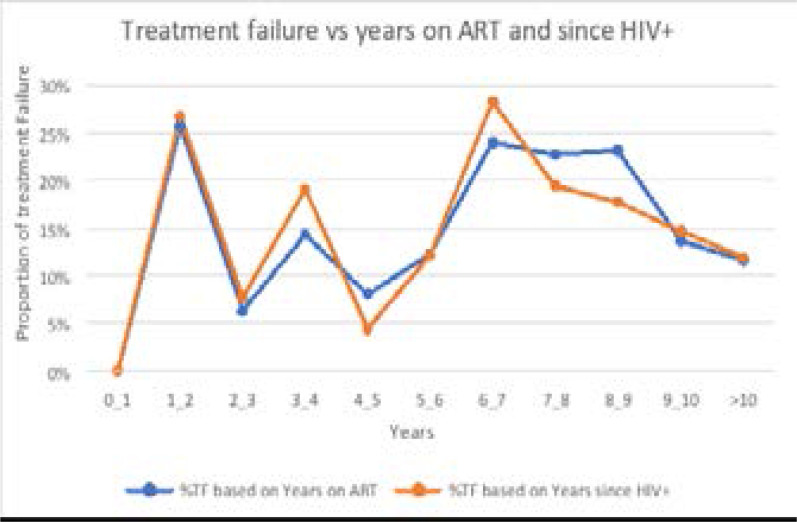
A total of 430 people who had six months and above antiretroviral treatment (ART) follow up were enrolled in the study. Of these, 57.9% were females & the mean age was 38 years. The mean month of ART follow up was 83 months. In the first viral load analysis, 106 (24.7%) of the cohort were virologically failed. These failed people were followed for 3 months with intensive adherence support; then second viral load analysis showed a viralogical failure among 65 people of the second cohort. Thus, the overall viralogical failure or TF was 15.1%. The re-suppression rates were 41(38.7%). Male gender, people with history of drug discontinuation, poor adherence, irregular time of drug intake, multiple sexual practice showed significant association with TF. Moreover, base line and current CD4 counts of <200 cells/ml also demonstrated significant association with TF.
Significant proportion of treatment failure was reported in the present study. Moreover, behavioral factors such as drug discontinuation, poor adherence, multiple sexual partner were associated with treatment failure. Hence, to avoid TF, regular patient counseling and monitoring should be in place. To identify the predictors for treatment failure, further follow-up study is desirable.
抗逆转录病毒治疗可增强免疫状态并降低不良后果。然而,治疗失败和耐药性的发展引起了人们对艾滋病毒/艾滋病等慢性疾病终身治疗的关注。
本研究旨在确定在埃塞俄比亚西北部巴赫达尔接受艾滋病毒治疗的人群中治疗失败(TF)的比例,并确定与 TF 相关的因素。
本研究于 2017 年 11 月至 2018 年 4 月期间进行了一项基于机构的横断面研究。采用结构化问卷收集社会人口学和临床数据。采集血样进行病毒载量、全血细胞计数(CBC)、肝肾功能试验和 CD4 计数分析。当连续两次病毒载量分析中每三个月的病毒载量值高于 1000 RNA 拷贝/ml 时,即宣布患者治疗失败。数据采用 SPSS 版本 23 进行录入和分析。采用逻辑回归模型确定与 TF 相关的因素。
共纳入了 430 名接受了 6 个月及以上抗逆转录病毒治疗(ART)随访的患者。其中,57.9%为女性,平均年龄为 38 岁。平均 ART 随访月数为 83 个月。在第一次病毒载量分析中,队列中有 106 人(24.7%)病毒学失败。这些失败的人接受了 3 个月的强化依从性支持;然后对第二队列的 65 人进行了第二次病毒载量分析,显示第二次病毒载量分析中有 65 人失败。因此,总的病毒学失败或 TF 发生率为 15.1%。重新抑制率为 41(38.7%)。男性、有停药史、依从性差、不规则服药时间、多性伴与 TF 有显著关联。此外,基线和当前 CD4 计数<200 个细胞/ml 也与 TF 有显著关联。
本研究报道了相当比例的治疗失败。此外,停药、依从性差、多性伴等行为因素与治疗失败相关。因此,为了避免治疗失败,应定期进行患者咨询和监测。为了确定治疗失败的预测因素,需要进一步的随访研究。