Department of Translational Medicine, Lund University, Malmö, Sweden.
The Ethiopian Public Health Institute, Addis Ababa, Ethiopia.
PLoS One. 2018 Oct 10;13(10):e0205446. doi: 10.1371/journal.pone.0205446. eCollection 2018.
The HIV-1 epidemic in Ethiopia has been shown to be dominated by two phylogenetically distinct subtype C clades, the Ethiopian (C'-ET) and East African (C-EA) clades, however, little is known about the temporal dynamics of the HIV epidemic with respect to subtypes and distinct clades. Moreover, there is only limited information concerning transmission of HIV-1 drug resistance (TDR) in the country.
A cross-sectional survey was conducted among young antiretroviral therapy (ART)-naïve individuals recently diagnosed with HIV infection, in Gondar, Ethiopia, 2011-2013 using the WHO recommended threshold survey. A total of 84 study participants with a median age of 22 years were enrolled. HIV-1 genotyping was performed and investigated for drug resistance in 67 individuals. Phylogenetic analyses were performed on all available HIV sequences obtained from Gondar (n = 301) which were used to define subtype C clades, temporal trends and local transmission clusters. Dating of transmission clusters was performed using BEAST.
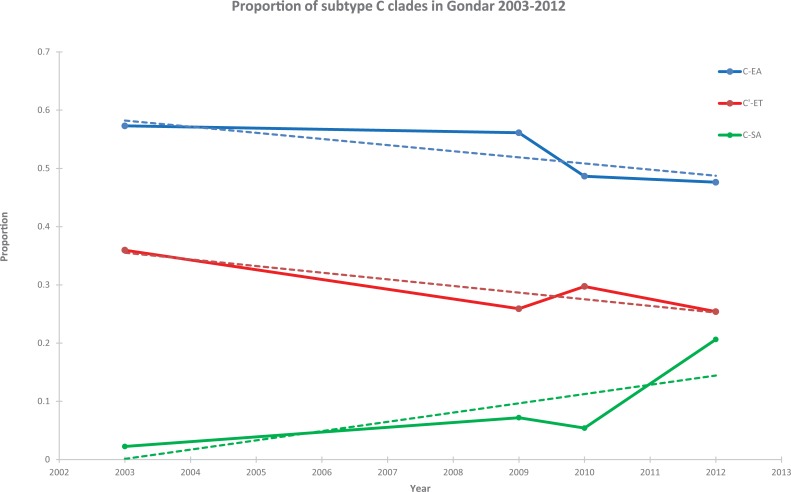
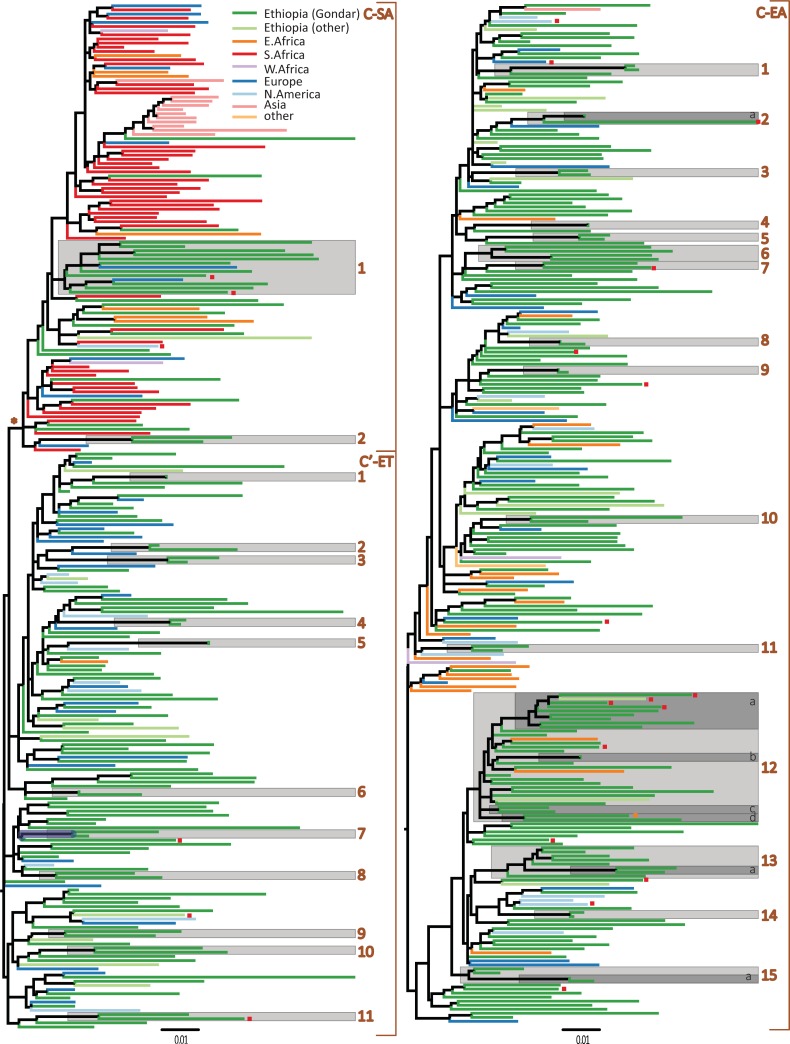
Four of 67 individuals (6.0%) carried a HIV drug resistance mutation strain, all associated with non-nucleoside reverse transcriptase inhibitors (NNRTI). Strains of the C-EA clade were most prevalent as we found no evidence of temporal changes during this time period. However, strains of the C-SA clade, prevalent in Southern Africa, have been introduced in Ethiopia, and became more abundant during the study period. The oldest Gondar transmission clusters dated back to 1980 (C-EA), 1983 (C-SA) and 1990 (C'-ET) indicating the presence of strains of different subtype C clades at about the same time point in Gondar. Moreover, some of the larger clusters dated back to the 1980s but transmissions within clusters have been ongoing up till end of the study period. Besides being associated with more sequences and larger clusters, the C-EA clade sequences were also associated with clustering of HIVDR sequences. One cluster was associated with the G190A mutation and showed onward transmissions at high rate.
TDR was detected in 6.0% of the sequenced samples and confirmed pervious reports that the two subtype C clades, C-EA and C'-ET, are common in Ethiopia. Moreover, the findings indicated an increased diversity in the epidemic as well as differences in transmission clusters sizes of the different clades and association with resistance mutations. These findings provide epidemiological insights not directly available using standard surveillance and may inform the adjustment of public health strategies in HIV prevention in Ethiopia.
埃塞俄比亚的 HIV-1 流行情况显示,其主要由两个在系统进化上截然不同的亚型 C 分支组成,即埃塞俄比亚(C'-ET)和东非(C-EA)分支,但对于亚型和不同分支的 HIV 流行的时间动态了解甚少。此外,关于该国 HIV-1 耐药性传播(TDR)的信息也很有限。
本研究于 2011 年至 2013 年在埃塞俄比亚贡德尔,对新诊断为 HIV 感染的年轻抗逆转录病毒治疗(ART)初治个体进行了横断面调查,采用世界卫生组织推荐的阈值调查方法。共纳入 84 名中位年龄为 22 岁的研究参与者。对 67 名个体进行 HIV-1 基因分型,并对所有获得的 HIV 序列(n=301)进行耐药性调查,以确定亚型 C 分支、时间趋势和本地传播群。使用 BEAST 对所有获得的 HIV 序列进行传播群的定年。
67 名个体中有 4 名(6.0%)携带 HIV 耐药性突变株,均与非核苷类逆转录酶抑制剂(NNRTI)相关。C-EA 分支的毒株最为常见,因为在此期间没有发现时间变化的证据。然而,在南部非洲流行的 C-SA 分支的毒株已传入埃塞俄比亚,并且在研究期间变得更加丰富。最古老的贡德尔传播群可追溯到 1980 年(C-EA)、1983 年(C-SA)和 1990 年(C'-ET),这表明不同的 C 亚型分支的毒株在贡德尔同时存在。此外,一些较大的集群可追溯到 20 世纪 80 年代,但集群内的传播一直持续到研究结束。除了与更多的序列和更大的集群有关外,C-EA 分支的序列也与 HIVDR 序列的聚类有关。一个集群与 G190A 突变有关,并以较高的速率继续传播。
在测序样本中检测到 6.0%的耐药性,证实了之前的报告,即两个亚型 C 分支 C-EA 和 C'-ET 在埃塞俄比亚很常见。此外,研究结果表明,该流行情况的多样性有所增加,不同分支的传播群大小以及与耐药性突变的差异也有所增加。这些发现提供了使用标准监测无法直接获得的流行病学见解,并可能为调整埃塞俄比亚 HIV 预防公共卫生策略提供信息。