Andrea Luke, Dicpinigaitis Peter V, Fazzari Melissa J, Kapoor Sumit
Division of Critical Care Medicine, Department of Medicine, Montefiore Medical Center, Albert Einstein College of Medicine, Bronx, NY.
Department of Epidemiology and Population Health, Albert Einstein College of Medicine, Bronx, NY.
Crit Care Explor. 2021 Aug 10;3(8):e0508. doi: 10.1097/CCE.0000000000000508. eCollection 2021 Aug.
Few studies have reported the complications and outcomes of patients with Legionella pneumonia requiring ICU admission. The objective of our study is to report the clinical course, complications, and 30-day mortality of patients with Legionella pneumonia admitted to the critical care units at our medical center over a 10-year period.
Retrospective observational study.
Tertiary care teaching hospital.
All adult (≥ 18 yr old) patients with Legionella pneumonia admitted to the ICUs from January 1, 2010, to December 31, 2019.
None.
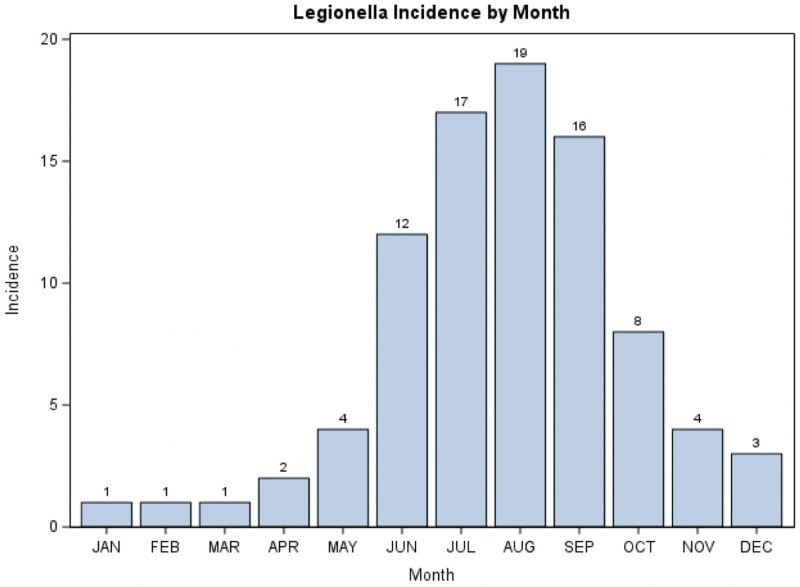
A total of 88 patients with Legionella pneumonia were admitted to ICUs over the 10-year period. The majority of infections ( = 80; 90.9%) were community acquired. The median (interquartile range) age of patients was 60 years (51.5-71.0 yr); 58 (66%) were male, and 41 (46.6%) identified their race as Black. The median (interquartile range) Sequential Organ Failure Assessment score at ICU admission was 6 (3-9). The distribution of infections showed seasonal dominance with most cases (86%) occurring in the summer to early fall (May to October). Invasive mechanical ventilation was required in 62 patients (70.5%), septic shock developed in 57 patients (64.8%), and acute respiratory distress syndrome developed in 42 patients (47.7%). A majority of patients developed acute kidney injury ( = 69; 78.4%), with 15 (21.7%) receiving only intermittent hemodialysis and 15 (21.7%) requiring continuous renal replacement therapy. Ten patients required venovenous extracorporeal membrane oxygenation support; eight (80%) survived and were successfully decannulated. Overall 30-day mortality was 26.1% ( = 23). Advanced age, higher Sequential Organ Failure Assessment score at admission, and not receiving Legionella-specific antimicrobial therapy within 24 hours of hospital admission were predictors of 30-day mortality.
Patients with Legionella pneumonia may require ICU admission and major organ support. Legionella-targeted antibiotics should be included in the empiric regimen for any patient with severe pneumonia. Outcomes of extracorporeal membrane oxygenation therapy in this population are encouraging.
很少有研究报告需要入住重症监护病房(ICU)的军团菌肺炎患者的并发症和预后情况。我们研究的目的是报告在10年期间入住我们医疗中心重症监护病房的军团菌肺炎患者的临床病程、并发症和30天死亡率。
回顾性观察研究。
三级护理教学医院。
2010年1月1日至2019年12月31日期间入住ICU的所有成年(≥18岁)军团菌肺炎患者。
无。
在这10年期间,共有88例军团菌肺炎患者入住ICU。大多数感染(n = 80;90.9%)为社区获得性。患者的年龄中位数(四分位间距)为60岁(51.5 - 71.0岁);58例(66%)为男性,41例(46.6%)将其种族确定为黑人。入住ICU时序贯器官衰竭评估(SOFA)评分的中位数(四分位间距)为6(3 - 9)。感染分布呈现季节性优势,大多数病例(86%)发生在夏季至初秋(5月至10月)。62例患者(70.5%)需要有创机械通气,57例患者(64.8%)发生感染性休克,42例患者(47.7%)发生急性呼吸窘迫综合征。大多数患者发生急性肾损伤(n = 69;78.4%),其中15例(21.7%)仅接受间歇性血液透析,15例(21.7%)需要持续肾脏替代治疗。10例患者需要静脉 - 静脉体外膜肺氧合支持;8例(80%)存活并成功拔管。总体30天死亡率为26.1%(n = 23)。高龄、入院时较高的序贯器官衰竭评估评分以及在入院24小时内未接受针对军团菌的抗菌治疗是30天死亡率的预测因素。
军团菌肺炎患者可能需要入住ICU并接受主要器官支持。对于任何重症肺炎患者,经验性治疗方案应包括针对军团菌的抗生素。该人群体外膜肺氧合治疗的结果令人鼓舞。