Okwuosa Tochi M, Ray Roberta M, Palomo Andres, Foraker Randi E, Johnson Lisa, Paskett Electra D, Caan Bette, Jones Lee W
Rush University Medical Center, Division of Cardiology, Department of Internal Medicine; Chicago, Illinois, USA.
Division of Public Health Sciences, Fred Hutchinson Cancer Research Center, Seattle, Washington, USA.
JACC CardioOncol. 2019 Sep 24;1(1):41-50. doi: 10.1016/j.jaccao.2019.08.014. eCollection 2019 Sep.
The purpose of this study was to investigate whether pre-diagnosis exercise reduces the risk of subsequent cardiovascular events (CVEs) in women with primary breast cancer.
Cardiovascular disease (CVD) is the leading nonmalignant cause of death in patients with cancer, and it is the leading cause of death in women with primary breast cancer who are older than 65 years of age.
Using a prospective design, 4,015 patients with confirmed diagnosis of primary breast cancer enrolled in the Women's Health Initiative (WHI) completed a self-report questionnaire assessing leisure-time physical activity (i.e., exercise) in metabolic equivalent task (MET) hours per week. Age- and multivariable-adjusted Cox proportional hazards models were used to estimate associations between pre-diagnosis exercise and new-onset CVEs (i.e., heart failure [HF], myocardial infarction [MI], angina, coronary revascularization, peripheral arterial disease [PAD], carotid artery disease, transient ischemic attack [TIA], stroke, and cardiovascular death).
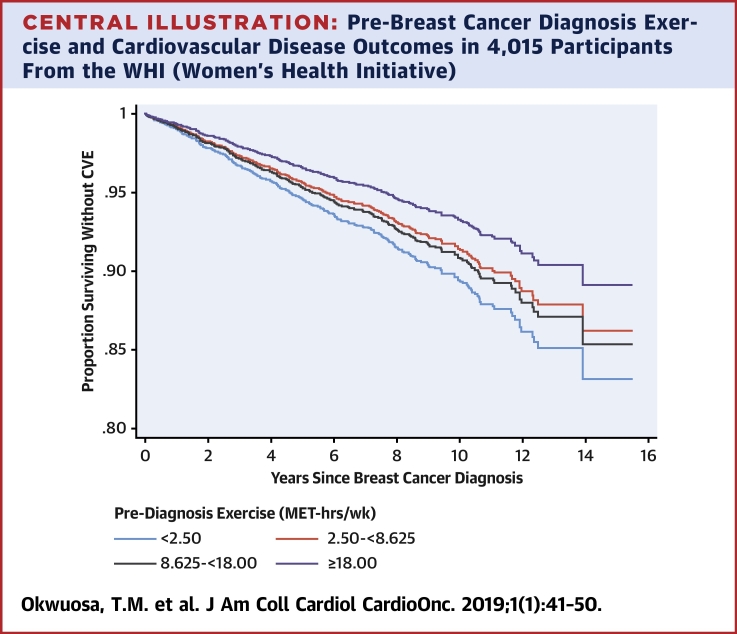
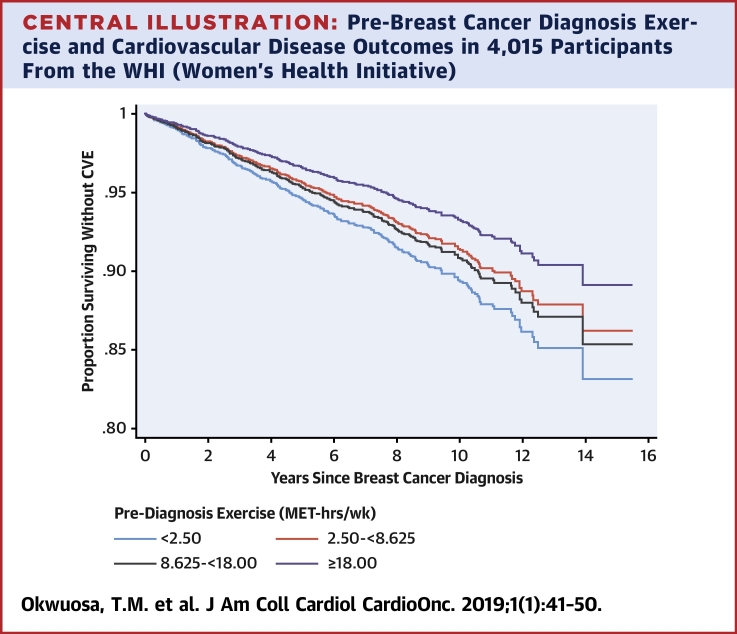
Median follow-up was 12.7 years and 8.2 years for cardiovascular disease (CVD) mortality and CVEs, respectively, with 324 CVEs, including 89 MIs, 49 new diagnoses of HF, and 215 CVD deaths. In multivariable analysis, the incidence of composite CVEs decreased across increasing total MET h/week categories (p = 0.016). Compared with <2.5 MET-hours per week, the adjusted hazard ratio (HR) was 0.80 (95% confidence interval [CI]: 0.59 to 1.09) for 2.5 to <8.6 MET h/week; 0.9 (95% CI: 0.64 to 1.17) for 8.6 to <18 MET h/week; and 0.63 (95% CI: 0.45 to 0.88) for ≥18 MET h/week.
Pre-diagnosis exercise exposure is associated with a significant graded reduction in subsequent CVEs in long-term survivors of primary breast cancer.
本研究旨在调查诊断前进行运动是否能降低原发性乳腺癌女性随后发生心血管事件(CVE)的风险。
心血管疾病(CVD)是癌症患者非恶性死亡的主要原因,也是65岁以上原发性乳腺癌女性的主要死因。
采用前瞻性设计,4015名确诊为原发性乳腺癌且参加了女性健康倡议(WHI)的患者完成了一份自我报告问卷,评估每周以代谢当量任务(MET)小时为单位的休闲时间身体活动(即运动)情况。使用年龄和多变量调整的Cox比例风险模型来估计诊断前运动与新发CVE(即心力衰竭[HF]、心肌梗死[MI]、心绞痛、冠状动脉血运重建、外周动脉疾病[PAD]、颈动脉疾病、短暂性脑缺血发作[TIA]、中风和心血管死亡)之间的关联。
心血管疾病(CVD)死亡率和CVE的中位随访时间分别为12.7年和8.2年,有324例CVE,包括89例MI、49例新诊断的HF和215例CVD死亡。在多变量分析中,复合CVE的发生率随着每周总MET小时数类别的增加而降低(p = 0.016)。与每周<2.5 MET小时相比,每周2.5至<8.6 MET小时的调整后风险比(HR)为0.80(95%置信区间[CI]:0.59至1.09);每周8.6至<18 MET小时为0.9(95%CI:0.64至1.17);每周≥18 MET小时为0.63(95%CI:0.45至0.88)。
诊断前运动暴露与原发性乳腺癌长期幸存者随后发生的CVE显著分级降低有关。