Department of Epidemiology, Colorado School of Public Health, University of Colorado Denver, Aurora, 80045, USA.
Breast Cancer Res. 2011 Jun 20;13(3):R64. doi: 10.1186/bcr2901.
Many women who survive breast cancer die of causes unrelated to their cancer diagnosis. This study was undertaken to assess factors that are related to breast cancer mortality versus mortality from other causes and to describe the leading causes of death among older women diagnosed with breast cancer.
Women diagnosed with breast cancer at age 66 or older between 1992 and 2000 were identified in the Surveillance, Epidemiology and End Results-Medicare linked database and followed through the end of 2005.
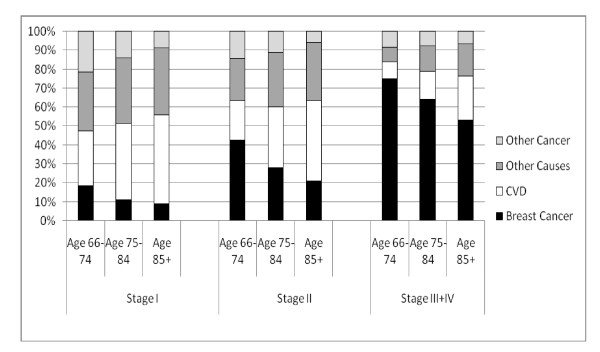
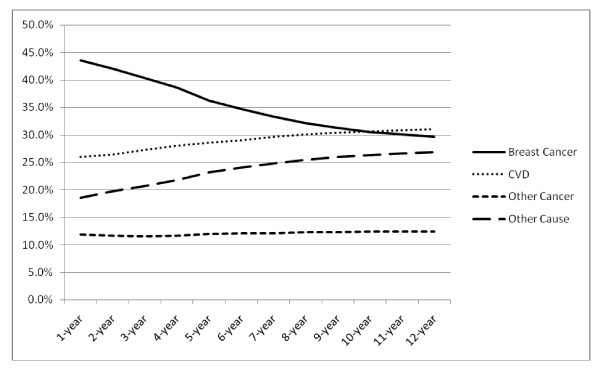
A total of 63,566 women diagnosed with breast cancer met the inclusion criteria and were followed for a median of approximately nine years. Almost one-half (48.7%) were alive at the end of follow-up. Ages and comorbidities at the time of diagnosis had the largest effects on mortality from other causes, while tumor stage, tumor grade, estrogen receptor status, age and comorbidities at the time of diagnosis all had effects on breast cancer-specific mortality. Fully adjusted relative hazards of the effects of comorbidities on breast cancer-specific mortality were 1.24 (95% confidence interval (95% CI) 1.13 to 1.26) for cardiovascular disease, 1.13 (95% CI 1.13 to 1.26) for previous cancer, 1.13 (95% CI 1.05 to 1.22) for chronic obstructive pulmonary disease and 1.10 (95% CI 1.03 to 1.16) for diabetes. Among the total study population, cardiovascular disease was the primary cause of death in the study population (15.9% (95% CI 15.6 to 16.2)), followed closely by breast cancer (15.1% (95% CI 14.8 to 15.4)).
Comorbid conditions contribute importantly to both total mortality and breast cancer-specific mortality among breast cancer survivors. Attention to reducing the risk of cardiovascular disease should be a priority for the long-term care of women following the diagnosis and treatment of breast cancer.
许多乳腺癌幸存者死于与癌症诊断无关的原因。本研究旨在评估与乳腺癌死亡率相关的因素与其他原因死亡率,并描述诊断为乳腺癌的老年女性的主要死亡原因。
在监测、流行病学和最终结果-医疗保险数据库中确定了 1992 年至 2000 年间诊断为年龄在 66 岁及以上的乳腺癌女性,并随访至 2005 年底。
共有 63566 名符合纳入标准的乳腺癌患者被纳入研究,并进行了大约九年的中位随访。随访结束时,近一半(48.7%)患者仍然存活。诊断时的年龄和合并症对其他原因导致的死亡率影响最大,而肿瘤分期、肿瘤分级、雌激素受体状态、诊断时的年龄和合并症均对乳腺癌特异性死亡率有影响。合并症对乳腺癌特异性死亡率的完全调整相对危险度为:心血管疾病 1.24(95%置信区间(95%CI)为 1.13 至 1.26),既往癌症为 1.13(95%CI 为 1.13 至 1.26),慢性阻塞性肺疾病为 1.13(95%CI 为 1.05 至 1.22),糖尿病为 1.10(95%CI 为 1.03 至 1.16)。在总研究人群中,心血管疾病是研究人群的主要死亡原因(15.9%(95%CI 为 15.6%至 16.2%)),其次是乳腺癌(15.1%(95%CI 为 14.8%至 15.4%))。
合并症对乳腺癌幸存者的总死亡率和乳腺癌特异性死亡率都有重要影响。在乳腺癌诊断和治疗后,应优先关注降低心血管疾病风险,以作为女性长期护理的重点。