Department of Biomedical Science and Engineering, Gwangju Institute of Science and Technology, Gwangju.
Division of Biomedical Informatics, Seoul National University College of Medicine.
Medicine (Baltimore). 2021 Jul 30;100(30):e26670. doi: 10.1097/MD.0000000000026670.
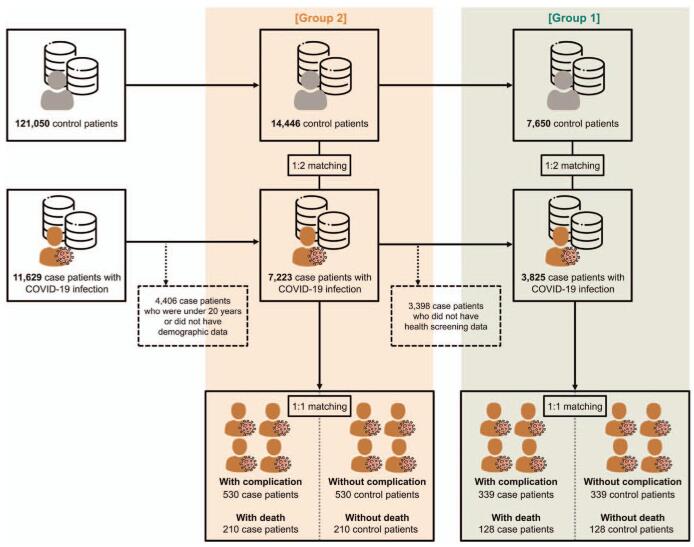
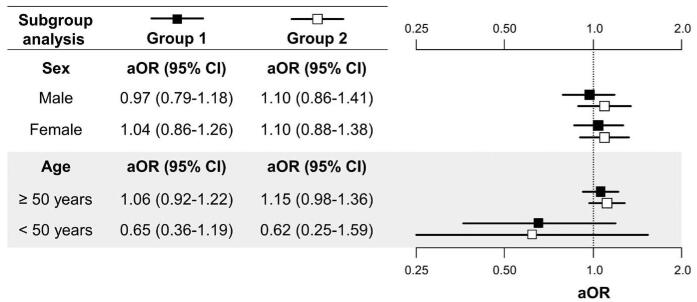
Several studies reported that aspirin can potentially help prevent infection and serious complications of coronavirus disease (COVID-19), but no study has elucidated a definitive association between aspirin and COVID-19. This study aims to investigate the association between aspirin and COVID-19.This case-control study used demographic, clinical, and health screening laboratory test data collected from the National Health Insurance Service database. Patients who tested positive for severe acute respiratory syndrome coronavirus 2 (SARS-CoV-2) infection until June 4, 2020, were matched with control patients using propensity score matching according to their SARS-CoV-2 status, the composite of complications, and death. The composite of complications included intensive care unit admission, use of vasopressors, high-flow oxygen therapy, renal replacement therapy, extracorporeal membrane oxygenation, and death. Exposure to aspirin was defined as having a prescription for aspirin for more than 14 days, including the index date. After matching, multivariable-adjusted conditional logistic regression analysis was performed. To confirm the robustness of this study, we used 2 study groups, 3 propensity score matching methods, and 3 models for conditional logistic regression analyses.The crude odds ratio and 95% confidence interval for SARS-CoV-2 infection between the groups without and with exposure to aspirin were 1.21 (1.04-1.41), but the adjusted odds ratios (95% confidence interval) were not significant. There was no association between aspirin exposure and COVID-19 status. Multiple statistical analyses, including subgroup analysis, revealed consistent results. Furthermore, the results of analysis for complications and death were not significant. Aspirin exposure was not associated with COVID-19-related complications and mortality in COVID-19 patients.In this nationwide population-based case-control study, aspirin use was not associated with SARS-CoV-2 infection or related complications. With several ongoing randomized controlled trials of aspirin in COVID-19 patients, more studies would be able to confirm the effectiveness of aspirin in COVID-19.
几项研究报告称,阿司匹林可能有助于预防冠状病毒病(COVID-19)感染和严重并发症,但没有研究阐明阿司匹林与 COVID-19 之间的明确关联。本研究旨在探讨阿司匹林与 COVID-19 之间的关联。这项病例对照研究使用了从国家健康保险服务数据库中收集的人口统计学、临床和健康筛查实验室测试数据。直到 2020 年 6 月 4 日,对严重急性呼吸综合征冠状病毒 2(SARS-CoV-2)感染检测呈阳性的患者,根据 SARS-CoV-2 状态、并发症综合情况和死亡情况,与对照患者进行倾向评分匹配。并发症综合情况包括入住重症监护病房、使用升压药、高流量氧疗、肾脏替代治疗、体外膜氧合和死亡。阿司匹林暴露定义为在索引日期之前有超过 14 天的阿司匹林处方。匹配后,进行多变量调整条件逻辑回归分析。为了确认本研究的稳健性,我们使用了 2 个研究组、3 种倾向评分匹配方法和 3 种条件逻辑回归分析模型。未暴露于阿司匹林组和暴露于阿司匹林组 SARS-CoV-2 感染的粗比值比(95%置信区间)为 1.21(1.04-1.41),但调整后的比值比(95%置信区间)不显著。阿司匹林暴露与 COVID-19 状态之间没有关联。包括亚组分析在内的多项统计分析得出了一致的结果。此外,并发症和死亡分析的结果也不显著。阿司匹林暴露与 COVID-19 患者的 COVID-19 相关并发症和死亡率无关。在这项基于全国人口的病例对照研究中,阿司匹林的使用与 SARS-CoV-2 感染或相关并发症无关。随着几项针对 COVID-19 患者的阿司匹林随机对照试验的进行,更多的研究将能够证实阿司匹林在 COVID-19 中的有效性。