Department of Data Science, Sejong University College of Software Convergence, Seoul, South Korea.
Department of Otorhinolaryngology-Head and Neck Surgery, CHA Bundang Medical Center, CHA University School of Medicine, Seongnam, South Korea.
J Allergy Clin Immunol Pract. 2021 Jun;9(6):2262-2271.e2. doi: 10.1016/j.jaip.2021.03.044. Epub 2021 Apr 28.
Basic studies suggest that severe acute respiratory syndrome coronavirus 2 (SARS-CoV-2) infection can affect chronic rhinosinusitis (CRS), but there is unclear real-world evidence regarding the association of underlying CRS with the risk for SARS-CoV-2 infection and severe coronavirus disease 19 (COVID-19).
We aimed to determine whether CRS is associated with increased risk for SARS-CoV-2 infection and severe COVID-19.
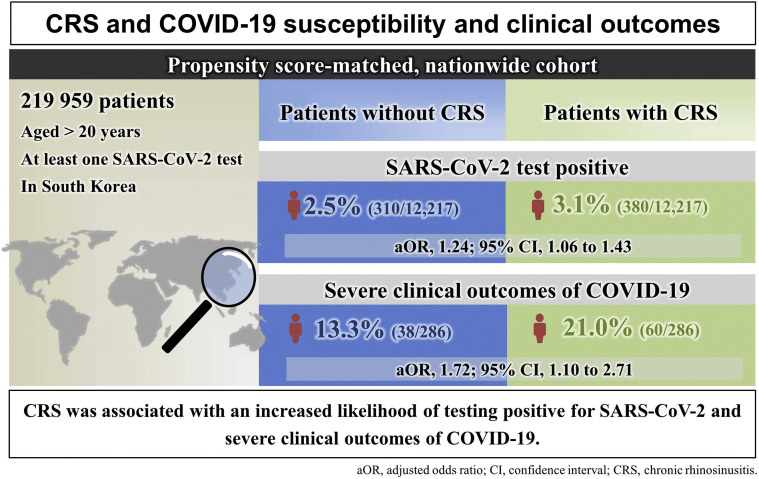
Altogether, 219,959 adult patients who tested for SARS-CoV-2 in South Korea from January 1 to May 15, 2020 (excluding self-referral) were identified in this nested case-control study with propensity score matching. Data on SARS-CoV-2 test results and COVID-19 worsened outcomes (ie, the need for oxygen therapy, intensive care, or mechanical ventilation, and death) were obtained from the Health Insurance Review and Assessment Service of Korea.
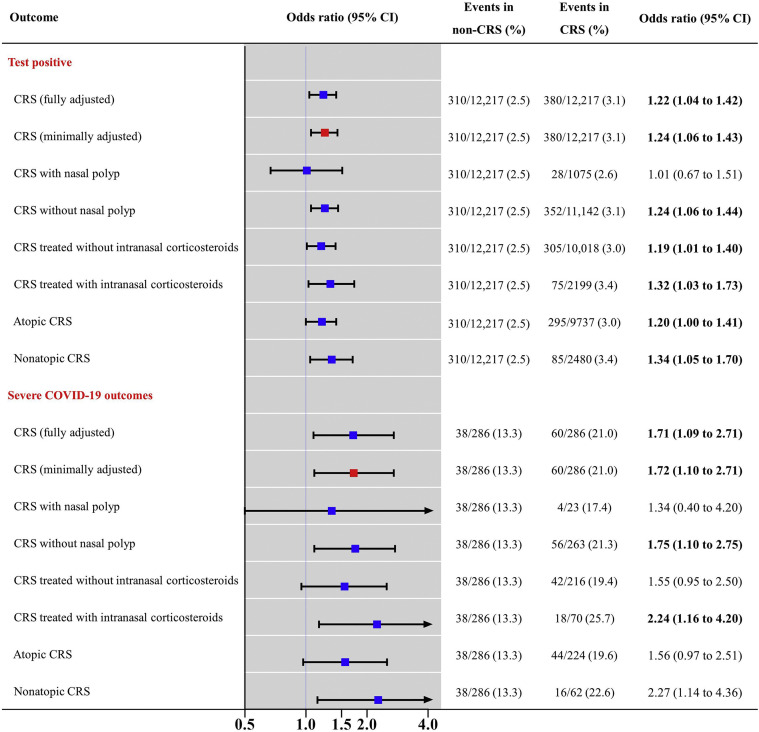
In this matched cohort, 380 of 12,217 patients with CRS (3.1%) tested positive for SARS-CoV-2 infection, compared with 310 patients without CRS (2.5%; adjusted odds ratio = 1.22; 95% confidence interval, 1.04-1.42). Moreover, 60 of 286 COVID-19 patients with CRS (21.0%) had severe COVID-19 outcomes, compared with 38 without CRS (13.3%; adjusted odds ratio = 1.71; 95% confidence interval, 1.09-2.71). Subgroup analysis identified that CRS patients with an absence of nasal polyps, prior intranasal corticosteroid use, or nonatopic type had a greater risk for SARS-CoV-2 infection and severe COVID-19 outcomes.
In patients with CRS, prior intranasal corticosteroid use, the absence of nasal polyps, or nonatopic type was associated with increased risk for SARS-CoV-2 infection and severe COVID-19 in the Korean nationwide cohort. Clinicians should be cautious in determining prognosis and care for patients with CRS amid the COVID-19 pandemic.
基础研究表明,严重急性呼吸综合征冠状病毒 2(SARS-CoV-2)感染可能会影响慢性鼻-鼻窦炎(CRS),但目前尚不清楚 CRS 与 SARS-CoV-2 感染和严重的 2019 冠状病毒病(COVID-19)之间关联的真实世界证据。
我们旨在确定 CRS 是否与 SARS-CoV-2 感染和严重 COVID-19 风险增加有关。
本研究采用倾向评分匹配的嵌套病例对照研究,共纳入 2020 年 1 月 1 日至 5 月 15 日期间在韩国接受 SARS-CoV-2 检测的 219959 例成年患者(不包括自行转诊)。从韩国健康保险审查与评估服务处获得 SARS-CoV-2 检测结果和 COVID-19 恶化结局(即需要氧疗、重症监护或机械通气以及死亡)的数据。
在该匹配队列中,12217 例 CRS 患者中有 380 例(3.1%)SARS-CoV-2 检测呈阳性,而 286 例无 CRS 患者中有 310 例(2.5%)(调整后的优势比=1.22;95%置信区间,1.04-1.42)。此外,60 例 CRS 合并 COVID-19 患者(21.0%)出现严重 COVID-19 结局,而 38 例无 CRS 合并 COVID-19 患者(13.3%)(调整后的优势比=1.71;95%置信区间,1.09-2.71)。亚组分析发现,无鼻息肉、既往鼻内皮质类固醇使用或非特应性类型的 CRS 患者 SARS-CoV-2 感染和严重 COVID-19 结局的风险更高。
在 CRS 患者中,既往鼻内皮质类固醇使用、无鼻息肉或非特应性类型与韩国全国队列中 SARS-CoV-2 感染和严重 COVID-19 的风险增加相关。在 COVID-19 大流行期间,临床医生在确定预后和护理 CRS 患者时应谨慎。