School of Chemistry, University of Birmingham, Birmingham B15 2TT, United Kingdom.
School of Biosciences, University of Birmingham, Birmingham B15 2TT, United Kingdom.
Proc Natl Acad Sci U S A. 2021 Aug 31;118(35). doi: 10.1073/pnas.2100347118.
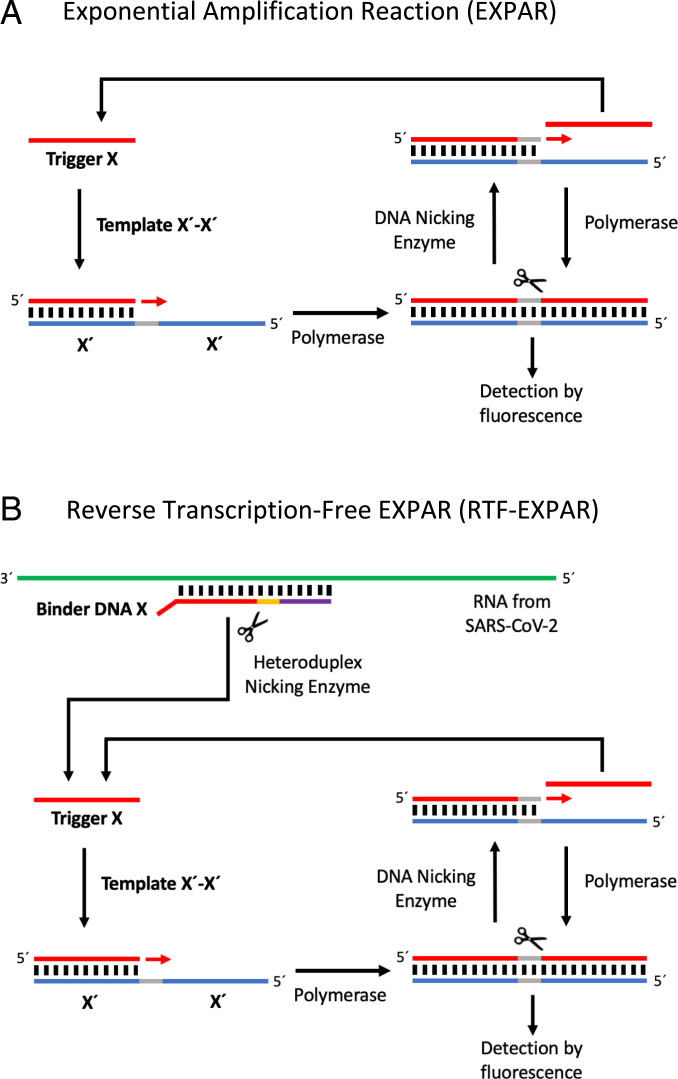
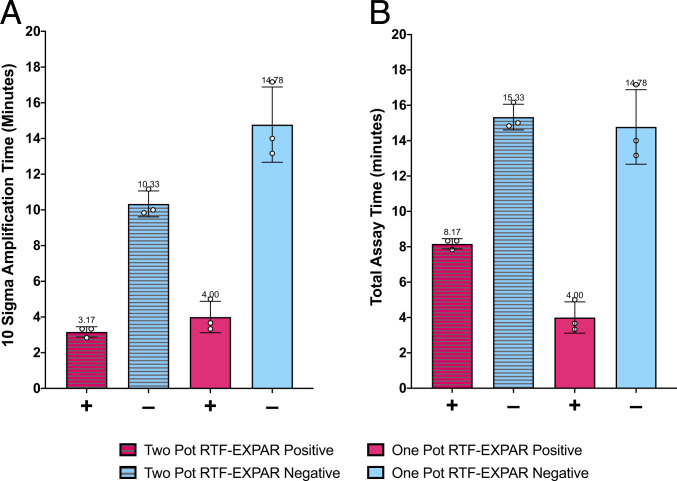
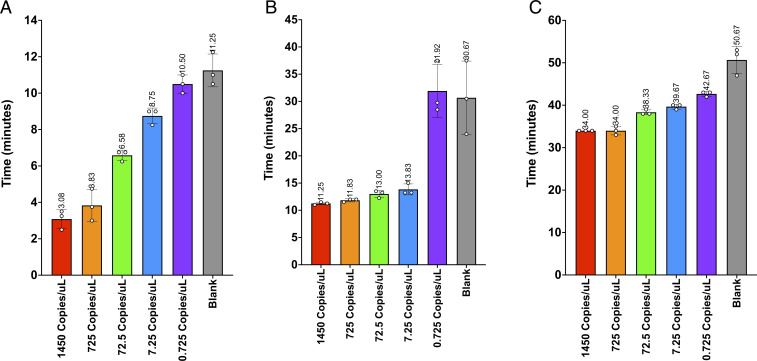
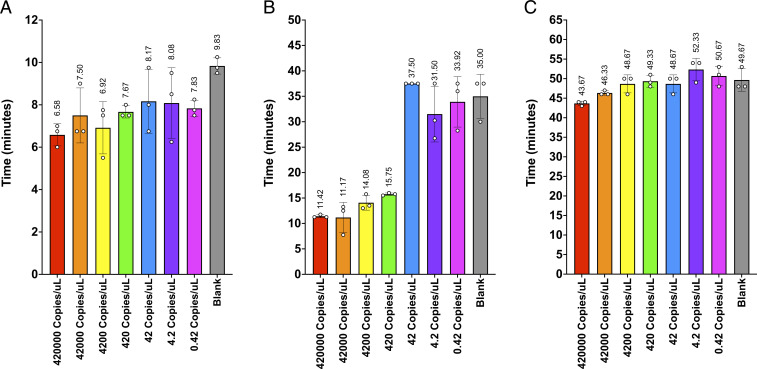
A rapid isothermal method for detecting severe acute respiratory syndrome coronavirus 2 (SARS-CoV-2), the virus responsible for COVID-19, is reported. The procedure uses an unprecedented reverse transcription-free (RTF) approach for converting genomic RNA into DNA. This involves the formation of an RNA/DNA heteroduplex whose selective cleavage generates a short DNA trigger strand, which is then rapidly amplified using the exponential amplification reaction (EXPAR). Deploying the RNA-to-DNA conversion and amplification stages of the RTF-EXPAR assay in a single step results in the detection, via a fluorescence read-out, of single figure copy numbers per microliter of SARS-CoV-2 RNA in under 10 min. In direct three-way comparison studies, the assay has been found to be faster than both RT-qPCR and reverse transcription loop-mediated isothermal amplification (RT-LAMP), while being just as sensitive. The assay protocol involves the use of standard laboratory equipment and is readily adaptable for the detection of other RNA-based pathogens.
一种用于检测引发 COVID-19 的严重急性呼吸综合征冠状病毒 2(SARS-CoV-2)的快速等温检测方法已被报道。该方法采用了一种前所未有的无逆转录(RT)方法,将基因组 RNA 转化为 DNA。这涉及到 RNA/DNA 异源双链体的形成,其选择性切割产生短的 DNA 触发链,然后使用指数扩增反应(EXPAR)快速扩增。在单个步骤中部署 RTF-EXPAR 测定的 RNA 到 DNA 转换和扩增阶段,通过荧光读取,可以在不到 10 分钟的时间内检测到每微升 SARS-CoV-2 RNA 的单个数字拷贝数。在直接的三方比较研究中,该测定法比 RT-qPCR 和逆转录环介导等温扩增(RT-LAMP)都更快,同时也具有相同的灵敏度。该测定法方案涉及使用标准实验室设备,并且易于适应其他基于 RNA 的病原体的检测。