Department of Pharmacy, The Second Xiangya Hospital, Central South University, Changsha, 410011, Hunan, China.
Institute of Clinical Pharmacy, Central South University, Changsha, 410011, Hunan, China.
Int J Med Sci. 2021 Jun 16;18(14):3059-3065. doi: 10.7150/ijms.61153. eCollection 2021.
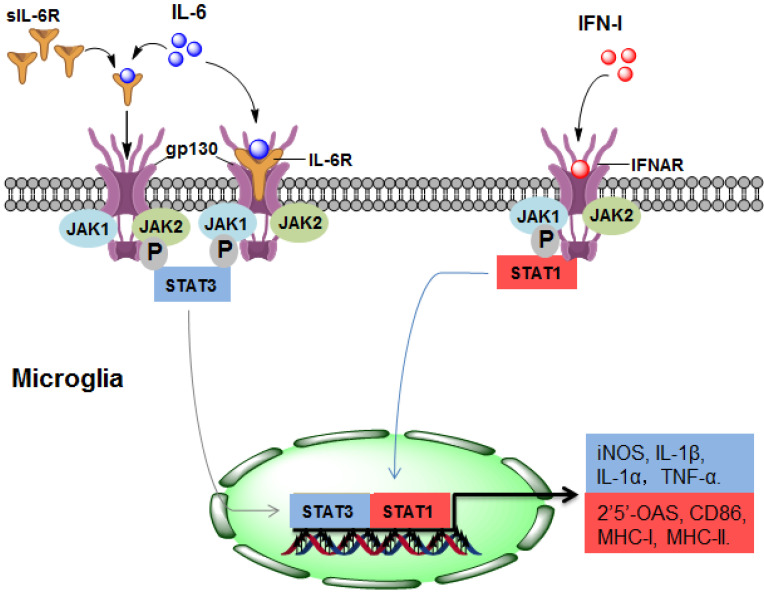
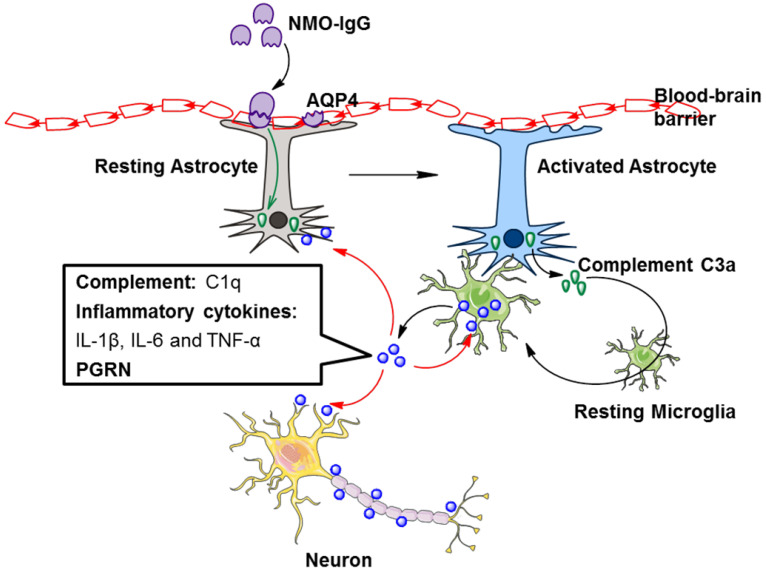
Neuromyelitis optica spectrum disorder (NMOSD) is an autoimmune neurological disease that can cause blindness and disability. As the major mediators in the central nervous system, microglia plays key roles in immunological regulation in neuroinflammatory diseases, including NMOSD. Microglia can be activated by interleukin (IL)-6 and type I interferons (IFN-Is) during NMOSD, leading to signal transducer and activator of transcription (STAT) activation. Moreover, complement C3a secreted from activated astrocytes may induce the secretion of complement C1q, inflammatory cytokines and progranulin (PGRN) by microglia, facilitating injury to microglia, neurons, astrocytes and oligodendrocytes in an autocrine or paracrine manner. These processes involving activated microglia ultimately promote the pathological course of NMOSD. In this review, recent research progress on the roles of microglia in NMOSD pathogenesis is summarized, and the mechanisms of microglial activation and microglial-mediated inflammation, and the potential research prospects associated with microglial activation are also discussed.
视神经脊髓炎谱系疾病(NMOSD)是一种自身免疫性神经系统疾病,可导致失明和残疾。小胶质细胞作为中枢神经系统的主要介质,在包括 NMOSD 在内的神经炎症性疾病的免疫调节中发挥关键作用。在 NMOSD 期间,小胶质细胞可被白细胞介素(IL)-6 和 I 型干扰素(IFN-Is)激活,导致信号转导和转录激活因子(STAT)激活。此外,活化星形胶质细胞分泌的补体 C3a 可能诱导小胶质细胞分泌补体 C1q、炎性细胞因子和颗粒蛋白(PGRN),以自分泌或旁分泌方式促进小胶质细胞、神经元、星形胶质细胞和少突胶质细胞损伤。这些涉及活化小胶质细胞的过程最终促进 NMOSD 的病理过程。本文总结了小胶质细胞在 NMOSD 发病机制中的作用的最新研究进展,并讨论了小胶质细胞活化的机制以及小胶质细胞介导的炎症,以及与小胶质细胞活化相关的潜在研究前景。