Karimianpour Ahmadreza, John Leah, Gold Michael R
Division of Cardiology, Department of Medicine, Medical University of South Carolina, Charleston, SC, US.
Arrhythm Electrophysiol Rev. 2021 Jul;10(2):108-112. doi: 10.15420/aer.2020.47.
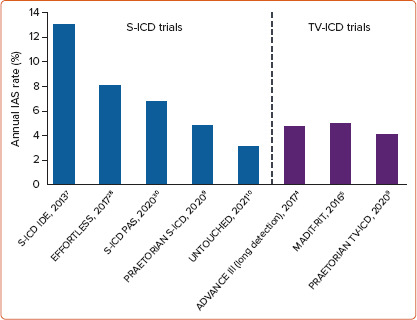
The ICD is an important part of the treatment and prevention of sudden cardiac death in many high-risk populations. Traditional transvenous ICDs (TV-ICDs) are associated with certain short- and long- term risks. The subcutaneous ICD (S-ICD) was developed in order to avoid these risks and complications. However, this system is associated with its own set of limitations and complications. First, patient selection is important, as S-ICDs do not provide pacing therapy currently. Second, pre-procedural screening is important to minimise T wave and myopotential oversensing. Finally, until recently, the S-ICD was primarily used in younger patients with fewer co-morbidities and less structural heart disease, limiting the general applicability of the device. S-ICDs achieve excellent rates of arrhythmia conversion and have demonstrated noninferiority to TV-ICDs in terms of complication rates in real-world studies. The objective of this review is to discuss the latest literature, including the UNTOUCHED and PRAETORIAN trials, and to address the risk of inappropriate shocks.
植入式心律转复除颤器(ICD)是许多高危人群心脏性猝死治疗和预防的重要组成部分。传统的经静脉ICD(TV-ICD)存在一定的短期和长期风险。皮下ICD(S-ICD)的研发旨在避免这些风险和并发症。然而,该系统也有其自身的一系列局限性和并发症。首先,患者选择很重要,因为目前S-ICD不提供起搏治疗。其次,术前筛查对于最大限度减少T波和肌电位过度感知很重要。最后,直到最近,S-ICD主要用于合并症较少且结构性心脏病较少的年轻患者,这限制了该设备的普遍适用性。在实际研究中,S-ICD实现了优异的心律失常转复率,并且在并发症发生率方面已证明不劣于TV-ICD。本综述的目的是讨论最新文献,包括UNTOUCHED和PRAETORIAN试验,并探讨不适当电击的风险。