Konno Yuki, Sasaki Shingo, Ishida Yuji, Toyama Yuichi, Nishizaki Kimitaka, Kinjo Takahiko, Itoh Taihei, Kimura Masaomi, Kato Kazufumi, Iwasaki Toshihiro, Umezaki Hitoshi, Hirosawa Shun, Tomita Hirofumi
Department of Cardiology and Nephrology Hirosaki University Graduate School of Medicine Hirosaki Japan.
Department of Cardiac Remote Management System Hirosaki University Graduate School of Medicine Hirosaki Japan.
J Arrhythm. 2025 Apr 11;41(2):e70063. doi: 10.1002/joa3.70063. eCollection 2025 Apr.
Subcutaneous implantable cardioverter-defibrillator (S-ICD) has been reported to be non-inferior to transvenous ICD (TV-ICD) in terms of device-related complications and inappropriate shock (IAS). We aimed to evaluate the long-term clinical outcomes of S-ICD compared with TV-ICD in Japanese patients.
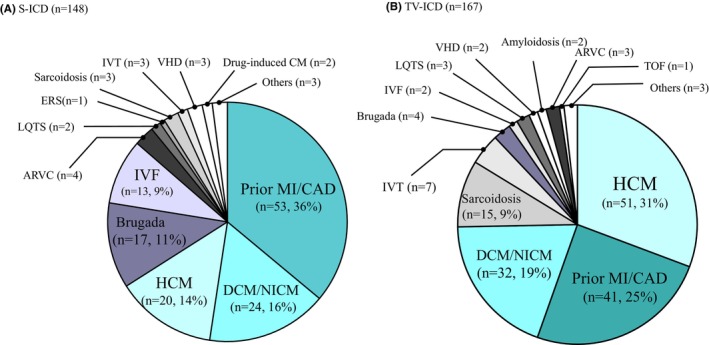
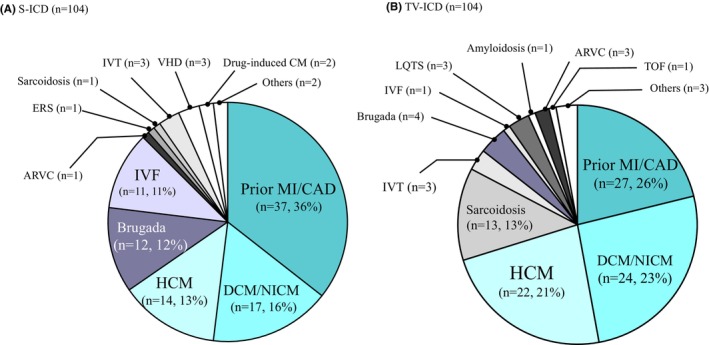
We studied 315 consecutive patients (TV-ICD, 167; S-ICD, 148) who underwent ICD implantation. A propensity score matching analysis was performed to select patient subgroups for comparison (104 patients in each group). Clinical outcomes, including appropriate and inappropriate ICD therapy, procedure- and lead-related complications, and mortality, were compared between the two groups.
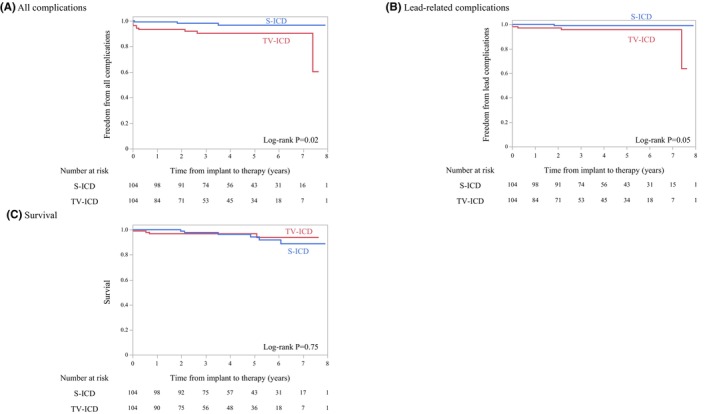
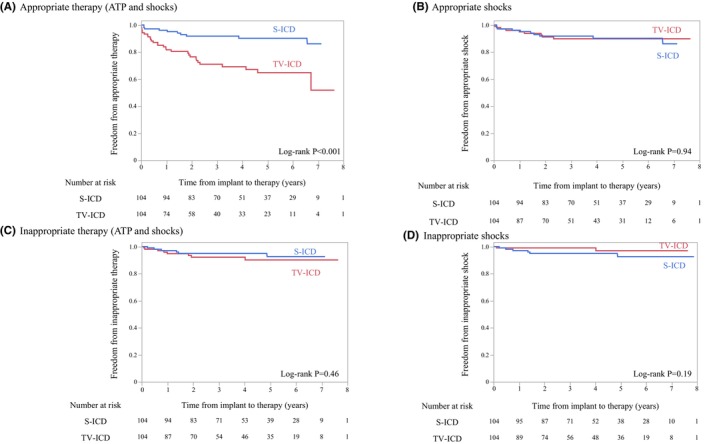
During follow-up (median, 1458 [interquartile range, 1353-1572] days), the cumulative incidence of appropriate shock therapy was 9.6% and 8.7% in the S-ICD and TV-ICD groups, respectively ( = 0.94). Although the S-ICD group tended to have a higher IAS than the TV-ICD group (5.8% vs. 1.9%), the difference was not significant ( = 0.19). Conversely, the cumulative incidence of procedural and lead-related complications was significantly lower in the S-ICD group (2.9% vs. 9.6%, = 0.02). Notably, lead-related complications were more common in the TV-ICD group ( = 0.05). There was no difference in all-cause mortality between the two groups ( = 0.75), and heart failure exacerbation was the most common cause of death in both groups.
In propensity score-matched Japanese patients with S-ICD, the cumulative incidence of appropriate shock and mortality was comparable to those with TV-ICD. There was no significant difference in the rate of IAS. Notably, patients with S-ICD had fewer lead-related complications than those with TV-ICD.
据报道,皮下植入式心律转复除颤器(S-ICD)在与设备相关的并发症和不适当电击(IAS)方面不劣于经静脉植入式心律转复除颤器(TV-ICD)。我们旨在评估日本患者中S-ICD与TV-ICD相比的长期临床结局。
我们研究了315例连续接受植入式心律转复除颤器(ICD)植入的患者(TV-ICD组167例,S-ICD组148例)。进行倾向评分匹配分析以选择用于比较的患者亚组(每组104例患者)。比较两组的临床结局,包括适当和不适当的ICD治疗、与手术和导线相关的并发症以及死亡率。
在随访期间(中位数为1458[四分位间距为l353 - 1572]天),S-ICD组和TV-ICD组适当电击治疗的累积发生率分别为9.6%和8.7%(P = 0.94)。虽然S-ICD组的IAS发生率往往高于TV-ICD组(5.8%对1.9%),但差异无统计学意义(P = 0.19)。相反,S-ICD组与手术和导线相关的并发症累积发生率显著更低(2.9%对9.6%,P = 0.02)。值得注意的是,与导线相关的并发症在TV-ICD组更常见(P = 0.05)。两组的全因死亡率无差异(P = 0.75)心力衰竭加重是两组最常见的死亡原因。
在倾向评分匹配的日本S-ICD患者中,适当电击的累积发生率和死亡率与TV-ICD患者相当。IAS发生率无显著差异。值得注意的是,S-ICD患者与导线相关的并发症比TV-ICD患者少。