Hebert Kevin J, Linder Brian J, Morrisson Griffin T, Latuche Laureano Rangel, Elliott Daniel S
Department of Urology, Mayo Clinic, Rochester, MN, USA.
Department of Health Sciences Research, Mayo Clinic, Rochester, MN, USA.
Asian J Urol. 2021 Jul;8(3):298-302. doi: 10.1016/j.ajur.2021.03.003. Epub 2021 Mar 13.
The artificial urinary sphincter (AUS) is the gold standard for severe male stress urinary incontinence, though evaluations of specific predictors for device outcomes are sparse. We sought to compare outcomes between primary and revision AUS surgery for non-infectious failures.
We identified 2045 consecutive AUS surgeries at Mayo Clinic (Rochester, MN, USA) from 1983 to 2013. Of these, 1079 were primary AUS implantations and 281 were initial revision surgeries, which comprised our study group. Device survival rates, including overall and specific rates for device infection/erosion, urethral atrophy and mechanical failure, were compared between primary AUS placements versus revision surgeries. Patient follow-up was obtained through office examination, written correspondence, or telephone correspondence.
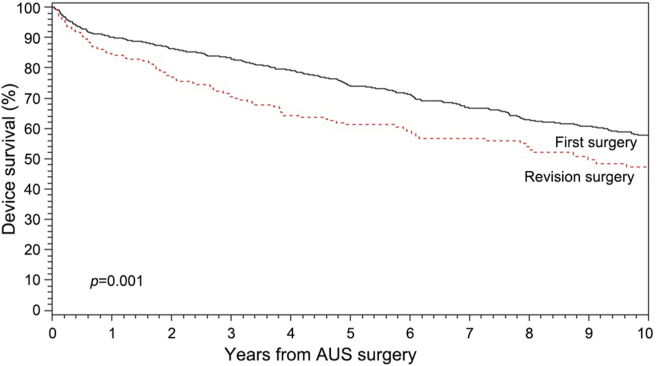
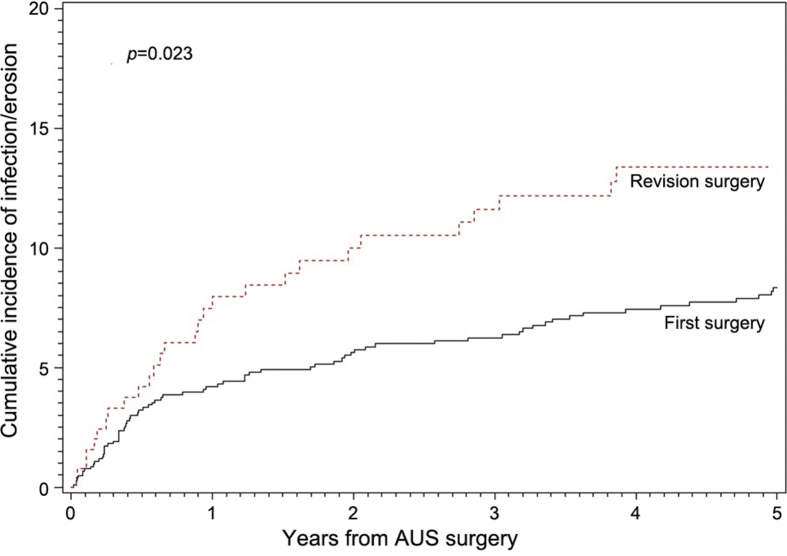
During the study period, 1079 (79.3%) patients had a primary AUS placement and 281 (20.7%) patients underwent a first revision surgery for mechanical failure or urethral atrophy. Patients undergoing revision surgery were found to have adverse 1- and 5-year AUS device survival on Kaplan-Meier analysis, 90% 85% and 74% 61%, respectively (<0.001). Specifically, revision surgery was associated with a significantly increased cumulative incidence of explantation for device infection/urethral erosion (4.2% 7.5% at 1 year; =0.02), with similar rates of repeat surgery for mechanical failure (=0.43) and urethral atrophy (=0.77).
Our findings suggest a significantly higher rate of overall device failure following revision AUS surgery, which is likely secondary to an increased rate of infection/urethral erosion events.
人工尿道括约肌(AUS)是重度男性压力性尿失禁的金标准,不过针对该装置预后的特定预测因素的评估却很少。我们试图比较初次和翻修AUS手术治疗非感染性失败的预后。
我们确定了1983年至2013年在美国明尼苏达州罗切斯特市梅奥诊所连续进行的2045例AUS手术。其中,1079例为初次AUS植入术,281例为初次翻修手术,这些构成了我们的研究组。比较了初次AUS植入与翻修手术之间的装置生存率,包括装置感染/侵蚀、尿道萎缩和机械故障的总体及特定发生率。通过门诊检查、书面通信或电话通信对患者进行随访。
在研究期间,1079例(79.3%)患者接受了初次AUS植入,281例(20.7%)患者因机械故障或尿道萎缩接受了首次翻修手术。经Kaplan-Meier分析,接受翻修手术的患者1年和5年的AUS装置生存率较差,分别为90%对85%和74%对61%(<0.001)。具体而言,翻修手术与装置感染/尿道侵蚀导致的取出累积发生率显著增加相关(1年时为4.2%对7.5%;P=0.02),机械故障(P=0.43)和尿道萎缩(P=0.77)的再次手术发生率相似。
我们的研究结果表明,AUS翻修手术后总体装置失败率显著更高,这可能是由于感染/尿道侵蚀事件发生率增加所致。