Tumuhimbise Wilson, Musiimenta Angella
Mbarara University of Science and Technology, Mbarara, Uganda.
Angels Compassion Research and Development Initiative, Mbarara, Uganda.
Internet Interv. 2021 Jun 16;25:100417. doi: 10.1016/j.invent.2021.100417. eCollection 2021 Sep.
The World Health Organization (WHO) recommends the use of mobile health (mHealth) technologies as emerging opportunities to closing the gaps in Tuberculosis (TB) care through enhancing Public Private Mix (PPM). However, little is known about mHealth interventions that have been used for enhancing PPM in TB care, those that worked and those that did not.
This review summarizes the published evidence on the utilization and effectiveness of mHealth interventions for public private mix in TB care from literature.
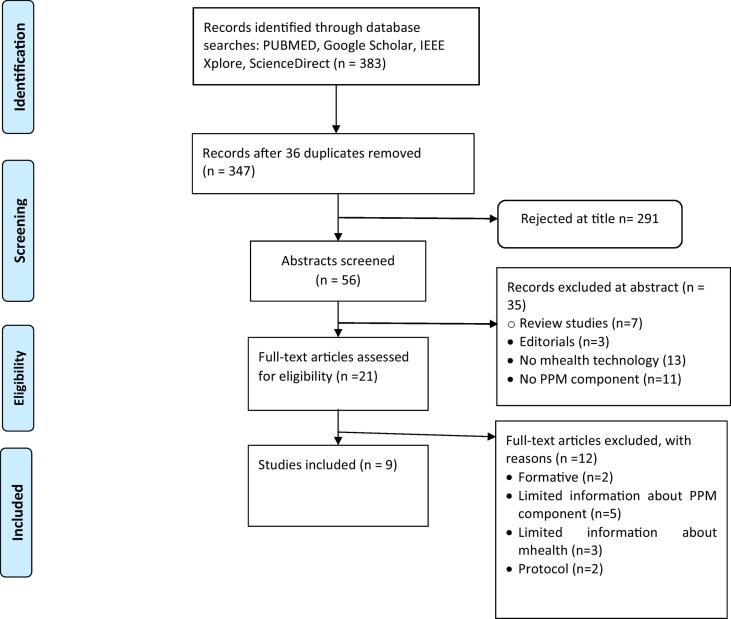
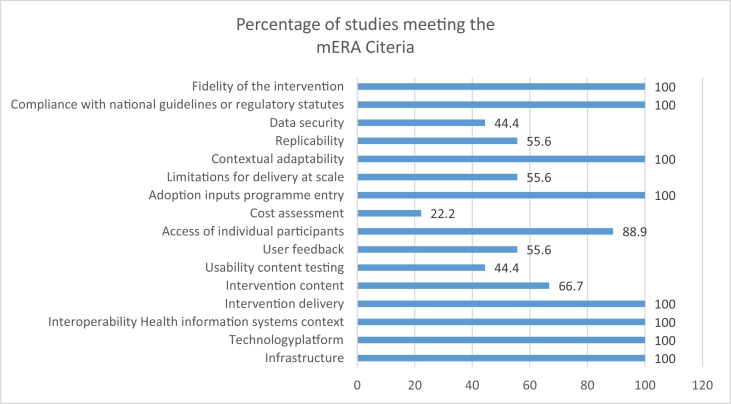
Google scholar, PUBMED, IEEE Xplore and ScienceDirect databases were searched for peer reviewed literature from 1st January 2003 to 31st December 2020 for studies about the mHealth interventions for public private mix in TB care. This was guided by the scoping review methodology proposed by Arksey and O' Malley. In order to assess the quality of the selected studies, mHealth evidence reporting and assessment (mERA) checklist was utilized. Studies that discussed the utilization of mHealth interventions for implementing PPM in TB care were included. Nine studies met the inclusion criteria and were analyzed for review.
The review found out the application of mHealth in Public Private Mix in TB care through the following ways; 1) TB screening, 2) TB case notification 3) TB treatment adherence 4) data collection and management 5) patient referral and follow up, and 6) education. This resulted into high user experience, significant time reduction in data aggregation, increased case notification and referrals and proactive tracking and provision of follow up care hence reduced treatment and completion gaps. One study yielded suboptimal utilization due to the technical and operational challenges encountered by the healthcare workers.
Although this scoping review highlights the role of mHealth technologies in enhancing PPM in TB care, its utilization is still limited in African settings. No Africa-based study was identified by this review. Future studies should focus on assessing the utilization of mHealth for PPM in Africa.
世界卫生组织(WHO)建议利用移动健康(mHealth)技术,将其作为通过加强公私合作(PPM)来缩小结核病(TB)治疗差距的新机遇。然而,对于已用于加强结核病治疗中公私合作的移动健康干预措施,哪些有效、哪些无效,我们却知之甚少。
本综述总结了文献中已发表的关于移动健康干预措施在结核病治疗公私合作中的应用及效果的证据。
在谷歌学术、PubMed、IEEE Xplore和ScienceDirect数据库中检索2003年1月1日至2020年12月31日期间关于结核病治疗公私合作中移动健康干预措施的同行评审文献。这是按照Arksey和O'Malley提出的范围综述方法进行的。为了评估所选研究的质量,使用了移动健康证据报告与评估(mERA)清单。纳入讨论了移动健康干预措施在结核病治疗中实施公私合作应用的研究。九项研究符合纳入标准并进行了综述分析。
该综述发现移动健康在结核病治疗公私合作中的应用方式如下:1)结核病筛查;2)结核病病例通报;3)结核病治疗依从性;4)数据收集与管理;5)患者转诊与随访;6)教育。这带来了较高的用户体验,显著减少了数据汇总时间,增加了病例通报和转诊数量,并实现了主动跟踪和后续护理,从而缩小了治疗和完成治疗方面的差距。有一项研究由于医护人员遇到的技术和操作挑战,导致利用率未达最佳水平。
尽管本范围综述强调了移动健康技术在加强结核病治疗公私合作中的作用,但其在非洲地区的应用仍然有限。本综述未找到基于非洲的研究。未来的研究应侧重于评估移动健康在非洲公私合作中的应用情况。