Schmidt Tamara, Ebersbach Georg, Oelsner Henriette, Sprock Anette, König Inke R, Bäumer Tobias, Münchau Alexander, Weissbach Anne
Movement Disorders Clinic Kliniken Beelitz GmbH Beelitz-Heilstätten Germany.
Institute of Medical Biometry and Statistics University of Lübeck Lübeck Germany.
Mov Disord Clin Pract. 2021 Jun 24;8(6):911-918. doi: 10.1002/mdc3.13268. eCollection 2021 Aug.
Functional movement disorders (FMD) are associated with considerable morbidity and impairment of quality of life. Specialized treatment is scarce and data on efficacy of different therapies are limited.
To evaluate a multi-modal inpatient treatment program for patients with FMD.
Thirty-one patients with FMD were analyzed before (t1) and after multi-modal inpatient treatment (t2) by a blinded video rating using the Psychogenic Movement Disorder Rating Scale (PMDRS), the simplified Functional Movement Disorder Rating Scale (S-FMDRS), and the Clinical Global Impression Scale of Severity (CGI-S), as well as patients' self-rating. In 23 out of 31 patients a 5 months follow-up investigation was performed (t3). Wilcoxon signed-rank test and Friedman test were used for rating scale and self-rating comparisons over time. Spearman correlation was used for correlation of symptom improvement and clinical characteristics.
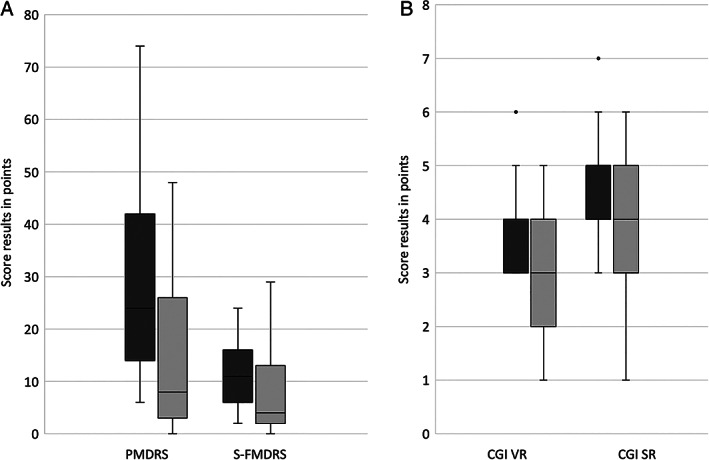
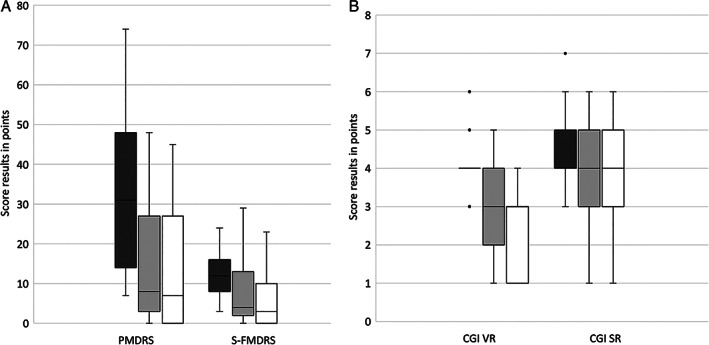
Video rating revealed significant reduction of scores after therapy (median PMDRS t1 = 24, t2 = 8, = 0.0006; S-FMDRS t1 = 11, t2 = 4, = 0.008; CGI-S t1 = 4, t2 = 3, = 0.000136) with sustained score decrease in follow-up evaluations (PMDRS t1 = 31, t2 = 8, t3 = 7, = 0.000032; S-FMDRS t1 = 12, t2 = 4, t3 = 3, = 0.000888; CGI-S t1 = 4, t2 = 3, t3 = 3, = 0.000032). Patients reported a stable reduction of symptoms in the self-rating (CGI-S t1 = 5, t2 = 4, t3 = 4, = 0.016). Age correlated with treatment response with older patients showing better improvement, but disease duration did not correlate with outcome. Patients who suffered from physical trauma, sexual or physical abuse had smaller score reductions.
Blinded video and self-rating assessment showed significant score reduction in patients with FMD after an individualized interdisciplinary inpatient intervention.
功能性运动障碍(FMD)与相当高的发病率及生活质量受损相关。专门的治疗方法稀缺,且关于不同疗法疗效的数据有限。
评估针对FMD患者的多模式住院治疗方案。
采用精神性运动障碍评定量表(PMDRS)、简化功能性运动障碍评定量表(S-FMDRS)和临床总体印象严重程度量表(CGI-S),通过盲法视频评分,对31例FMD患者在多模式住院治疗前(t1)和治疗后(t2)进行分析,并结合患者自评。对31例患者中的23例进行了为期5个月的随访调查(t3)。采用Wilcoxon符号秩检验和Friedman检验对不同时间的评定量表和自评结果进行比较。采用Spearman相关性分析症状改善与临床特征之间的相关性。
视频评分显示治疗后评分显著降低(PMDRS中位数:t1 = 24,t2 = 8,P = 0.0006;S-FMDRS:t1 = 11,t2 = 4,P = 0.008;CGI-S:t1 = 4,t2 = 3,P = 0.000136),随访评估中评分持续下降(PMDRS:t1 = 31,t2 = 8,t3 = 7,P = 0.000032;S-FMDRS:t1 = 12,t2 = 4,t3 = 3,P = 0.000888;CGI-S:t1 = 4,t2 = 3,t3 = 3,P = 0.000032)。患者自评显示症状持续减轻(CGI-S:t1 = 5,t2 = 4,t3 = 4,P = 0.016)。年龄与治疗反应相关,年龄较大的患者改善更好,但病程与治疗结果无关。遭受身体创伤、性虐待或身体虐待的患者评分降低幅度较小。
盲法视频和自评评估显示,个体化的跨学科住院干预后,FMD患者的评分显著降低。