Department of Internal Medicine, Morsani College of Medicine, University of South Florida, Tampa, Florida, United States of America.
Center for Global Health and Infectious Diseases Research, College of Public Health, University of South Florida, Tampa, Florida, United States of America.
PLoS Pathog. 2021 Aug 17;17(8):e1009351. doi: 10.1371/journal.ppat.1009351. eCollection 2021 Aug.
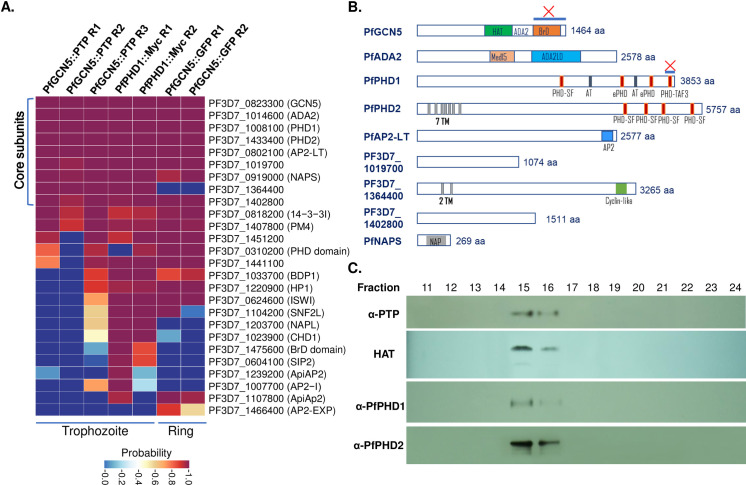
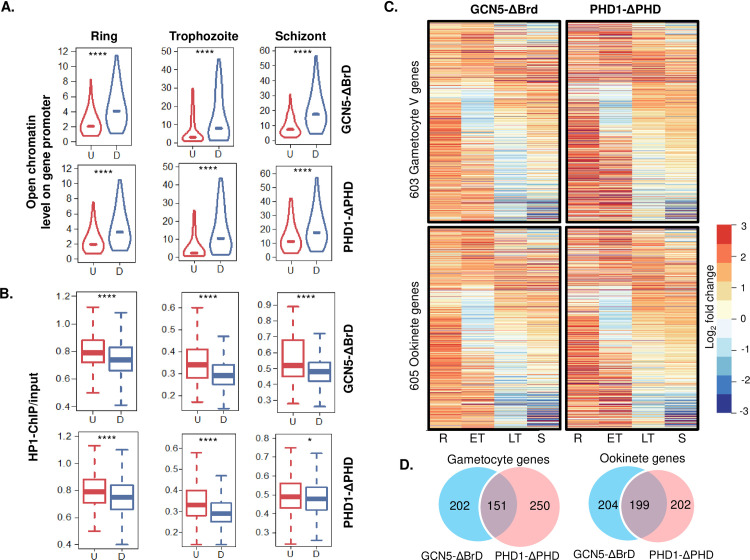
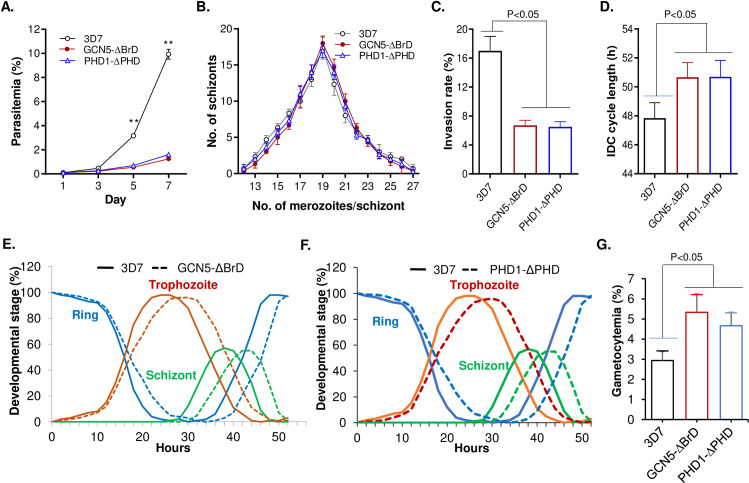
The histone acetyltransferase GCN5-associated SAGA complex is evolutionarily conserved from yeast to human and functions as a general transcription co-activator in global gene regulation. In this study, we identified a divergent GCN5 complex in Plasmodium falciparum, which contains two plant homeodomain (PHD) proteins (PfPHD1 and PfPHD2) and a plant apetela2 (AP2)-domain transcription factor (PfAP2-LT). To dissect the functions of the PfGCN5 complex, we generated parasite lines with either the bromodomain in PfGCN5 or the PHD domain in PfPHD1 deleted. The two deletion mutants closely phenocopied each other, exhibiting significantly reduced merozoite invasion of erythrocytes and elevated sexual conversion. These domain deletions caused dramatic decreases not only in histone H3K9 acetylation but also in H3K4 trimethylation, indicating synergistic crosstalk between the two euchromatin marks. Domain deletion in either PfGCN5 or PfPHD1 profoundly disturbed the global transcription pattern, causing altered expression of more than 60% of the genes. At the schizont stage, these domain deletions were linked to specific down-regulation of merozoite genes involved in erythrocyte invasion, many of which contain the AP2-LT binding motif and are also regulated by AP2-I and BDP1, suggesting targeted recruitment of the PfGCN5 complex to the invasion genes by these specific factors. Conversely, at the ring stage, PfGCN5 or PfPHD1 domain deletions disrupted the mutually exclusive expression pattern of the entire var gene family, which encodes the virulent factor PfEMP1. Correlation analysis between the chromatin state and alteration of gene expression demonstrated that up- and down-regulated genes in these mutants are highly correlated with the silent and active chromatin states in the wild-type parasite, respectively. Collectively, the PfGCN5 complex represents a novel HAT complex with a unique subunit composition including an AP2 transcription factor, which signifies a new paradigm for targeting the co-activator complex to regulate general and parasite-specific cellular processes in this low-branching parasitic protist.
组蛋白乙酰转移酶 GCN5 相关的 SAGA 复合物从酵母到人类在进化上是保守的,作为全局基因调控的通用转录辅激活因子发挥作用。在这项研究中,我们在恶性疟原虫中鉴定了一个分化的 GCN5 复合物,它包含两个植物同源域(PHD)蛋白(PfPHD1 和 PfPHD2)和一个植物 apetela2(AP2)-结构域转录因子(PfAP2-LT)。为了剖析 PfGCN5 复合物的功能,我们生成了缺失 PfGCN5 溴结构域或 PfPHD1 PHD 结构域的寄生虫系。这两个缺失突变体彼此紧密表型相似,表现出明显减少的裂殖子入侵红细胞和升高的有性转化。这些结构域缺失不仅导致组蛋白 H3K9 乙酰化,而且导致 H3K4 三甲基化显著减少,表明两种常染色质标记之间存在协同的串扰。PfGCN5 或 PfPHD1 的结构域缺失严重扰乱了全局转录模式,导致超过 60%的基因表达发生改变。在裂殖体阶段,这些结构域缺失与涉及红细胞入侵的裂殖子基因的特异性下调有关,其中许多基因含有 AP2-LT 结合基序,并且还受到 AP2-I 和 BDP1 的调控,表明这些特定因子将 PfGCN5 复合物靶向入侵基因。相反,在环状体阶段,PfGCN5 或 PfPHD1 结构域缺失破坏了整个 var 基因家族的相互排斥表达模式,该基因家族编码毒力因子 PfEMP1。染色质状态与基因表达改变之间的相关性分析表明,这些突变体中上调和下调的基因与野生型寄生虫中的沉默和活跃染色质状态高度相关。总之,PfGCN5 复合物代表了一种具有独特亚基组成的新型 HAT 复合物,包括一个 AP2 转录因子,为靶向共激活复合物以调节这种低分支寄生原生动物的通用和寄生虫特异性细胞过程提供了一个新范例。