Department of Orthopaedics, Institute of Clinical Sciences, Sahlgrenska Academy, University of Gothenburg, Gothenburg, Sweden.
Department of Orthopaedics, Institute of Clinical Sciences, Sahlgrenska Academy, University of Gothenburg, Sahlgrenska University Hospital, SE-41345, Gothenburg, Sweden.
BMC Musculoskelet Disord. 2021 Aug 17;22(1):702. doi: 10.1186/s12891-021-04577-y.
Tibial plateau fractures involve the knee joint, one of the most weight-bearing joints in the body. Studies have shown that gait asymmetries exist several years after injury. Instrumental gait analysis, generating both kinematic and kinetic data from patients with tibial plateau fractures, is uncommon.
To examine walking ability and knee range of motion in patients suffering intra-articular tibial plateau fractures.
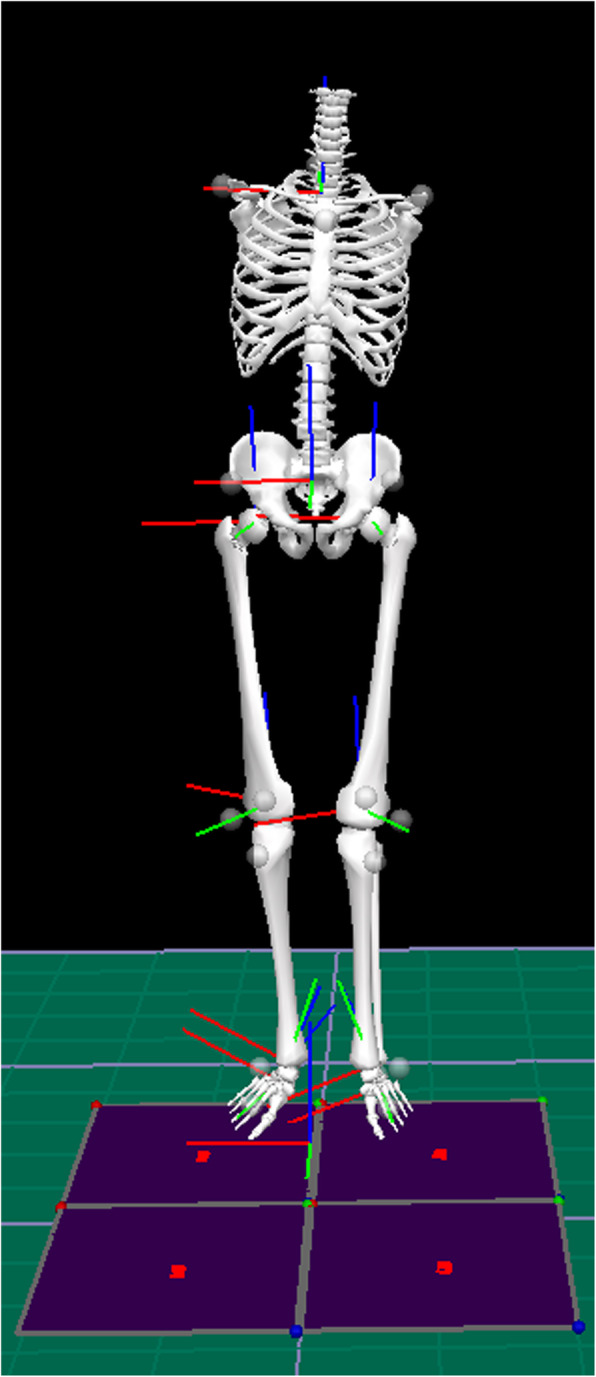
Twenty participants, eight males and 12 females, aged 44 years (range 26-60), with unilateral isolated tibial plateau fractures, were examined 12 weeks (range 7-20) after injury. The investigation consisted of passive range of motion (ROM) using a goniometer, six-minute walking test (6 MW), pain estimation using the visual analogue scale (VAS), the "Knee injury and Osteoarthritis Outcome Score" (KOOS) self-assessment questionnaire and instrumental 3-dimensional gait analysis (3DGA). 3DGA included spatiotemporal variables (speed, relative stance time, step length), kinematic variables (knee flexion, knee extension, ankle dorsiflexion) and kinetic variables (generating knee power (extension) and ankle power (plantarflexion)). A skin marker model with twenty reflective markers was used. Non-parametric tests were used for comparisons of the injured leg, the uninjured leg and a reference group.
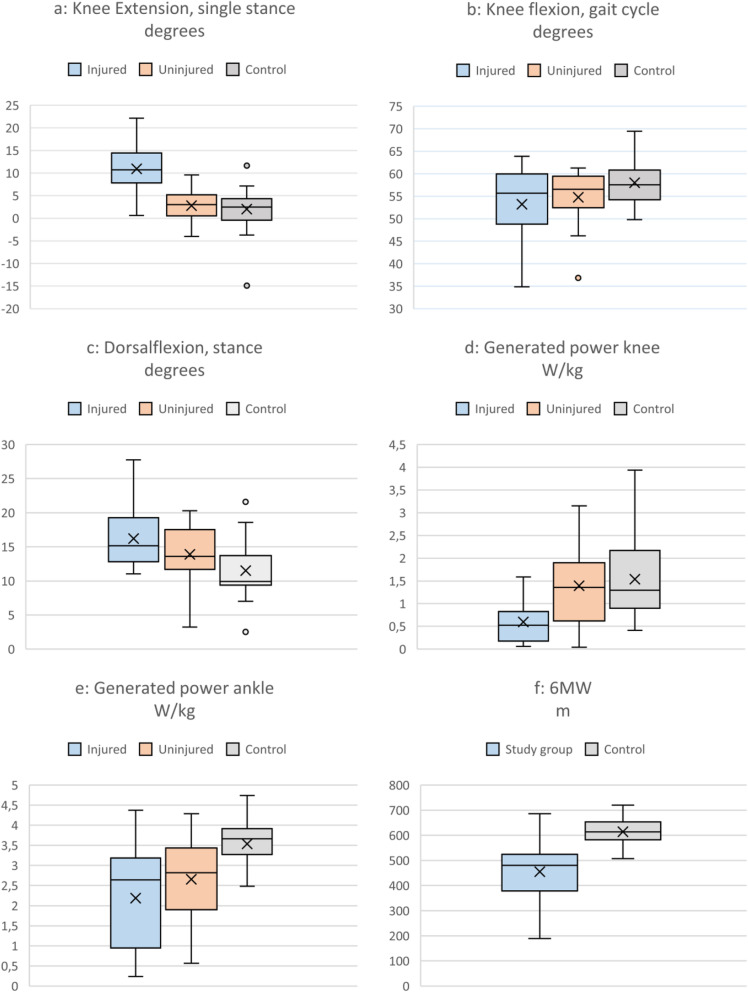
The participants walked more slowly compared with healthy references (p < 0.001). Stance time and step length was shorter for the injured side compared with the uninjured side (p < 0.014). Step length was shorter compared with the reference group (p = 0.001). The maximum knee extension in the single stance phase was worse in the injured side compared with the uninjured side and the reference group (p < 0.001) respectively. The maximum ankle dorsiflexion during stance phase was higher in the injured leg compared with the uninjured side and the reference group (p < 0.012). Maximum generated power in the knee was lower in the injured side compared with the uninjured side and the reference group (p < 0.001 respectively). The same was true of maximum power generated in the ankle (p < 0.023). The median KOOS value was lower in the study group (p < 0.001). ROM showed decreased flexion and extension in the knee joint and decreased dorsiflexion in the ankle joint compared with the uninjured side (p < 0.006). The average distance in the six-minute walking test was shorter in the study group (p < 0.001).
Patients who have sustained tibial plateau fractures generally display a limitation in their walking pattern 3 months after injury. These limitations are mainly related to the inability to extend the knee.
胫骨平台骨折涉及膝关节,膝关节是人体承重最大的关节之一。研究表明,受伤后数年仍存在步态不对称。对胫骨平台骨折患者进行关节内的步态分析仪器,生成运动学和动力学数据,这种情况并不常见。
检查患有胫骨平台骨折的患者的行走能力和膝关节活动范围。
20 名参与者,8 名男性和 12 名女性,年龄 44 岁(范围 26-60 岁),患有单侧孤立性胫骨平台骨折,在受伤后 12 周(范围 7-20 周)进行检查。研究包括使用量角器进行被动关节活动度(ROM)检查、6 分钟步行测试(6MWT)、使用视觉模拟量表(VAS)评估疼痛、“膝关节损伤和骨关节炎结果评分”(KOOS)自我评估问卷和仪器 3 维步态分析(3DGA)。3DGA 包括时空变量(速度、相对支撑时间、步长)、运动学变量(膝关节屈曲、膝关节伸展、踝关节背屈)和动力学变量(产生膝关节力(伸展)和踝关节力(跖屈))。使用带有二十个反射标记的皮肤标记模型。使用非参数检验比较受伤腿、未受伤腿和参考组。
与健康参考组相比,参与者的行走速度较慢(p<0.001)。受伤侧的支撑时间和步长比未受伤侧短(p<0.014)。与参考组相比,步长较短(p=0.001)。单足站立阶段的最大膝关节伸展在受伤侧与未受伤侧和参考组相比均较差(p<0.001)。在站立阶段,受伤腿的最大踝关节背屈高于未受伤腿和参考组(p<0.012)。受伤侧的最大膝关节生成力低于未受伤侧和参考组(p<0.001)。踝关节最大生成功率也较低(p<0.023)。研究组的 KOOS 中位数较低(p<0.001)。与未受伤侧相比,膝关节的 ROM 显示出屈曲和伸展的减少,踝关节的背屈减少(p<0.006)。六分钟步行测试的平均距离在研究组中较短(p<0.001)。
胫骨平台骨折患者在受伤后 3 个月通常表现出行走模式受限。这些限制主要与膝关节伸展无力有关。