Department of International Public Health, Liverpool School of Tropical Medicine, Pembroke Place, Liverpool, L35QA, United Kingdom.
Faculty of Health and Life Sciences, University of Liverpool, Liverpool, L69 3BX, United Kingdom.
Health Res Policy Syst. 2021 Aug 17;19(1):117. doi: 10.1186/s12961-021-00767-1.
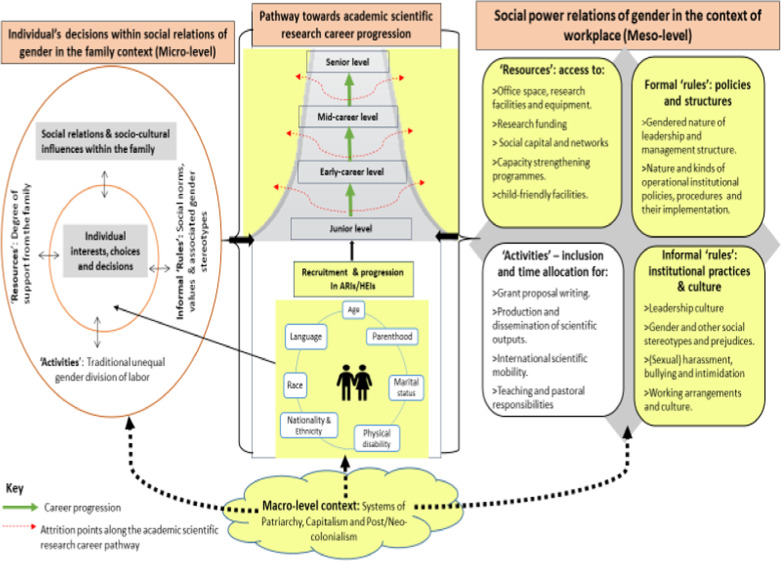
This study sought to determine how institutional environments, including values, policies, and their implementation, shape inequities in scientific career progression for women and men, and their disadvantages in relation to their multiple social identities in sub-Saharan Africa (SSA). The findings are drawn from a wider research study that was aimed at gaining an in-depth understanding of the barriers and enablers of gender-equitable scientific career progression for researchers in SSA. This was nested within the context of the Developing Excellence in Leadership, Training and Science in Africa (DELTAS Africa) programme-a health-based scientific research capacity-strengthening initiative.
The study adopted an exploratory qualitative cross-sectional study design. In-depth interviews (IDIs) with trainees/research fellows at various career stages supported and/or affiliated to three purposively selected DELTAS Africa Research Consortia were the main method of data collection. In addition, key informant interviews (KIIs) with consortia research leaders/directors, co-investigators, and the consortia management team were also conducted to corroborate information gathered from the IDIs, and also to provide additional insights on the drivers of intersectional gender-inequitable career progression. In total, 58 IDIs (32 female and 26 male) and 20 KIIs (4 female and 16 male) were conducted. The interviews were carried out in English between May and December 2018. The data were analysed inductively based on emergent themes.
Three interrelated themes were identified: first, characterization of the institutional environment as highly complex and competitive with regard to advancement opportunities and funding structure; second, inequitable access to support systems within institutions; third, informal rules-everyday experiences of negative practices and culture at the workplace, characterized by negative stereotypical attitudes, gender biases, sexual harassment, and bullying and intimidation.
We contend that understanding and addressing the social power relations at the meso-institutional environment and macro-level contexts could benefit career progression of both female and male researchers by improving work culture and practices, resource allocation, and better rules and policies, thus fostering positive avenues for systemic and structural policy changes.
本研究旨在探讨机构环境(包括价值观、政策及其实施)如何影响撒哈拉以南非洲(SSA)女性和男性的科研职业发展不平等,以及他们在与社会多重身份相关的劣势。研究结果来自一项更广泛的研究,旨在深入了解 SSA 研究人员实现性别平等科研职业发展的障碍和促进因素。该研究嵌套在“非洲领导力、培训和科学发展卓越计划(DELTAS Africa)”计划中,该计划是一项基于健康的科学研究能力加强倡议。
该研究采用探索性定性横断面研究设计。对来自三个专门选择的 DELTAS Africa 研究联盟的各个职业阶段的受训者/研究人员进行深入访谈(IDIs),是主要的数据收集方法。此外,还对联盟研究负责人/主任、共同研究者和联盟管理团队进行了关键知情人访谈(KIIs),以核实从 IDIs 中收集到的信息,并提供关于交叉性别不平等职业发展驱动因素的额外见解。共进行了 58 次 IDI(32 名女性和 26 名男性)和 20 次 KII(4 名女性和 16 名男性)。访谈于 2018 年 5 月至 12 月期间以英语进行。数据根据出现的主题进行了归纳分析。
确定了三个相互关联的主题:第一,机构环境的特点是在晋升机会和资金结构方面非常复杂和竞争激烈;第二,机构内部支持系统的不公平获取;第三,非正式规则——工作场所日常经历的消极行为和文化,其特点是负面刻板印象、性别偏见、性骚扰、欺凌和恐吓。
我们认为,了解和解决中观机构环境和宏观层面的社会权力关系,可以通过改善工作文化和实践、资源分配以及更好的规则和政策,有利于女性和男性研究人员的职业发展,从而为系统性和结构性政策变革创造积极途径。