Department of Population Health, London School of Hygiene and Tropical Medicine, London, United Kingdom.
Emergency Nutrition Network, Kidlington, Oxford, United Kingdom.
PLoS One. 2021 Aug 18;16(8):e0256188. doi: 10.1371/journal.pone.0256188. eCollection 2021.
Small and nutritionally at-risk infants under 6 months (<6m) are a vulnerable group at increased risk of mortality, morbidity, poor growth and sub-optimal development. Current national and international (World Health Organization) management guidelines focus mainly on infants' needs, yet growing evidence suggests that maternal factors also influence infant outcomes. We aimed to inform future guidelines by exploring the impacts of maternal-focused interventions on infant feeding and growth.
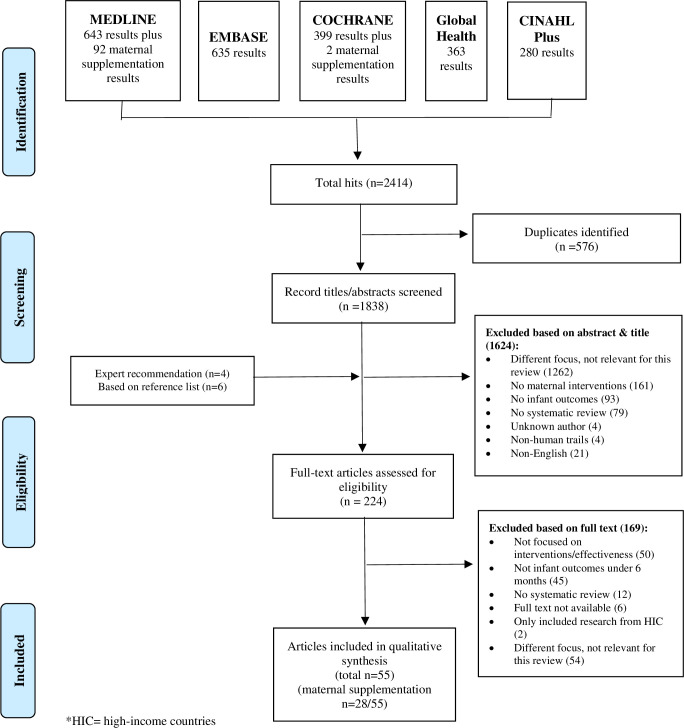
We conducted a systematic review of reviews published since 2008 (PROSPERO, register number CRD 42019141724). We explored five databases and a wide variety of maternal-focused interventions based in low- and middle-income countries. Infant outcomes of interest included anthropometric status, birthweight, infant mortality, breastfeeding and complementary feeding practices. Given heterogenous interventions, we present a narrative synthesis of the extracted data.
We included a total of 55 systematic reviews. Numerous maternal interventions were effective in improving infant growth or feeding outcomes. These included breastfeeding promotion, education, support and counselling interventions. Maternal mental health, while under-researched, showed potential to positively impact infant growth. There was also some evidence for a positive impact of: women's empowerment, m-health technologies, conditional cash transfers, water, sanitation and hygiene and agricultural interventions. Effectiveness was increased when implemented as part of a multi-sectoral program. Antenatal supplementation with macronutrient, multiple micronutrients, Vitamin D, zinc, iron folic acid and possibly calcium, iodine and B12 in deficient women, improved birth outcomes. In contrast, evidence for postnatal supplementation was limited as was evidence directly focusing on small and nutritionally at-risk infants; most reviews focused on the prevention of growth faltering.
Our findings suggest sufficient evidence to justify greater inclusion of mothers in more holistic packages of care for small and nutritionally at-risk infants aged <6m. Context specific approaches are likely needed to support mother-infant dyads and ensure infants survive and thrive.
6 个月(<6m)以下的小而营养不足的婴儿是一个脆弱群体,他们面临更高的死亡风险、患病风险、生长不良和发育欠佳的风险。目前的国家和国际(世界卫生组织)管理指南主要侧重于婴儿的需求,但越来越多的证据表明,产妇因素也会影响婴儿的结局。我们旨在通过探索以母亲为重点的干预措施对婴儿喂养和生长的影响,为未来的指南提供信息。
我们对 2008 年以来发表的综述进行了系统评价(PROSPERO,注册号 CRD 42019141724)。我们探索了五个数据库和各种基于中低收入国家的以母亲为重点的干预措施。感兴趣的婴儿结局包括人体测量状况、出生体重、婴儿死亡率、母乳喂养和补充喂养实践。鉴于干预措施存在异质性,我们对提取的数据进行了叙述性综合。
我们共纳入了 55 项系统评价。许多针对母亲的干预措施在改善婴儿生长或喂养结局方面是有效的。这些措施包括促进母乳喂养、教育、支持和咨询干预。虽然产妇心理健康研究不足,但有证据表明其可能对婴儿的生长产生积极影响。妇女赋权、移动健康技术、有条件的现金转移、水、环境卫生和农业干预也有一定的积极影响。当作为多部门方案的一部分实施时,有效性会增加。在营养不足的妇女中补充宏量营养素、多种微量营养素、维生素 D、锌、铁、叶酸和可能的钙、碘和 B12,可改善出生结局。相反,产后补充的证据有限,直接针对小而营养不足的婴儿的证据也有限;大多数综述侧重于预防生长迟缓。
我们的研究结果表明,有足够的证据证明在 6 个月以下的小而营养不足的婴儿的更全面的护理方案中,更有必要纳入母亲。可能需要根据具体情况采取方法来支持母婴二人组,并确保婴儿存活和茁壮成长。