Wang Huai-Yu, Lv Xiaozhen, Du Jian, Kong Guilan, Zhang Luxia
National Institute of Health Data Science, Peking University, Beijing, China.
School of Public Health, Peking University, Beijing, China.
Front Med (Lausanne). 2021 Aug 2;8:719806. doi: 10.3389/fmed.2021.719806. eCollection 2021.
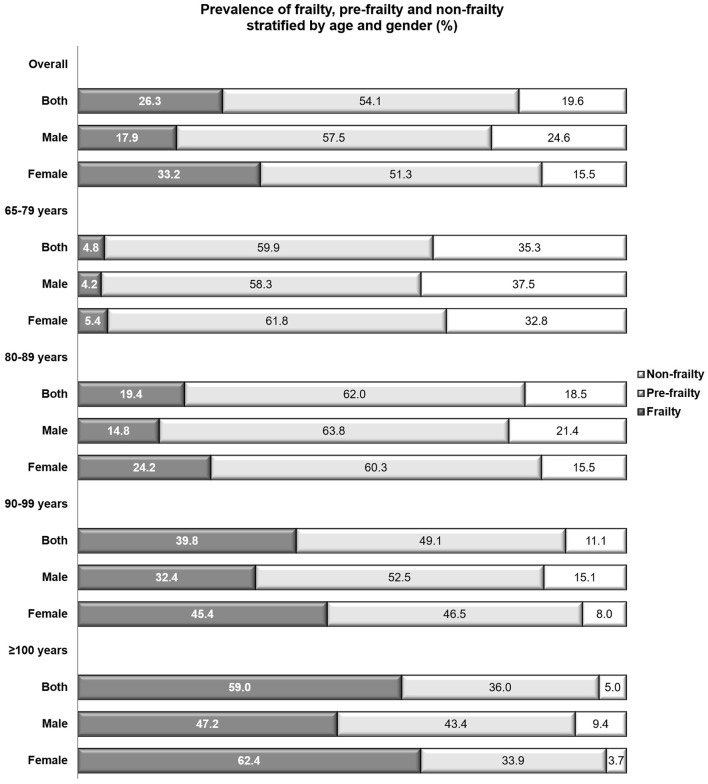
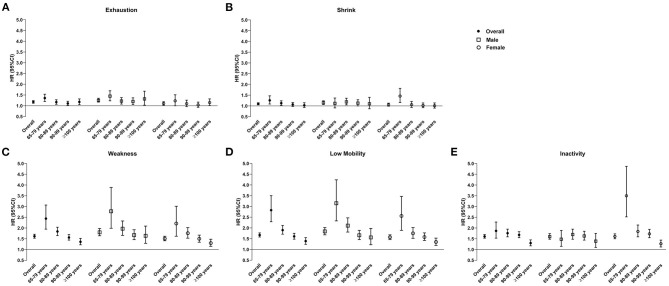
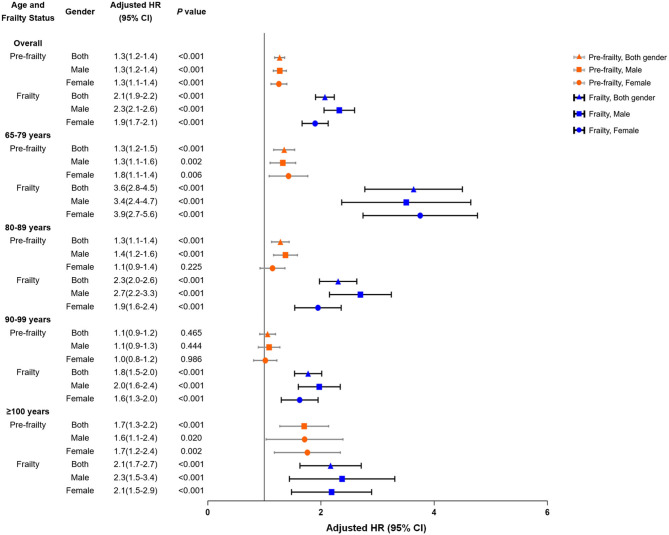
Frailty is an epidemic age-related syndrome addressing heavy burden to the healthcare system. Subject to the rarity, age-, and gender-specific prevalence of frailty and its prognosis among the longevous population remains under-investigated. Based on the Chinese Longitudinal Healthy Longevity Study (CLHLS, 2008-2018), individuals aged ≥ 65 years having complete data of frailty were recruited. Modified Fried criteria (exhaustion, shrink, weakness, low mobility, and inactivity) were adopted to define pre-frailty (1-2 domains) and frailty (≥3 domains), respectively. The association between pre-frailty/frailty and adverse outcomes (frequent hospitalization, limited physical performance, cognitive decline, multimorbidity, and dependence) was analyzed using logistic regression models. The association between pre-frailty/frailty and mortality was analyzed using Cox proportional hazards models. Age- and gender-stratified analyses were performed. Totally, 13,859 participants aged 85.8 ± 11.1 years, including 2,056 centenarians, were recruited. The overall prevalence of pre-frailty and frailty were 54.1 and 26.3%, respectively. Only 5.0% of centenarians were non-frailty whereas 59.9% of the young-old (65-79 years) showed pre-frailty. Both pre-frailty and frailty were associated with the increased risk of multiple adverse outcomes, such as incident limited physical performance, cognitive decline and dependence, respectively ( < 0.05). Frail males were more vulnerable to the risk of mortality (hazard ratio [HR] = 2.3, 95% confidence interval [CI], 2.1-2.6) compared with frail females (HR = 1.9, 95%CI, 1.7-2.1). The strongest association between frailty and mortality was observed among the young-old (HR = 3.6, 95%CI, 2.8-4.5). Exhaustion was the most common domain among patients with pre-frailty (74.8%) or frailty (83.2%), followed by shrink (32.3%) in pre-frailty and low mobility (83.0%) in frailty. Inactivity among females aged 65-79 years showed the strongest association with the risk of mortality (HR = 3.50, 95%CI, 2.52-4.87). A huge gap exists between longer life and healthy aging in China. According to the age- and gender-specific prevalence and prognosis of frailty, the strategy of frailty prevention and intervention should be further individualized.
衰弱是一种与年龄相关的流行综合征,给医疗保健系统带来沉重负担。由于衰弱在长寿人群中的罕见性、年龄特异性和性别特异性患病率及其预后情况仍未得到充分研究。基于中国老年健康长寿纵向研究(CLHLS,2008 - 2018),招募了年龄≥65岁且有完整衰弱数据的个体。采用改良的弗里德标准(疲惫、消瘦、虚弱、行动不便和活动减少)分别定义衰弱前期(1 - 2个领域)和衰弱(≥3个领域)。使用逻辑回归模型分析衰弱前期/衰弱与不良结局(频繁住院、身体功能受限、认知衰退、多种疾病并存和依赖)之间的关联。使用Cox比例风险模型分析衰弱前期/衰弱与死亡率之间的关联。进行了年龄和性别分层分析。总共招募了13859名年龄为85.8±11.1岁的参与者,其中包括2056名百岁老人。衰弱前期和衰弱的总体患病率分别为54.1%和26.3%。只有5.0%的百岁老人无衰弱,而59.9%的年轻老年人(65 - 79岁)表现为衰弱前期。衰弱前期和衰弱均分别与多种不良结局风险增加相关,如身体功能受限、认知衰退和依赖(P<0.05)。与衰弱女性(风险比[HR]=1.9,95%置信区间[CI],1.7 - 2.1)相比,衰弱男性更容易面临死亡风险(HR = 2.3,95%CI,2.1 - 2.6)。在年轻老年人中观察到衰弱与死亡率之间的关联最强(HR = 3.6,95%CI,2.8 - 4.5)。疲惫是衰弱前期(74.8%)或衰弱(83.2%)患者中最常见的领域,其次是衰弱前期的消瘦(32.3%)和衰弱的行动不便(83.0%)。65 - 79岁女性的活动减少与死亡风险之间的关联最强(HR = 3.50,95%CI,2.52 - 4.87)。在中国,长寿与健康老龄化之间存在巨大差距。根据衰弱的年龄和性别特异性患病率及预后情况,衰弱预防和干预策略应进一步个体化。