Kudelko Mateusz, Chen Peikai, Tam Vivian, Zhang Ying, Kong Oi-Yin, Sharma Rakesh, Au Tiffany Y K, To Michael Kai-Tsun, Cheah Kathryn S E, Chan Wilson C W, Chan Danny
School of Biomedical Sciences, The University of Hong Kong, Pokfulam, Hong Kong.
Department of Orthopaedics Surgery and Traumatology, The University of Hong Kong -Shenzhen Hospital (HKU-SZH), Shenzhen, China.
Matrix Biol Plus. 2021 Jul 24;12:100082. doi: 10.1016/j.mbplus.2021.100082. eCollection 2021 Dec.
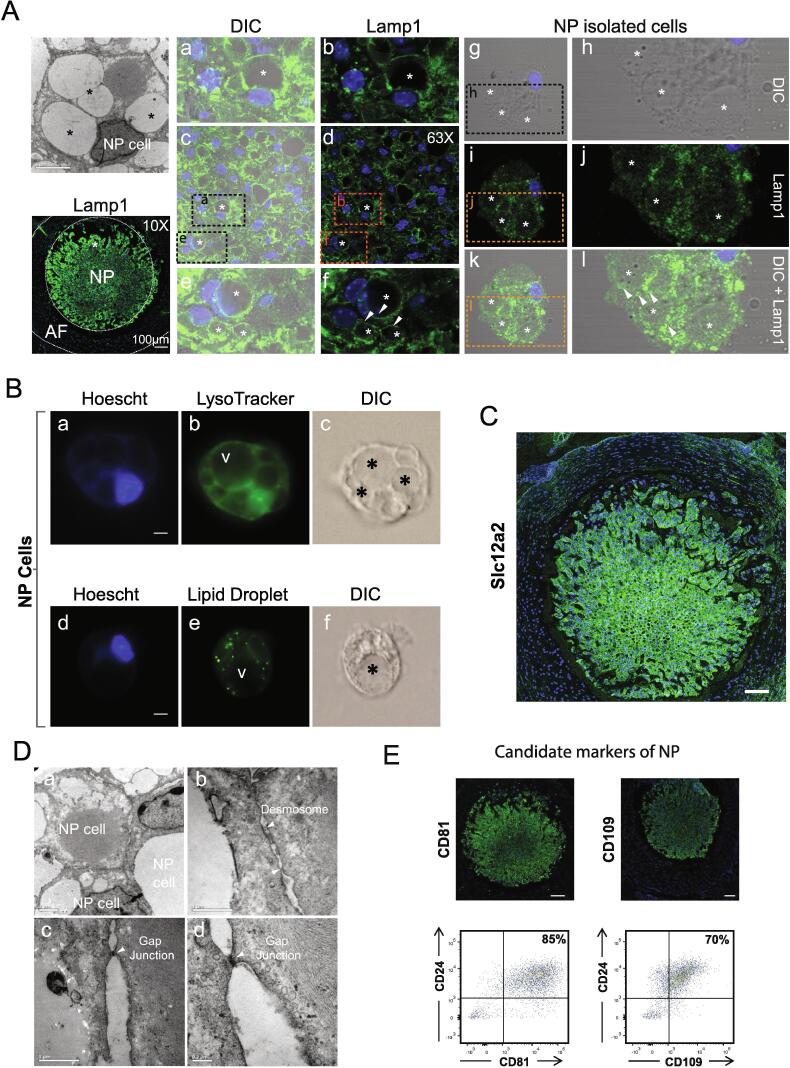
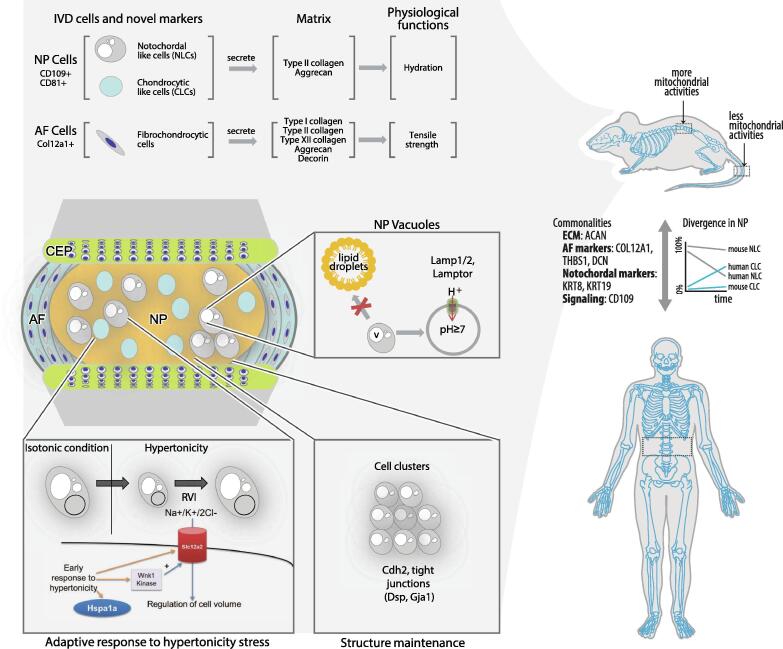
Mice are commonly used to study intervertebral disc (IVD) biology and related diseases such as IVD degeneration. Discs from both the lumbar and tail regions are used. However, little is known about compartmental characteristics in the different regions, nor their relevance to the human setting, where a functional IVD unit depends on a homeostatic proteome. Here, we address these major gaps through comprehensive proteomic profiling and in-depth analyses of 8-week-old healthy murine discs, followed by comparisons with human. Leveraging on a dataset of over 2,700 proteins from 31 proteomic profiles, we identified key molecular and cellular differences between disc compartments and spine levels, but not gender. The nucleus pulposus (NP) and annulus fibrosus (AF) compartments differ the most, both in matrisome and cellularity contents. Differences in the matrisome are consistent with the fibrous nature required for tensile strength in the AF and hydration property in the NP. Novel findings for the NP cells included an enrichment in cell junction proteins for cell-cell communication (Cdh2, Dsp and Gja1) and osmoregulation (Slc12a2 and Wnk1). In NP cells, we detected heterogeneity of vacuolar organelles; where about half have potential lysosomal function (Vamp3, Copb2, Lamp1/2, Lamtor1), some contain lipid droplets and others with undefined contents. The AF is enriched in proteins for the oxidative stress responses (Sod3 and Clu). Interestingly, mitochondrial proteins are elevated in the lumbar than tail IVDs that may reflect differences in metabolic requirement. Relative to the human, cellular and structural information are conserved for the AF. Even though the NP is more divergent between mouse and human, there are similarities at the level of cell biology. Further, common cross-species markers were identified for both NP (KRT8/19, CD109) and AF (COL12A1). Overall, mouse is a relevant model to study IVD biology, and an understanding of the limitation will facilitate research planning and data interpretation, maximizing the translation of research findings to human IVDs.
小鼠常用于研究椎间盘(IVD)生物学及相关疾病,如IVD退变。研究使用了来自腰椎和尾部区域的椎间盘。然而,对于不同区域的分区特征及其与人类情况的相关性知之甚少,在人类中,一个功能性IVD单元依赖于一个稳态蛋白质组。在此,我们通过对8周龄健康小鼠椎间盘进行全面的蛋白质组分析和深入分析,随后与人类进行比较,来填补这些主要空白。利用来自31个蛋白质组图谱的2700多种蛋白质的数据集,我们确定了椎间盘各分区和脊柱节段之间的关键分子和细胞差异,但未发现性别差异。髓核(NP)和纤维环(AF)分区在基质成分和细胞含量方面差异最大。基质成分的差异与AF中拉伸强度所需的纤维性质以及NP中的水合性质一致。NP细胞的新发现包括参与细胞间通讯(Cdh2、Dsp和Gja1)和渗透调节(Slc12a2和Wnk1)的细胞连接蛋白富集。在NP细胞中,我们检测到液泡细胞器的异质性;其中约一半具有潜在的溶酶体功能(Vamp3、Copb2、Lamp1/2、Lamtor1),一些含有脂滴,另一些内容物不明确。AF富含参与氧化应激反应的蛋白质(Sod3和Clu)。有趣的是,腰椎IVD中的线粒体蛋白质比尾部IVD中的升高,这可能反映了代谢需求的差异。相对于人类,AF的细胞和结构信息是保守的。尽管NP在小鼠和人类之间差异更大,但在细胞生物学水平上存在相似之处。此外,还确定了NP(KRT8/19、CD109)和AF(COL12A1)的共同跨物种标记。总体而言,小鼠是研究IVD生物学的相关模型,了解其局限性将有助于研究规划和数据解释,最大限度地将研究结果转化应用于人类IVD。