School of Health Sciences, Faculty of Health and Medical Sciences, University of Surrey, Kate Granger Building, Priestley Road, Surrey Research Park, GU2 7YH, Guildford, UK.
Department of Psychology and Pedagogic Science, Faculty of Sport, Health and Applied Science, St Mary's University, Waldegrave Road, Twickenham, TW1 4SX, London, UK.
BMC Health Serv Res. 2021 Aug 19;21(1):839. doi: 10.1186/s12913-021-06785-7.
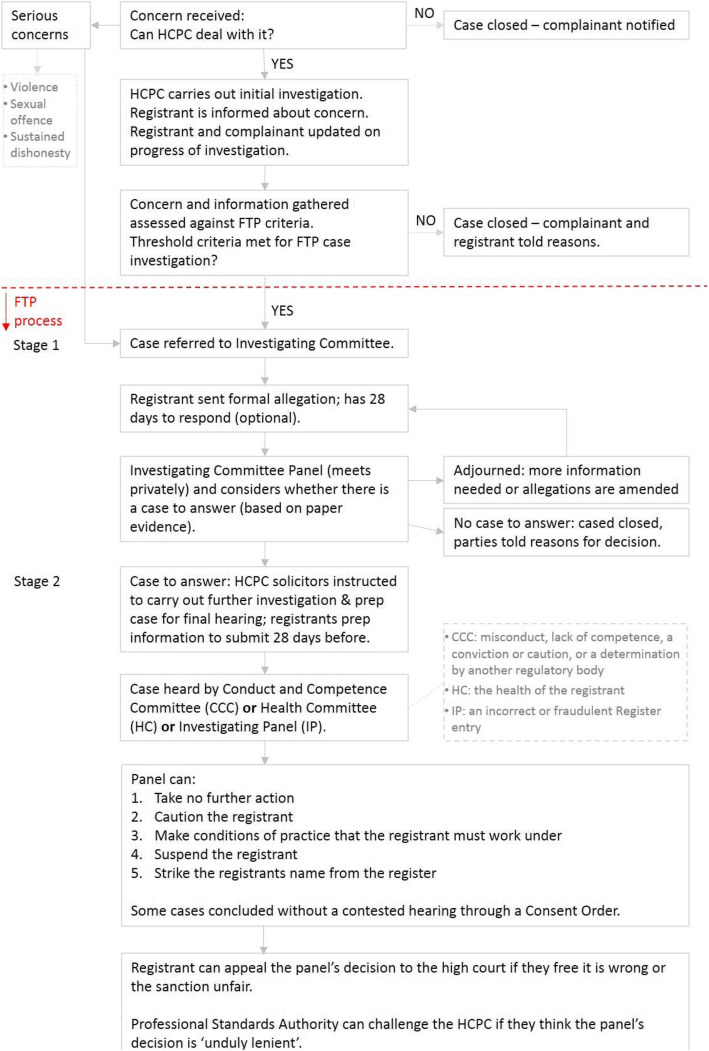
It is the responsibility of healthcare regulators to ensure healthcare professionals remain fit for practice in healthcare settings. If there are concerns about an individual healthcare professional they may undergo a fitness to practice investigation. This process is known to be hugely stressful for doctors and social workers, but little is known about the impact of this experience on other professions. This study explores the experiences of registrants going through the process of being reported to the UK's Health and Care Professions Council (HCPC) and attending fitness to practice (FTP) hearings. We discuss the implications of this process on registrants' wellbeing and, from our findings, present recommendations based on registrants experiences. In doing so we articulate the structural processes of the HCPC FTP process and the impact this has on individuals.
This study uses semi-structured interviews and framework analysis to explore the experiences of 15 registrants who had completed the FTP process. Participants were sampled for maximum variation and were selected to reflect the range of possible processes and outcomes through the FTP process.
The psychological impact of undergoing a FTP process was significant for the majority of participants. Their stories described influences on their wellbeing at both a macro (institutional/organisational) and micro (individual) level. A lack of information, long length of time for the process and poor support avenues were macro factors impacting on the ability of registrants to cope with their experiences (theme 1). These macro factors led to feelings of powerlessness, vulnerability and threat of ruin for many registrants (theme 2). Suggested improvements (theme 3) included better psychological support (e.g. signposting or provision); proportional processes to the incident (e.g. mediation instead of hearings); and taking context into account.
Findings suggest that improvements to both the structure and conduct of the FTP process are warranted. Implementation of better signposting for support both during and after a FTP process may improve psychological wellbeing. There may also be value in considering alternative ways of organising the FTP process to enable greater consideration of and flexibility for registrants' context and how they are investigated.
医疗保健监管机构有责任确保医疗保健专业人员在医疗保健环境中保持适合执业。如果对某个医疗保健专业人员有顾虑,他们可能会接受执业能力调查。这个过程对医生和社会工作者来说压力很大,但对于其他职业来说,人们对这个过程的影响知之甚少。本研究探讨了在向英国健康和保健专业委员会(HCPC)报告并参加执业能力(FTP)听证会上,被举报的注册人员的经历。我们讨论了这个过程对注册人员福祉的影响,并根据注册人员的经验提出了建议。在这样做的过程中,我们阐述了 HCPC FTP 过程的结构流程以及这对个人的影响。
本研究使用半结构化访谈和框架分析来探索 15 名已完成 FTP 流程的注册人员的经历。参与者是为了最大限度地改变样本而选择的,并根据 FTP 流程中可能出现的各种流程和结果进行选择。
对大多数参与者来说,经历 FTP 流程的心理影响是显著的。他们的故事描述了在宏观(机构/组织)和微观(个人)层面上对他们福祉的影响。缺乏信息、漫长的处理时间和不良的支持途径是影响注册人员应对自身经历的能力的宏观因素(主题 1)。这些宏观因素导致许多注册人员感到无能为力、脆弱和面临毁灭的威胁(主题 2)。建议的改进措施(主题 3)包括更好的心理支持(例如,提供咨询服务);根据事件的严重程度调整处理流程(例如,采用调解而非听证);并考虑到背景因素。
研究结果表明,有必要改进 FTP 流程的结构和实施。在 FTP 过程中以及之后提供更好的支持咨询服务,可能会改善心理健康。考虑采用替代方式组织 FTP 流程,以便更充分地考虑和灵活处理注册人员的背景以及对他们的调查方式,也可能具有价值。