Department of Cellular Pathology, Oxford University Hospitals NHS Trust, John Radcliffe Hospital, Headley Way, OX3 9DU, Oxford, UK.
NIHR Oxford Biomedical Research Centre, Oxford University Hospitals NHS Foundation Trust, Oxford, Oxfordshire, UK.
Diagn Pathol. 2021 Aug 21;16(1):75. doi: 10.1186/s13000-021-01130-2.
There are recognised potential pitfalls in digital diagnosis in urological pathology, including the grading of dysplasia. The World Health Organisation/International Society of Urological Pathology (WHO/ISUP) grading system for renal cell carcinoma (RCC) is prognostically important in clear cell RCC (CCRCC) and papillary RCC (PRCC), and is included in risk stratification scores for CCRCC, thus impacting on patient management. To date there are no systematic studies examining the concordance of WHO/ISUP grading between digital pathology (DP) and glass slide (GS) images. We present a validation study examining intraobserver agreement in WHO/ISUP grade of CCRCC and PRCC.
Fifty CCRCCs and 10 PRCCs were graded (WHO/ISUP system) by three specialist uropathologists on three separate occasions (DP once then two GS assessments; GS1 and GS2) separated by wash-out periods of at least two-weeks. The grade was recorded for each assessment, and compared using Cohen's and Fleiss's kappa.
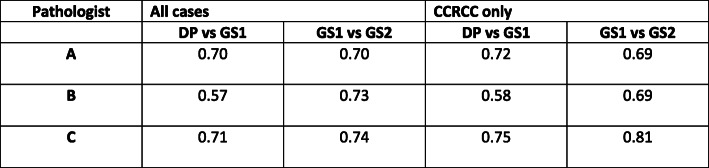
There was 65 to 78% concordance of WHO/ISUP grading on DP and GS1. Furthermore, for the individual pathologists, the comparative kappa scores for DP versus GS1, and GS1 versus GS2, were 0.70 and 0.70, 0.57 and 0.73, and 0.71 and 0.74, and with no apparent tendency to upgrade or downgrade on DP versus GS. The interobserver kappa agreement was less, at 0.58 on DP and 0.45 on GS.
Our results demonstrate that the assessment of WHO/ISUP grade on DP is noninferior to that on GS. There is an apparent slight improvement in agreement between pathologists on RCC grade when assessed on DP, which may warrant further study.
在泌尿病理学的数字诊断中存在公认的潜在陷阱,包括发育不良的分级。世界卫生组织/国际泌尿病理学会(WHO/ISUP)的肾细胞癌(RCC)分级系统对透明细胞 RCC(CCRCC)和乳头状 RCC(PRCC)具有重要的预后意义,并且包含在 CCRCC 的风险分层评分中,因此会影响患者的管理。迄今为止,尚无系统研究检查数字病理学(DP)和玻璃载玻片(GS)图像之间的 WHO/ISUP 分级一致性。我们提出了一项验证性研究,检查了 CCRCC 和 PRCC 的 WHO/ISUP 分级的观察者内一致性。
由三位泌尿科病理学家在三个不同的时间点(一次 DP,然后是两次 GS 评估;GS1 和 GS2)对 50 例 CCRCC 和 10 例 PRCC 进行分级(WHO/ISUP 系统),间隔至少两周的洗脱期。记录每次评估的分级,并使用 Cohen's 和 Fleiss 的 kappa 进行比较。
DP 和 GS1 上的 WHO/ISUP 分级的一致性为 65%至 78%。此外,对于个别病理学家,DP 与 GS1 的比较 Kappa 评分,以及 GS1 与 GS2 的比较 Kappa 评分,分别为 0.70 和 0.70、0.57 和 0.73、0.71 和 0.74,并且 DP 与 GS 之间没有明显的升级或降级趋势。观察者间的 Kappa 一致性较低,DP 为 0.58,GS 为 0.45。
我们的结果表明,DP 上的 WHO/ISUP 分级评估不劣于 GS。当在 DP 上评估时,病理学家对 RCC 分级的一致性明显提高,这可能需要进一步研究。