Zhao Xiao-Jie, Liu Liang-Chen, Guo Cui, Shen Wen-Wen, Cao Jia, Du Fen, Wu Dong-Fang, Yu Hong
Department of Biochemistry and Molecular Biology, Hubei Provincial Key Laboratory of Developmentally Originated Disease, Wuhan University School of Basic Medical Sciences, Wuhan, China.
Department of Pharmacy, Zhongnan Hospital of Wuhan University, Wuhan, China.
Ann Transl Med. 2021 Jul;9(13):1063. doi: 10.21037/atm-21-682.
High-density lipoprotein (HDL) plays an antiatherogenic role by mediating reverse cholesterol transport (RCT), antioxidation, anti-inflammation, and endothelial cell protection. Recently, series of evidence have shown that HDL can also convert to proatherogenic HDL under certain circumstances. Plasma paraoxonase 1 (PON1) as an HDL-bound esterase, is responsible for most of the antioxidant properties of HDL. However, whether PON1 can serve as a therapeutic target of dysfunctional HDL-related atherosclerosis remains unclear.
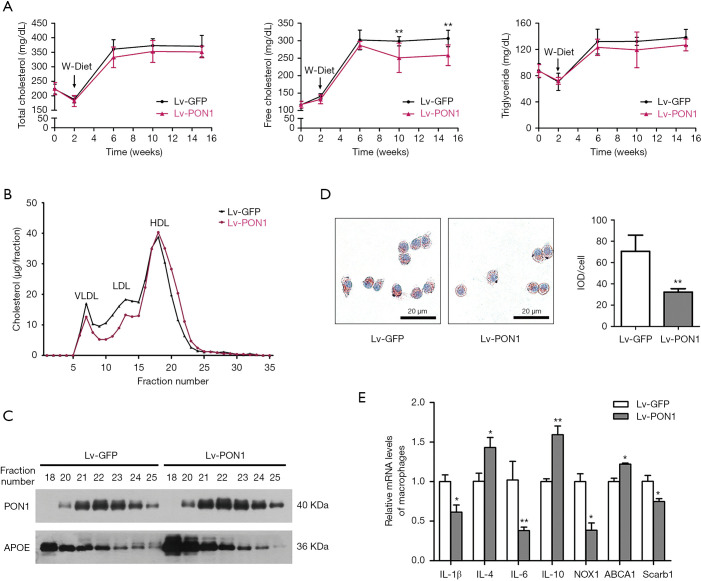
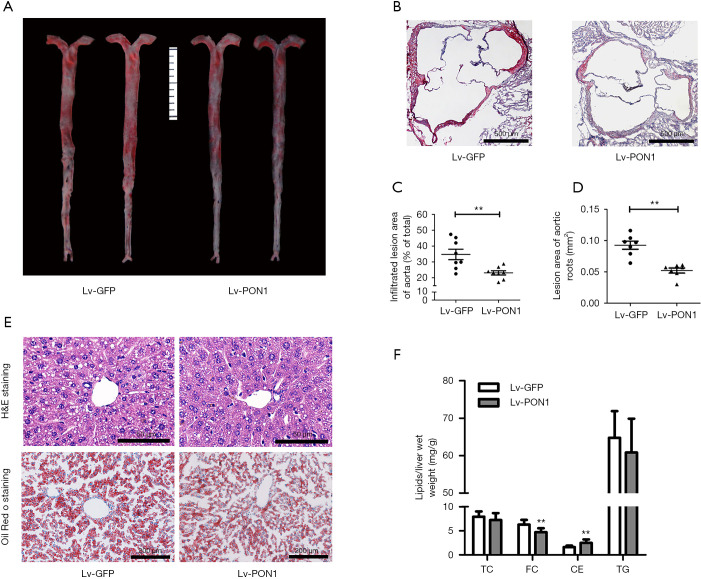
In this study, scavenger receptor class B type I deficient ( ) mice were used as the animal model with dysfunctional HDL and increased atherosclerotic susceptibility. Hepatic PON1 overexpression and secretion into circulation were achieved by lentivirus injection through the tail vein. We monitored plasma lipids levels and lipoprotein profiles in mice, and measured the levels and activities of proteins associated with HDL function. Meanwhile, lipid deposition in the liver and atherosclerotic lesions was quantified. Hepatic genes relevant to HDL metabolism and inflammation were analyzed.
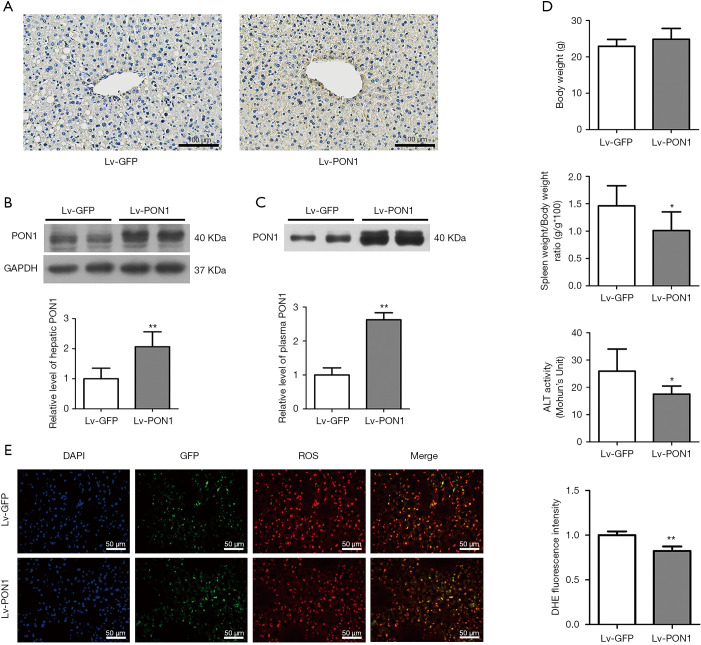
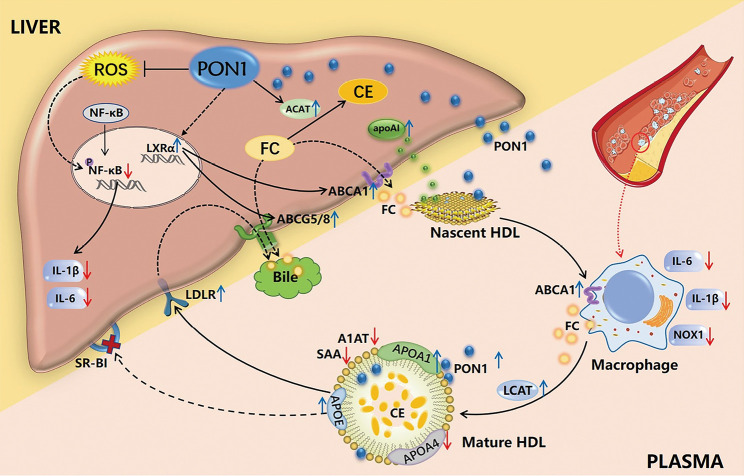
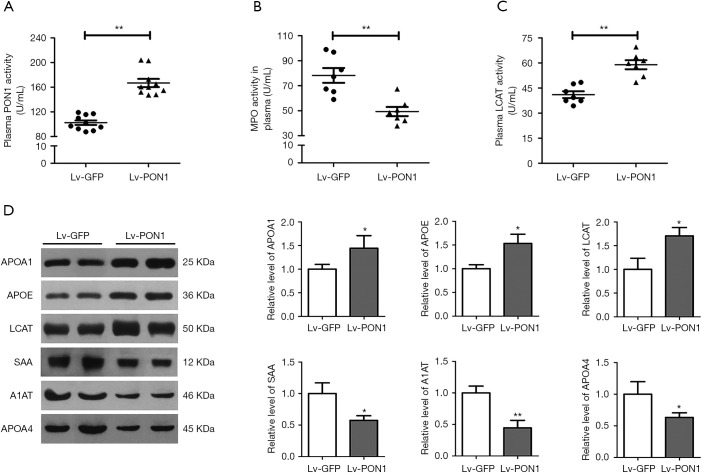
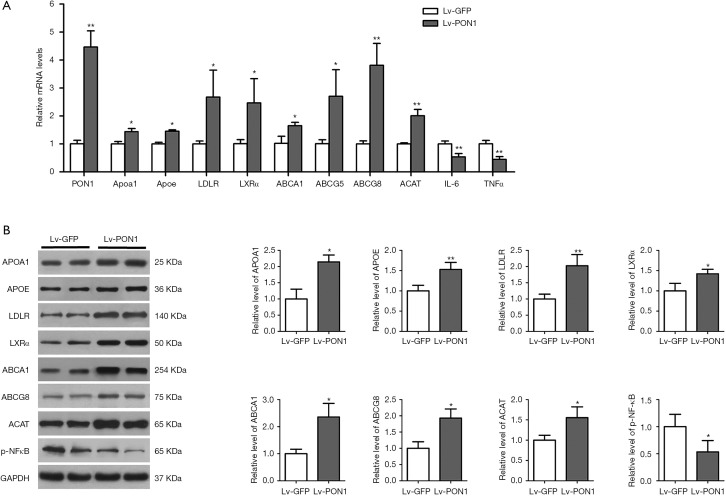
The results showed the relative levels of PON1 in liver and plasma were increased by 1.1-fold and 1.6-fold, respectively, and mean plasma PON1 activity was increased by 63%. High-level PON1 increased the antioxidative and anti-inflammatory properties, promoted HDL maturation and macrophage cholesterol efflux through increasing HDL functional proteins components apolipoprotein A1 (APOA1), apolipoprotein E (APOE), and lecithin-cholesterol acyltransferase (LCAT), while decreased inflammatory protein markers, such as serum amyloid A (SAA), apolipoprotein A4 (APOA4) and alpha 1 antitrypsin (A1AT). Furthermore, hepatic PON1 overexpression linked the effects of antioxidation and anti-inflammation with HDL metabolism regulation mainly through up-regulating liver X receptor alpha (LXRα) and its downstream genes. The pleiotropic effects involved promoting HDL biogenesis by raising the level of APOA1, increasing cholesterol uptake by the liver through the APOE-low density lipoprotein receptor (LDLR) pathway, and increasing cholesterol excretion into the bile, thereby reducing hepatic steatosis and aorta atherosclerosis in Western diet-fed mice.
Our study reveals that high-level PON1 improved dysfunctional HDL and alleviated the development of atherosclerosis in mice. It is suggested that PON1 represents a promising target of HDL-based therapeutic strategy for HDL-related atherosclerotic cardiovascular disease.
高密度脂蛋白(HDL)通过介导逆向胆固醇转运(RCT)、抗氧化、抗炎及保护内皮细胞发挥抗动脉粥样硬化作用。近来,一系列证据表明HDL在某些情况下也可转变为促动脉粥样硬化的HDL。血浆对氧磷酶1(PON1)作为一种与HDL结合的酯酶,负责HDL的大部分抗氧化特性。然而,PON1是否可作为功能失调的HDL相关动脉粥样硬化的治疗靶点仍不清楚。
在本研究中,将B类I型清道夫受体缺陷( )小鼠用作HDL功能失调且动脉粥样硬化易感性增加的动物模型。通过尾静脉注射慢病毒实现肝脏PON1的过表达并分泌至循环中。我们监测了 小鼠的血脂水平和脂蛋白谱,并检测了与HDL功能相关的蛋白质的水平和活性。同时,对肝脏中的脂质沉积和动脉粥样硬化病变进行了定量分析。分析了与HDL代谢和炎症相关的肝脏基因。
结果显示,肝脏和血浆中PON1的相对水平分别升高了1.1倍和1.6倍,血浆PON1平均活性升高了63%。高水平的PON1增强了抗氧化和抗炎特性,通过增加HDL功能蛋白成分载脂蛋白A1(APOA1)、载脂蛋白E(APOE)和卵磷脂胆固醇酰基转移酶(LCAT)促进HDL成熟和巨噬细胞胆固醇外流,同时降低了炎症蛋白标志物,如血清淀粉样蛋白A(SAA)、载脂蛋白A4(APOA4)和α1抗胰蛋白酶(A1AT)。此外,肝脏PON1过表达主要通过上调肝脏X受体α(LXRα)及其下游基因将抗氧化和抗炎作用与HDL代谢调节联系起来。这些多效性作用包括通过提高APOA1水平促进HDL生物合成,通过APOE-低密度脂蛋白受体(LDLR)途径增加肝脏对胆固醇的摄取,以及增加胆固醇向胆汁中的排泄,从而减轻西方饮食喂养小鼠的肝脏脂肪变性和主动脉粥样硬化。
我们的研究表明,高水平的PON1改善了功能失调的HDL,并减轻了 小鼠动脉粥样硬化的发展。提示PON1是基于HDL的治疗策略治疗HDL相关动脉粥样硬化性心血管疾病的一个有前景的靶点。