Department of Physiotherapy and Rehabilitation, Uttara Adhunik Medical College, Dhaka, Bangladesh
Center for Higher Studies and Research, Bangladesh University of Professionals, Dhaka, Bangladesh.
BMJ Open. 2021 Aug 24;11(8):e050303. doi: 10.1136/bmjopen-2021-050303.
To assess COVID-19 vaccine hesitancy in Bangladesh and identify population subgroups with higher odds of vaccine hesitancy.
A nationally representative cross-sectional survey was used for this study. Descriptive analyses helped to compute vaccine hesitancy proportions and compare them across groups. Multiple logistic regression analyses were performed to compute the adjusted OR.
Bangladesh.
A total of 1134 participants from the general population, aged 18 years and above participated in this study.
Prevalence and predictors of vaccine hesitancy.
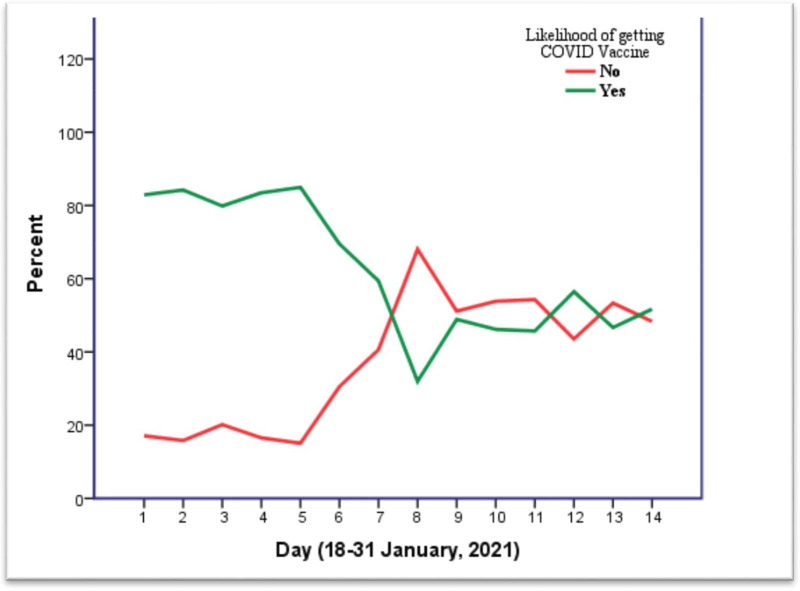
Of the total participants, 32.5% showed COVID-19 vaccine hesitancy. Hesitancy was high among respondents who were men, over 60, unemployed, from low-income families, from central Bangladesh, including Dhaka, living in rented houses, tobacco users, politically affiliated, doubtful of the vaccine's efficacy for Bangladeshis and those who did not have any physical illnesses in the past year. In the multiple logistic regression models, transgender respondents (adjusted OR, AOR=3.62), married individuals (AOR=1.49), tobacco users (AOR=1.33), those who had not experienced any physical illnesses in the past year (AOR=1.49), those with political affiliations with opposition parties (AOR=1.48), those who believed COVID-19 vaccines would not be effective for Bangladeshis (AOR=3.20), and those who were slightly concerned (AOR=2.87) or not concerned at all (AOR=7.45) about themselves or a family member getting infected with COVID-19 in the next year were significantly associated with vaccine hesitancy (p<0.05).
Given the high prevalence of COVID-19 vaccine hesitancy, in order to guarantee that COVID-19 vaccinations are widely distributed, the government and public health experts must be prepared to handle vaccine hesitancy and increase vaccine awareness among potential recipients. To address these issues and support COVID-19 immunisation programs, evidence-based educational and policy-level initiatives must be undertaken especially for the poor, older and chronically diseased individuals.
评估孟加拉国 COVID-19 疫苗犹豫情况,并确定疫苗犹豫率较高的人群亚组。
本研究采用全国代表性的横断面调查。描述性分析有助于计算疫苗犹豫率,并比较不同组之间的差异。采用多因素逻辑回归分析计算调整后的优势比(OR)。
孟加拉国。
本研究共纳入 1134 名年龄在 18 岁及以上的普通人群参与者。
疫苗犹豫的流行率和预测因素。
在所有参与者中,有 32.5%表现出 COVID-19 疫苗犹豫。在男性、60 岁以上、失业、来自低收入家庭、来自孟加拉国中部(包括达卡)、居住在出租房屋、吸烟者、政治党派人士、怀疑疫苗对孟加拉国人的有效性以及过去一年没有任何身体疾病的受访者中,疫苗犹豫率较高。在多因素逻辑回归模型中,跨性别受访者(调整后的 OR,AOR=3.62)、已婚人士(AOR=1.49)、吸烟者(AOR=1.33)、过去一年没有任何身体疾病的受访者(AOR=1.49)、与反对党有政治联系的受访者(AOR=1.48)、认为 COVID-19 疫苗对孟加拉国人无效的受访者(AOR=3.20)、以及对自己或家人在未来一年内感染 COVID-19 表示轻微担忧(AOR=2.87)或完全不担忧(AOR=7.45)的受访者与疫苗犹豫显著相关(p<0.05)。
鉴于 COVID-19 疫苗犹豫率较高,为了保证 COVID-19 疫苗的广泛接种,政府和公共卫生专家必须准备好应对疫苗犹豫,并提高潜在接种者的疫苗意识。为了解决这些问题并支持 COVID-19 免疫计划,必须采取基于证据的教育和政策层面的举措,特别是针对贫困人口、老年人和慢性病患者。