Koelfat Kiran V K, van Mierlo Kim M C, Lodewick Toine M, Bloemen Johanne G, van der Kroft Gregory, Amygdalos Iakovos, Neumann Ulf P, Dejong Cornelis H C, Jansen Peter L M, Olde Damink Steven W M, Schaap Frank G
Department of SurgeryNUTRIM School of Nutrition and Translational Research in MetabolismMaastricht UniversityMaastrichtThe Netherlands.
Department of RadiologyMaastricht University Medical Center+MaastrichtThe Netherlands.
Hepatol Commun. 2021 May 5;5(8):1400-1411. doi: 10.1002/hep4.1728. eCollection 2021 Aug.
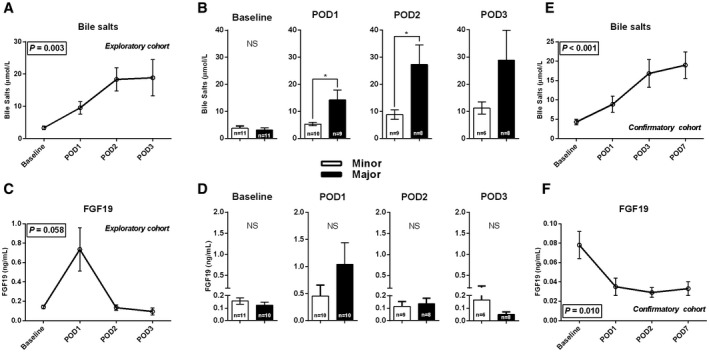
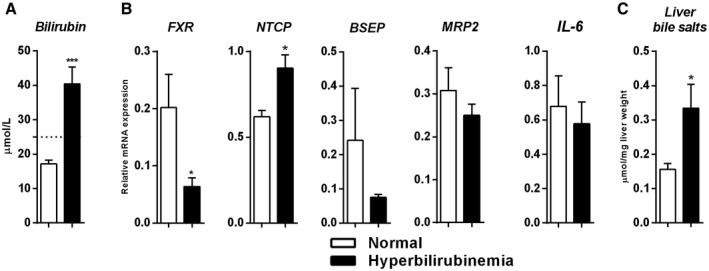
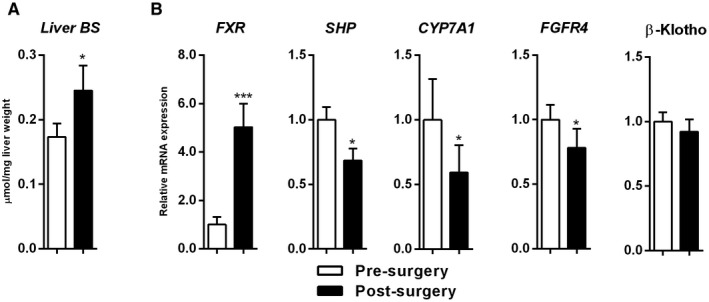
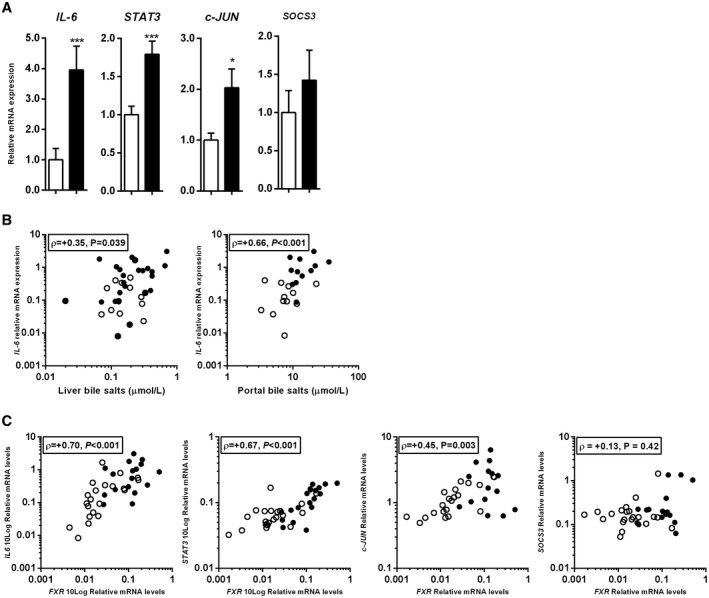
The involvement of bile salt-fibroblast growth factor 19 (FGF19) signaling in human liver regeneration (LR) is not well studied. Therefore, we studied aspects of bile salt-FGF19 signaling shortly after liver resection in patients. We compared plasma bile salt and FGF19 levels in arterial, portal and hepatic venous blood, calculated venous-arterial differences (ΔVA), and determined hepatic transcript levels on two intra-operative time points: before (< 1 hour) and immediately after (> 2-3 hours) liver resection (i.e., following surgery). Postoperative bile salt and FGF19 levels were assessed on days 1, 2, and 3. LR was studied by computed tomography (CT)-liver volumetry. Following surgery, the liver, arterial, and portal bile salt levels were elevated ( < 0.05). Furthermore, an increased amount of bile salts was released in portal blood and extracted by the remnant liver ( < 0.05). Postoperatively, bile salt levels were elevated from day 1 onward ( < 0.001). For FGF19, intra-operative or postoperative changes of ΔVA or plasma levels were not observed. The bile salt-homeostatic regulator farnesoid X receptor () was markedly up-regulated following surgery ( < 0.001). Cell-cycle re-entry priming factors (interleukin 6 [], signal transducer and activator of transcription 3 [], and ) were up-regulated following surgery and were positively correlated with expression < 0.05). Postoperative hyperbilirubinemia was preceded by postsurgery low and high Na+/Taurocholate cotransporting polypeptide () expression in the remnant liver coupled with higher liver bile salt content ( < 0.05). Finally, bile salt levels on postoperative day 1 were an independent predictor of LR ( < 0.05). : Systemic, portal, and liver bile salt levels are rapidly elevated after liver resection. Postoperative bile salts were positively associated with liver volume gain. In the studied time frame, FGF19 levels remained unaltered, suggesting that FGF19 plays a minor role in human LR. These findings indicate a more relevant role of bile salts in human LR.
胆汁盐-成纤维细胞生长因子19(FGF19)信号通路在人类肝脏再生(LR)中的作用尚未得到充分研究。因此,我们对肝切除术后患者短期内的胆汁盐-FGF19信号通路进行了研究。我们比较了动脉血、门静脉血和肝静脉血中的血浆胆汁盐和FGF19水平,计算了动静脉差值(ΔVA),并在两个手术时间点测定了肝脏转录水平:肝切除术前(<1小时)和肝切除术后立即(>2-3小时)(即手术后)。在术后第1、2和3天评估术后胆汁盐和FGF19水平。通过计算机断层扫描(CT)肝脏容积测量法研究肝脏再生。手术后,肝脏、动脉和门静脉胆汁盐水平升高(<0.05)。此外,门静脉血中释放的胆汁盐量增加,并被残余肝脏摄取(<0.05)。术后,胆汁盐水平从第1天开始升高(<0.001)。对于FGF19,未观察到术中或术后ΔVA或血浆水平的变化。胆汁盐稳态调节因子法尼醇X受体()在手术后显著上调(<0.001)。细胞周期重新进入启动因子(白细胞介素6 []、信号转导和转录激活因子3 []以及)在手术后上调,且与表达呈正相关(<0.05)。术后高胆红素血症之前,残余肝脏中手术后低和高钠/牛磺胆酸盐共转运多肽()表达以及肝脏胆汁盐含量较高(<0.05)。最后,术后第1天的胆汁盐水平是肝脏再生的独立预测因子(<0.05)。结论:肝切除术后全身、门静脉和肝脏胆汁盐水平迅速升高。术后胆汁盐与肝脏体积增加呈正相关。在研究的时间范围内,FGF19水平保持不变,表明FGF19在人类肝脏再生中起次要作用。这些发现表明胆汁盐在人类肝脏再生中具有更重要的作用。