Koelfat Kiran V K, Bloemen Johanne G, Jansen Peter L M, Dejong Cornelis H C, Schaap Frank G, Olde Damink Steven W M
Department of Surgery, Maastricht University Medical Center and NUTRIM School of Nutrition and Translational Research in Metabolism Maastricht University, Maastricht, The Netherlands
Department of Surgery, Maastricht University Medical Center and NUTRIM School of Nutrition and Translational Research in Metabolism Maastricht University, Maastricht, The Netherlands.
Physiol Rep. 2016 Dec;4(24). doi: 10.14814/phy2.13037.
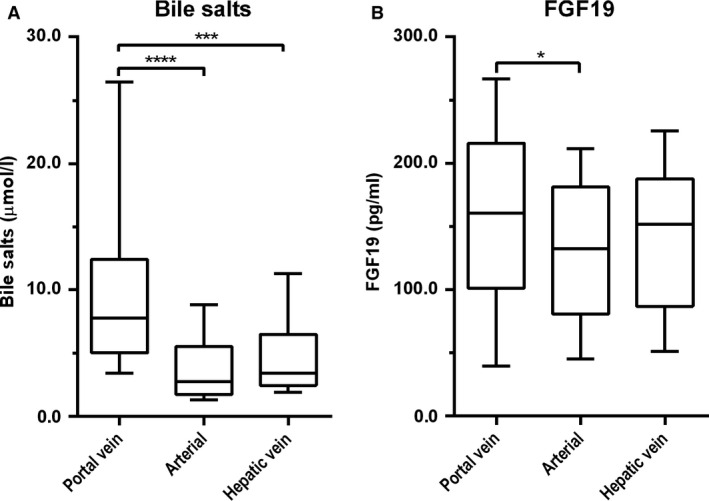
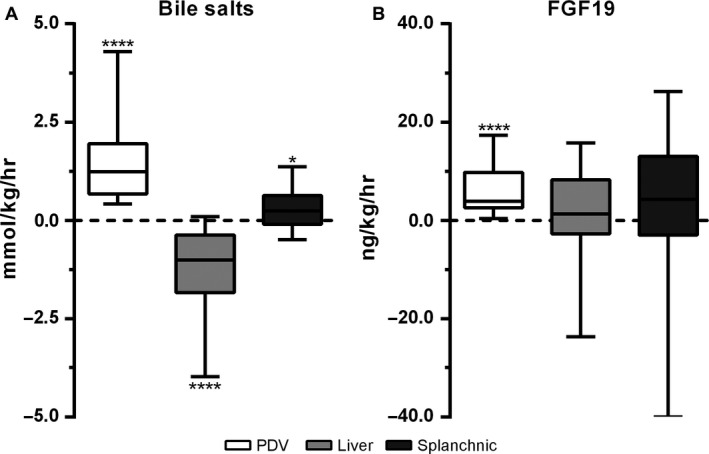
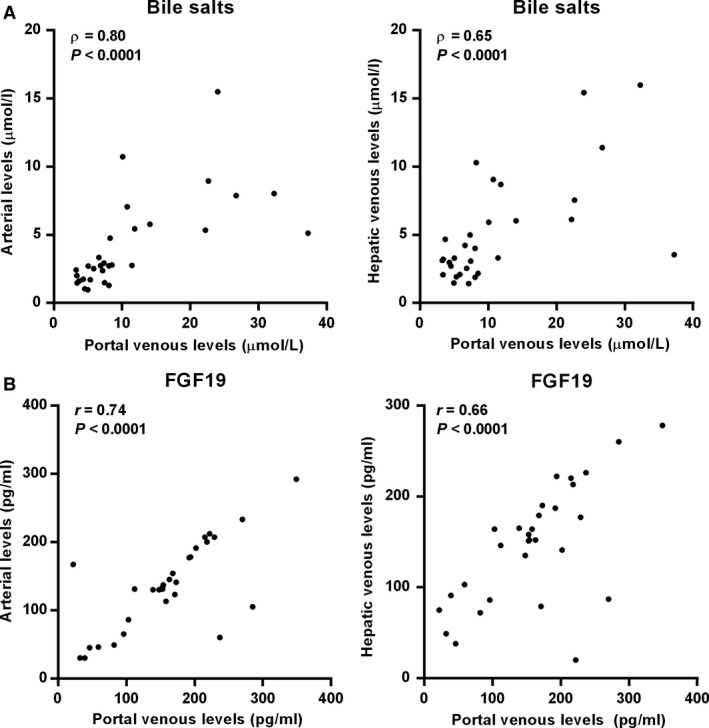
Fibroblast growth factor 19 (FGF19) is an ileum-derived endrocrine factor that is produced in response to transepithelial bile salt flux. FGF19 represses bile salt synthesis in the liver. Despite the general assumption that FGF19 signals to the liver via portal blood, no human data are available to support this notion. The aim was to study portal FGF19 levels, and determined bile salt and FGF19 fluxes across visceral organs in humans. Bile salt and FGF19 levels were assessed in arterial, portal, and hepatic venous blood collected from fasted patients who underwent partial liver resection for colorectal liver metastases (n = 30). Fluxes across the portal-drained viscera (PDV), liver, and splanchnic area were calculated. Portal bile salt levels (7.8 [5.0-12.4] μmol/L) were higher than levels in arterial (2.7 [1.7-5.5] μmol/L, P < 0.0001) and hepatic venous blood (3.4 [2.5-6.5] μmol/L, P < 0.0001). Bile salts released by the PDV (+1.2 [+0.7-+2.0] mmol kg h, P < 0.0001) were largely taken up by the liver (-1.0 [-1.8 to -0.4] mmol kg h, P < 0.0001). Portal levels of FGF19 (161 ± 78 pg/mL) were higher than arterial levels (135 ± 65 pg/mL, P = 0.046). A net release of FGF19 by the PDV (+4.0 [+2.1 to +9.9] ng kg h, P < 0.0001) was calculated. There was no significant flux of FGF19 across the liver (-0.2 [-3.7 to +7.4] ng kg h, P = 0.93). In conclusion, FGF19 levels in human portal blood are higher than in arterial blood. FGF19 is released by the portal-drained viscera under fasted steady state conditions.
成纤维细胞生长因子19(FGF19)是一种源自回肠的内分泌因子,其产生是对经上皮胆盐通量的反应。FGF19可抑制肝脏中的胆盐合成。尽管普遍认为FGF19通过门静脉血向肝脏发出信号,但尚无人类数据支持这一观点。本研究旨在探讨人体门静脉FGF19水平,并测定内脏器官中胆盐和FGF19的通量。对30例因结直肠癌肝转移接受部分肝切除术的禁食患者采集的动脉血、门静脉血和肝静脉血中的胆盐和FGF19水平进行评估。计算门静脉引流内脏(PDV)、肝脏和内脏区域的通量。门静脉胆盐水平(7.8[5.0 - 12.4]μmol/L)高于动脉血(2.7[1.7 - 5.5]μmol/L,P < 0.0001)和肝静脉血(3.4[2.5 - 6.5]μmol/L,P < 0.0001)中的水平。PDV释放的胆盐(+1.2[+0.7 - +2.0]mmol·kg·h,P < 0.0001)大部分被肝脏摄取(-1.0[-1.8至-0.4]mmol·kg·h,P < 0.0001)。门静脉FGF19水平(161±78 pg/mL)高于动脉血水平(135±65 pg/mL,P = 0.046)。计算得出PDV有FGF19的净释放(+4.0[+2.1至+9.9]ng·kg·h,P < 0.0001)。FGF19在肝脏中的通量无显著变化(-0.2[-3.7至+7.4]ng·kg·h,P = 0.93)。总之,人体门静脉血中FGF19水平高于动脉血。在禁食稳态条件下,FGF19由门静脉引流内脏释放。