Department of Gastroenterology, Hepatology and Endocrinology, Hannover Medical School, Carl-Neuberg-Str. 1, 30625, Hannover, Germany.
Department of Pathology, Hannover Medical School, Carl-Neuberg-Str. 1, 30625, Hannover, Germany.
J Cancer Res Clin Oncol. 2022 Aug;148(8):2137-2144. doi: 10.1007/s00432-021-03774-5. Epub 2021 Aug 26.
Several targeted agents demonstrated efficacy in early clinical trials for gastrointestinal (GI) cancers, but in many cases, phase-III trials and/or approval by the European Medicines Agency (EMA) are lacking. The primary focus of this study was to assess the regulatory processes associated with use and reimbursement of off-label treatment in precision oncology and to evaluate the benefit of targeted therapy in a real-world population in Germany.
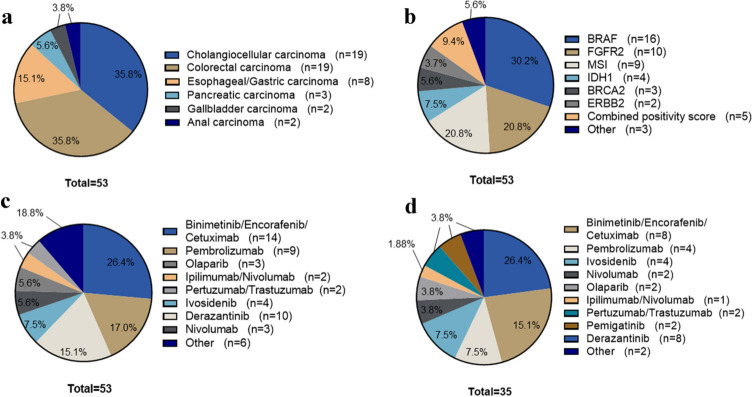
Our cohort comprises 137 patients with GI cancers and is biased towards cancer entities with a high frequency of known targetable alterations, such as cholangiocarcinoma. Genetic testing was used to identify molecular targets, and therapy response was evaluated based on CT scans.
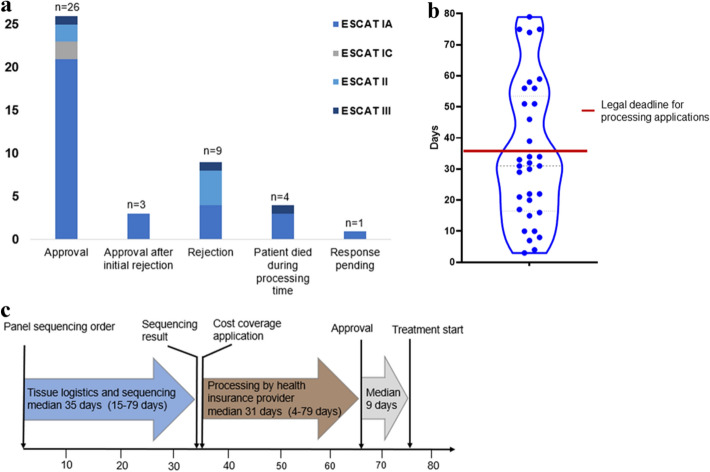
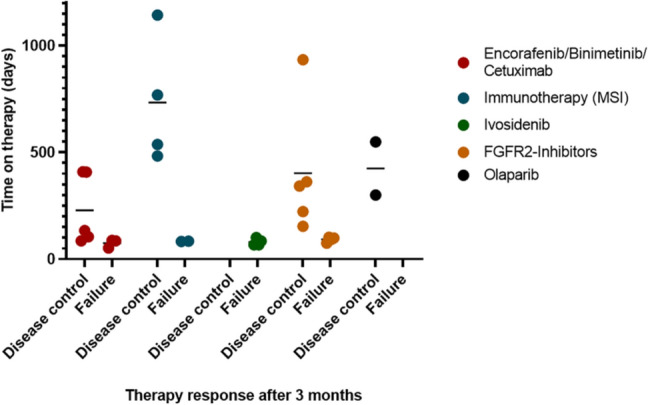
A molecular target for precision oncology was identified in 53 patients and 43 requests for cost coverage were submitted to health insurance companies. 60% of the requests received approval after initial application and another 7% after appeal. Half of the rejected requests were denied despite ESCAT IA level evidence. The median time between initiation of molecular testing and start of therapy was 75 days. 35 patients received matched targeted therapies (n = 28) or, in the case of MSI, immunotherapy (IO) (n = 7). We observed a trend in favor of molecular therapy when compared to the immediate prior treatment.
Relevant treatment options were identified by molecular testing in a significant subset of patients. When targeted therapies that lack EMA approval are considered, treatment initiation may be delayed by the duration of the molecular analysis and the regulatory processes.
一些针对胃肠道(GI)癌症的靶向药物在早期临床试验中显示出疗效,但在许多情况下,缺乏 III 期临床试验和/或欧洲药品管理局(EMA)的批准。本研究的主要重点是评估与精准肿瘤学中标签外治疗的使用和报销相关的监管程序,并评估靶向治疗在德国真实人群中的获益。
我们的队列包括 137 名胃肠道癌症患者,偏向于具有高频率已知可靶向改变的癌症实体,如胆管癌。基因检测用于识别分子靶点,根据 CT 扫描评估治疗反应。
在 53 名患者中确定了精准肿瘤学的分子靶点,并向健康保险公司提交了 43 份费用报销申请。最初申请后有 60%的申请获得批准,另外 7%在上诉后获得批准。一半被拒绝的申请尽管有 ESCAT IA 级证据仍被拒绝。从开始分子检测到开始治疗的中位时间为 75 天。35 名患者接受了匹配的靶向治疗(n=28)或在 MSI 的情况下接受免疫治疗(IO)(n=7)。与之前的即时治疗相比,我们观察到分子治疗的趋势更为有利。
通过分子检测在相当一部分患者中确定了相关的治疗选择。当考虑缺乏 EMA 批准的靶向治疗时,治疗开始可能会因分子分析和监管程序的持续时间而延迟。