Department of Allergy and Clinical Immunology, Ajou University School of Medicine, Suwon, Korea.
MD Healthcare Inc., Seoul, Korea.
PLoS One. 2021 Aug 26;16(8):e0256237. doi: 10.1371/journal.pone.0256237. eCollection 2021.
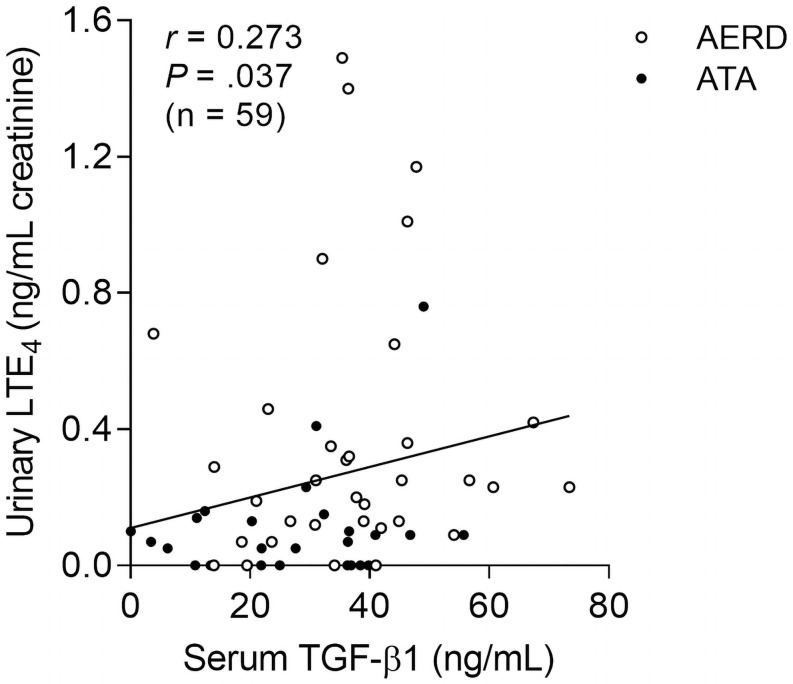
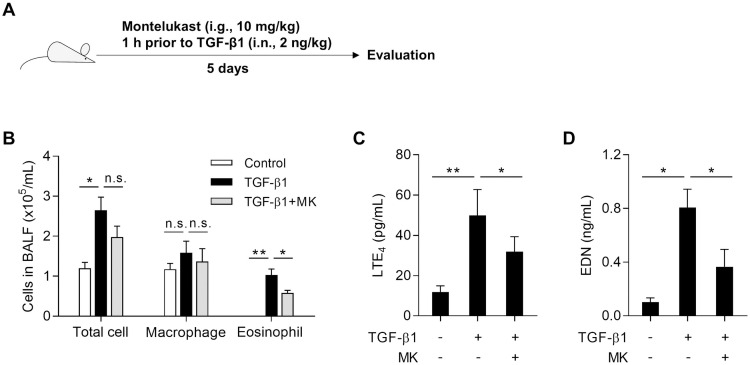
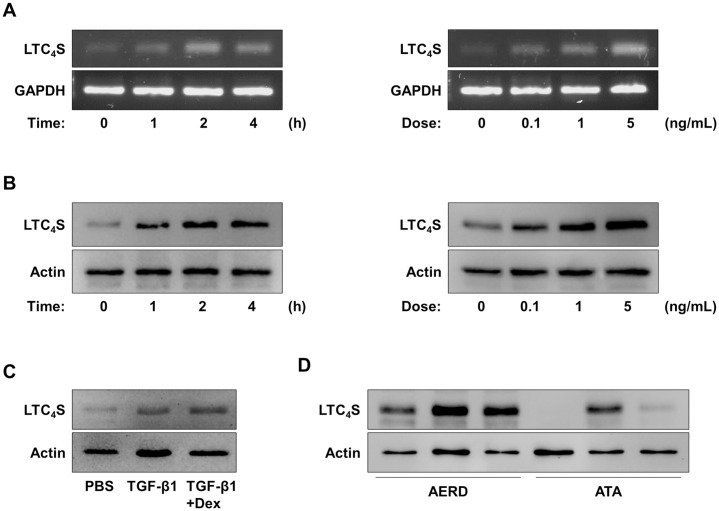
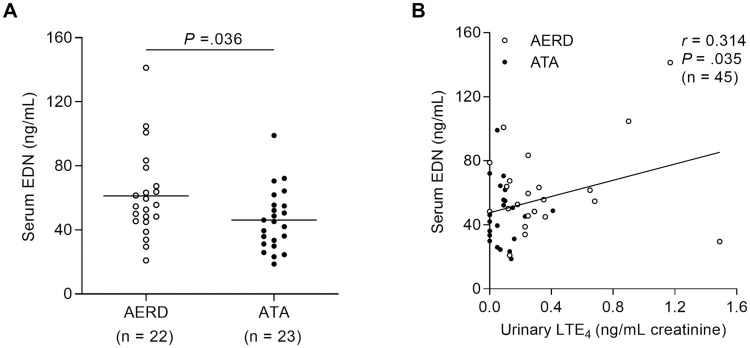
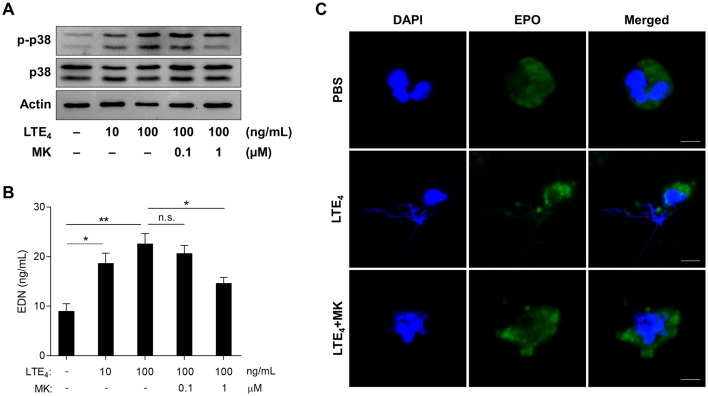
Cysteinyl leukotriene (cysLT) overproduction and eosinophil activation are hallmarks of aspirin-exacerbated respiratory disease (AERD). However, pathogenic mechanisms of AERD remain to be clarified. Here, we aimed to find the significance of transforming growth factor beta 1 (TGF-β1) in association with cysteinyl leukotriene E4 (LTE4) production, leading to eosinophil degranulation. To evaluate levels of serum TGF-β1, first cohort enrolled AERD (n = 336), ATA (n = 442) patients and healthy control subjects (HCs, n = 253). In addition, second cohort recruited AERD (n = 34) and ATA (n = 25) patients to investigate a relation between levels of serum TGF-β1 and urinary LTE4. The function of TGF-β1 in LTE4 production was further demonstrated by ex vivo (human peripheral eosinophils) or in vivo (BALB/c mice) experiment. As a result, the levels of serum TGF-β1 were significantly higher in AERD patients than in ATA patients or HCs (P = .001; respectively). Moreover, levels of serum TGF-β1 and urinary LTE4 had a positive correlation (r = 0.273, P = .037). In the presence of TGF-β1, leukotriene C4 synthase (LTC4S) expression was enhanced in peripheral eosinophils to produce LTE4, which sequentially induced eosinophil degranulation via the p38 pathway. When mice were treated with TGF-β1, significantly induced eosinophilia with increased LTE4 production in the lung tissues were noted. These findings suggest that higher levels of TGF-β1 in AERD patients may contribute to LTE4 production via enhancing LTC4S expression which induces eosinophil degranulation, accelerating airway inflammation.
半胱氨酰白三烯 (cysLT) 过度产生和嗜酸性粒细胞活化是阿司匹林加重的呼吸道疾病 (AERD) 的标志。然而,AERD 的发病机制仍需阐明。在这里,我们旨在寻找转化生长因子β 1 (TGF-β1) 在与半胱氨酰白三烯 E4 (LTE4) 产生相关联中的意义,导致嗜酸性粒细胞脱颗粒。为了评估血清 TGF-β1 的水平,首先招募了 AERD(n = 336)、ATA(n = 442)患者和健康对照组(HCs,n = 253)。此外,第二个队列招募了 AERD(n = 34)和 ATA(n = 25)患者,以研究血清 TGF-β1 水平与尿 LTE4 之间的关系。通过体外(人外周嗜酸性粒细胞)或体内(BALB/c 小鼠)实验进一步证明了 TGF-β1 在 LTE4 产生中的作用。结果,AERD 患者的血清 TGF-β1 水平明显高于 ATA 患者或 HCs(P =.001;分别)。此外,血清 TGF-β1 水平和尿 LTE4 之间存在正相关(r = 0.273,P =.037)。在 TGF-β1 的存在下,外周嗜酸性粒细胞中的白三烯 C4 合酶(LTC4S)表达增强,以产生 LTE4,这依次通过 p38 途径诱导嗜酸性粒细胞脱颗粒。当小鼠用 TGF-β1 治疗时,肺部组织中明显诱导了嗜酸性粒细胞增多和 LTE4 产生增加。这些发现表明,AERD 患者中较高水平的 TGF-β1 可能通过增强 LTC4S 表达来促进 LTE4 产生,从而诱导嗜酸性粒细胞脱颗粒,加速气道炎症。