Department of Respiratory Medicine, Norwich University Hospital, NorfolkNorwich, UK.
Norwich Medical School, University of East Anglia, Norwich, UK.
Curr Allergy Asthma Rep. 2022 Dec;22(12):209-229. doi: 10.1007/s11882-022-01049-8. Epub 2022 Nov 14.
Non-steroidal exacerbated respiratory disease (N-ERD) currently requires aspirin challenge testing for diagnosis. Urinary leukotriene E4 (uLTE) has been extensively investigated as potential biomarker in N-ERD. We aimed to assess the usefulness of uLTE as a biomarker in the diagnosis of N-ERD.
N-ERD, formerly known as aspirin-intolerant asthma (AIA), is characterised by increased leukotriene production. uLTE indicates cysteinyl leukotriene production, and a potential biomarker in N-ERD. Although several studies and have examined the relationship between uLTE and N-ERD, the usefulness of uLTE as a biomarker in a clinical setting remains unclear.
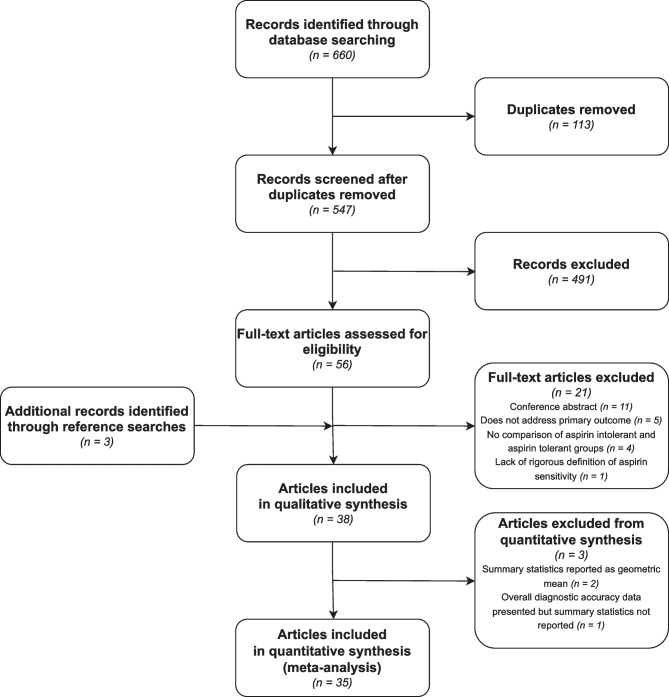
Our literature search identified 38 unique eligible studies, 35 were included in the meta-analysis. Meta-analysis was performed (i.e. pooled standardised mean difference (SMD) with 95% confidence intervals (95% CI)) and risk of bias assessed (implementing Cochrane Handbook for Systematic Reviews of Diagnostic Test Accuracy (Cochrane DTA)). Data from 3376 subjects was analysed (1354 N-ERD, 1420 ATA, and 602 HC). uLTE was higher in N-ERD vs ATA (n = 35, SMD 0.80; 95% CI 0.72-0.89). uLTE4 increased following aspirin challenge in N-ERD (n = 12, SMD 0.56; 95% CI 0.26-0.85) but not ATA (n = 8, SMD 0.12; CI - 0.08-0.33). This systematic review and meta-analysis showed that uLTE is higher in N-ERD than ATA or HC. Likewise, people with N-ERD have greater increases in uLTE following aspirin challenge. However, due to the varied uLTE measurement and result reporting practice, clinical utility of these findings is limited. Future studies should be standardised to increase clinical significance and interpretability of the results.
非甾体类药物加重的呼吸系统疾病(N-ERD)目前需要进行阿司匹林激发试验来诊断。尿白三烯 E4(uLTE)已被广泛研究作为 N-ERD 的潜在生物标志物。我们旨在评估 uLTE 作为 N-ERD 诊断生物标志物的有用性。
N-ERD,以前称为阿司匹林不耐受哮喘(AIA),其特征是白三烯生成增加。uLTE 表示半胱氨酰白三烯的生成,是 N-ERD 的潜在生物标志物。尽管多项研究已经研究了 uLTE 与 N-ERD 之间的关系,但 uLTE 作为临床环境中的生物标志物的有用性仍不清楚。
我们的文献检索确定了 38 项独特的合格研究,其中 35 项被纳入荟萃分析。进行了荟萃分析(即汇总标准化均数差(SMD)和 95%置信区间(95%CI)),并评估了偏倚风险(实施 Cochrane 系统评价诊断测试准确性手册(Cochrane DTA))。对 3376 名受试者的数据进行了分析(1354 名 N-ERD、1420 名 ATA 和 602 名 HC)。N-ERD 中的 uLTE 高于 ATA(n=35,SMD 0.80;95%CI 0.72-0.89)。N-ERD 中的 uLTE4 在阿司匹林激发后增加(n=12,SMD 0.56;95%CI 0.26-0.85),但 ATA 中没有增加(n=8,SMD 0.12;CI -0.08-0.33)。本系统评价和荟萃分析表明,N-ERD 中的 uLTE 高于 ATA 或 HC。同样,N-ERD 患者在接受阿司匹林激发后 uLTE 的增加幅度更大。然而,由于 uLTE 测量和结果报告实践的差异,这些发现的临床实用性有限。未来的研究应该标准化,以提高结果的临床意义和可解释性。