Naghavi-Behzad Mohammad, Oltmann Hjalte Rasmus, Alamdari Tural Asgharzadeh, Bülow Jakob Lykke, Ljungstrøm Lasse, Braad Poul-Erik, Asmussen Jon Thor, Vogsen Marianne, Kodahl Annette Raskov, Gerke Oke, Hildebrandt Malene Grubbe
Department of Clinical Research, University of Southern Denmark, 5000 Odense, Denmark.
Department of Nuclear Medicine, Odense University Hospital, 5000 Odense, Denmark.
Cancers (Basel). 2021 Aug 13;13(16):4080. doi: 10.3390/cancers13164080.
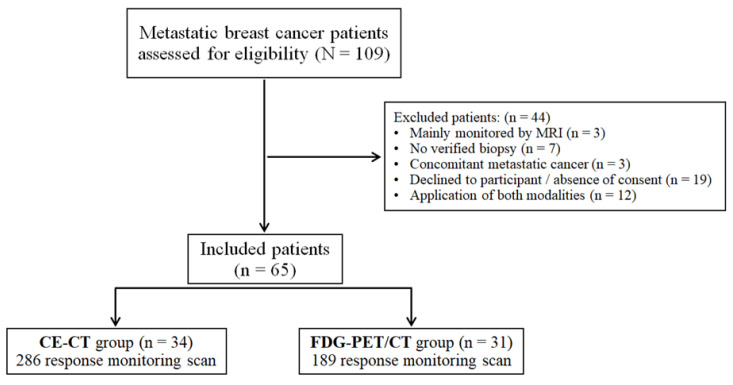
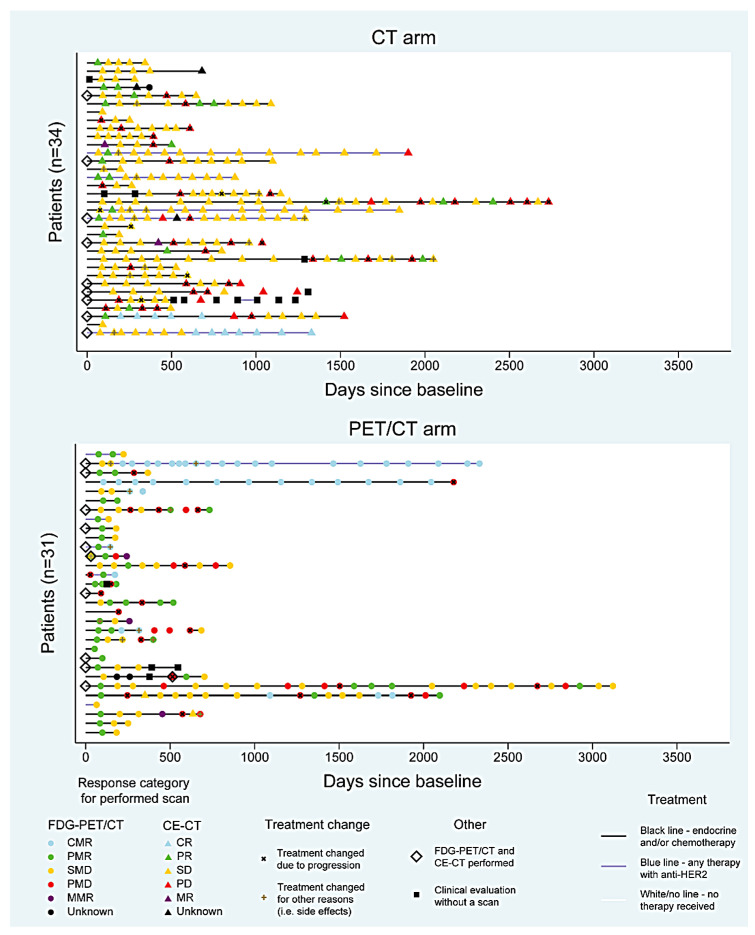
We compared response categories and impacts on treatment decisions for metastatic breast cancer (MBC) patients that are response-monitored with contrast-enhanced computed-tomography (CE-CT) or fluorodeoxyglucose-positron emission tomography/computed tomography (FDG-PET/CT). A comparative diagnostic study was performed on MBC patients undergoing response monitoring by CE-CT ( = 34) or FDG-PET/CT ( = 31) at the Odense University Hospital (Denmark). The responses were assessed visually and allocated into categories of complete response (CR/CMR), partial response (PR/PMR), stable disease (SD/SMD), and progressive disease (PD/PMD). Response categories, clinical impact, and positive predictive values (PPV) were compared for follow-up scans. A total of 286 CE-CT and 189 FDG-PET/CT response monitoring scans were performed. Response categories were distributed into CR (3.8%), PR (8.4%), SD (70.6%), PD (15%), and others (2.1%) by CE-CT and into CMR (22.2%), PMR (23.8%), SMD (31.2%), PMD (18.5%), and others (4.4%) by FDG-PET/CT, revealing a significant difference between the groups ( < 0.001). PD and PMD caused changes of treatment in 79.1% and 60%, respectively ( = 0.083). PPV for CE-CT and FDG-PET/CT was 0.85 (95% CI: 0.72-0.97) and 0.70 (95% CI: 0.53-0.87), respectively ( = 0.17). FDG-PET/CT indicated regression of disease more frequently than CE-CT, while CE-CT indicated stable disease more often. FDG-PET/CT seems to be more sensitive than CE-CT for monitoring response in metastatic breast cancer.
我们比较了采用对比增强计算机断层扫描(CE-CT)或氟脱氧葡萄糖正电子发射断层扫描/计算机断层扫描(FDG-PET/CT)进行反应监测的转移性乳腺癌(MBC)患者的反应类别及其对治疗决策的影响。在丹麦欧登塞大学医院,对34例接受CE-CT反应监测和31例接受FDG-PET/CT反应监测的MBC患者进行了一项对比诊断研究。通过视觉评估反应,并将其分为完全缓解(CR/CMR)、部分缓解(PR/PMR)、疾病稳定(SD/SMD)和疾病进展(PD/PMD)类别。比较随访扫描的反应类别、临床影响和阳性预测值(PPV)。共进行了286次CE-CT和189次FDG-PET/CT反应监测扫描。CE-CT将反应类别分为CR(3.8%)、PR(8.4%)、SD(70.6%)、PD(15%)和其他(2.1%),FDG-PET/CT将其分为CMR(22.2%)、PMR(23.8%)、SMD(31.2%)、PMD(18.5%)和其他(4.4%),两组之间存在显著差异(P<0.001)。PD和PMD分别导致79.1%和60%的治疗方案改变(P=0.083)。CE-CT和FDG-PET/CT的PPV分别为0.85(95%CI:0.72-0.97)和0.70(95%CI:0.53-0.87)(P=0.17)。FDG-PET/CT比CE-CT更频繁地显示疾病消退,而CE-CT更常显示疾病稳定。对于转移性乳腺癌反应监测,FDG-PET/CT似乎比CE-CT更敏感。