Department of Oncology, Odense University Hospital, Kloevervaenget 47, 5000, Odense C, Denmark.
Department of Nuclear Medicine, Odense University Hospital, Odense, Denmark.
Sci Rep. 2023 Apr 5;13(1):5552. doi: 10.1038/s41598-023-32727-w.
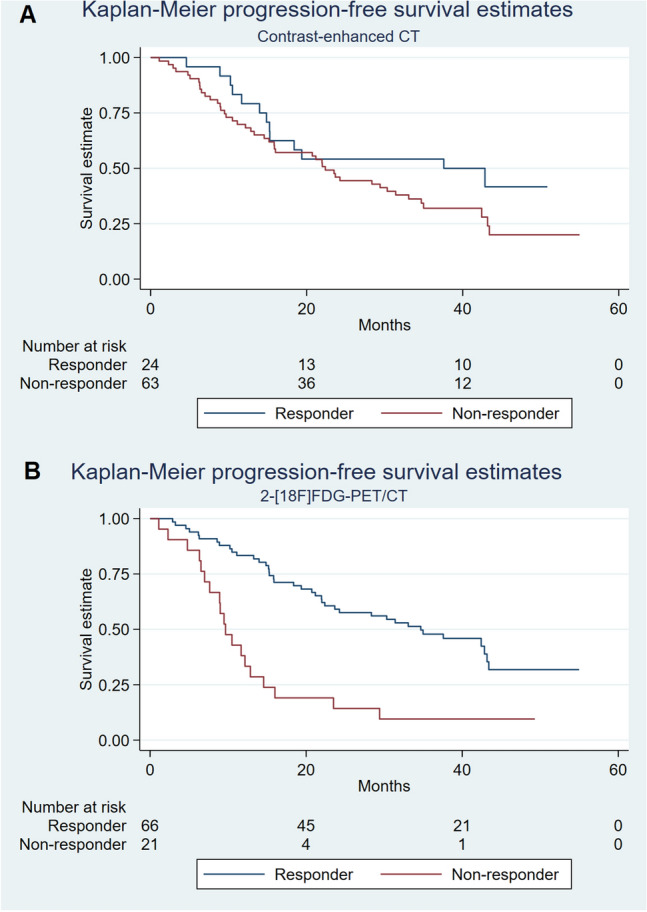
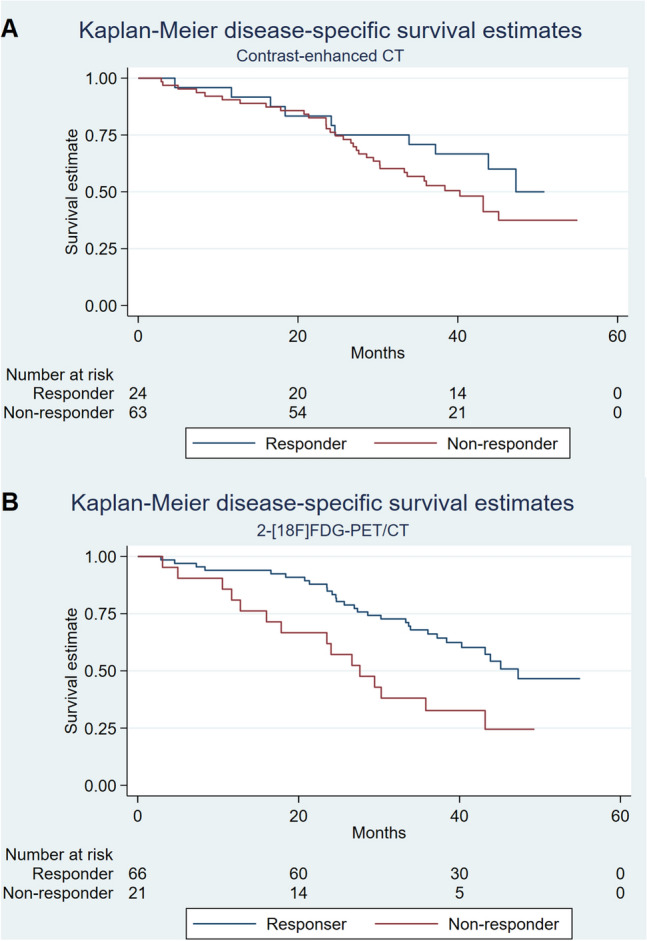
This study aimed to compare CE-CT and 2-[F]FDG-PET/CT for response monitoring metastatic breast cancer (MBC). The primary objective was to predict progression-free and disease-specific survival for responders vs. non-responders on CE-CT and 2-[F]FDG-PET/CT. The secondary objective was to assess agreement between response categorization for the two modalities. Treatment response in women with MBC was monitored prospectively by simultaneous CE-CT and 2-[F]FDG-PET/CT, allowing participants to serve as their own controls. The standardized response evaluation criteria in solid tumors (RECIST 1.1) and PET response criteria in solid tumors (PERCIST) were used for response categorization. For prediction of progression-free and disease-specific survival, treatment response was dichotomized into responders (partial and complete response) and non-responders (stable and progressive disease) at the first follow-up scan. Progression-free survival was defined as the time from baseline until disease progression or death from any cause. Disease-specific survival was defined as the time from baseline until breast cancer-specific death. Agreement between response categorization for both modalities was analyzed for all response categories and responders vs. non-responders. At the first follow-up, tumor response was reported more often by 2-[F]FDG-PET/CT than CE-CT, with only fair agreement on response categorization between the two modalities (weighted Kappa 0.28). Two-year progression-free survival for responders vs. non-responders by CE-CT was 54.2% vs. 46.0%, compared with 59.1% vs. 14.3% by 2-[F]FDG-PET/CT. Correspondingly, 2-year disease-specific survival were 83.3% vs. 77.8% for CE-CT and 84.6% vs. 61.9% for 2-[F]FDG-PET/CT. Tumor response on 2-[F]FDG-PET/CT was significantly associated with progression-free (HR: 3.49, P < 0.001) and disease-specific survival (HR 2.35, P = 0.008), while no association was found for tumor response on CE-CT. In conclusion, 2-[F]FDG-PET/CT appears a better predictor of progression-free and disease-specific survival than CE-CT when used to monitor metastatic breast cancer. In addition, we found low concordance between response categorization between the two modalities.
Clinical.
gov. NCT03358589. Registered 30/11/2017-Retrospectively registered, http://www.
gov.
本研究旨在比较 CE-CT 和 2-[F]FDG-PET/CT 用于监测转移性乳腺癌(MBC)的疗效。主要目的是预测 CE-CT 和 2-[F]FDG-PET/CT 对有反应者和无反应者的无进展和疾病特异性生存。次要目的是评估两种模式的反应分类之间的一致性。通过同时进行 CE-CT 和 2-[F]FDG-PET/CT,前瞻性地监测 MBC 女性的治疗反应,允许参与者作为自己的对照。使用实体瘤标准化反应评估标准(RECIST 1.1)和实体瘤 PET 反应标准(PERCIST)对反应进行分类。对于无进展和疾病特异性生存的预测,将治疗反应在第一次随访扫描时分为有反应者(部分和完全反应)和无反应者(稳定和进展性疾病)。无进展生存定义为从基线到任何原因导致疾病进展或死亡的时间。疾病特异性生存定义为从基线到乳腺癌特异性死亡的时间。分析了两种模式的所有反应类别和有反应者与无反应者之间的反应分类一致性。在第一次随访时,2-[F]FDG-PET/CT 报告的肿瘤反应比 CE-CT 更频繁,两种模式之间的反应分类仅存在适度一致性(加权 Kappa 0.28)。CE-CT 有反应者与无反应者的 2 年无进展生存率分别为 54.2%和 46.0%,而 2-[F]FDG-PET/CT 则分别为 59.1%和 14.3%。相应地,CE-CT 的 2 年疾病特异性生存率为 83.3%,无反应者为 77.8%,而 2-[F]FDG-PET/CT 则分别为 84.6%和 61.9%。2-[F]FDG-PET/CT 上的肿瘤反应与无进展生存(HR:3.49,P<0.001)和疾病特异性生存(HR 2.35,P=0.008)显著相关,而 CE-CT 上的肿瘤反应则无相关性。总之,与 CE-CT 相比,2-[F]FDG-PET/CT 似乎是监测转移性乳腺癌无进展和疾病特异性生存的更好预测指标。此外,我们发现两种模式之间的反应分类一致性较低。
临床。
gov. NCT03358589。注册日期:2017 年 11 月 30 日-回顾性注册,http://www.
gov.